What Are AI Agent Tokens — and Why Payments Security Teams Should Care
AI agents now initiate payments autonomously. They shop, route transfers, trigger recurring billing, and call PSP APIs — all without a human clicking "confirm." To do any of this, they carry credentials. Those credentials are AI agent tokens — effectively the access keys to your financial infrastructure.
Securing them is not an extension of existing identity or fraud controls. It's a categorically different problem.
Gartner predicts that 40% of enterprise applications will include task-specific AI agents by 2026, up from less than 5% in 2025. Payment workflows are among the first places those agents land — and the attack surface is growing faster than the governance frameworks around it.
What follows is a practical breakdown of how these tokens work, where attackers target them, and the controls payment security teams need in place before an autonomous agent takes a costly wrong turn.
Key Takeaways
- AI agent tokens are scoped authorization credentials, not card data substitutes — securing them requires runtime enforcement, not just encryption
- Overpermissioning is the default failure mode: 99% of cloud identities carry excessive permissions
- Prompt injection can manipulate a legitimate token into executing unauthorized payment actions
- Token scoping, authority decay, and per-action enforcement work together to limit what an agent can do, how long it can do it, and whether each action falls within its approved scope
- Existing fraud rules and perimeter tools cannot detect whether an agent's action is within its authorized scope
What Are AI Agent Tokens in Payment Systems?
Defining the Term (and What It Isn't)
AI agent tokens are scoped authorization credentials (OAuth-style access grants, session keys, API credentials, or cryptographic mandates) that define what an AI agent is permitted to do. Examples include: initiate a transfer up to $500, query an account balance, route a payment through a specific PSP.
They are not payment card tokens. PAN tokens replace card numbers to protect data in storage and transit. Agent tokens are access grants. Conflating the two creates dangerous blind spots : teams that treat agent tokens like card data focus on encryption while ignoring scope enforcement, which is where the real risk lives.
The Token Lifecycle in an Agentic Payment Flow
A typical agentic payment flow looks like this:
- Permission grant — user or system defines what the agent is allowed to do at onboarding
- Token issuance — the agent receives a token encoding those permissions
- Tool call invocation — the token is passed at each API call or tool invocation
- Downstream evaluation — PSPs, gateways, and fraud engines evaluate the token and decide whether to honor the request
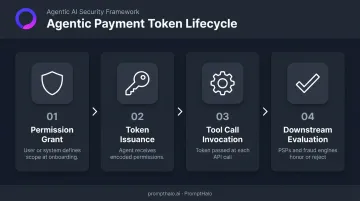
PromptHalo encodes this flow through signed agent security passports: credentials that travel with each request with policy, budget, and authority decay built in. Every decision returns a replayable verdict — a tamper-evident record of what the agent was permitted to do and why.
The Multi-Agent Handoff Problem
Modern payment workflows rarely involve a single agent. A planning agent delegates to a payment execution agent, which calls a KYC sub-agent. Each handoff creates a new attack surface where tokens can be forged, inflated, or intercepted.
The scale of that surface is already significant. LangChain's State of Agent Engineering reports 57.3% of organizations already have agents in production, and Wiz found 80% have adopted MCP servers (toolchains specifically designed to connect agents to external APIs and services). Multi-agent architectures are standard — and so is the handoff risk that comes with them.
Overpermissioning: The Most Exploitable Mistake
Unit 42 analyzed 680,000 identities across 200 organizations and found 99% of cloud users, roles, services, and resources had excessive permissions. Agent identities inherit the same overprovisioning culture — and the same exposure.
The difference between a safe token and a dangerous one:
| Token Type | What It Permits |
|---|---|
| Overpermissioned | Read all accounts, initiate any payment, call any API, no expiry |
| Well-scoped | Initiate transfers up to $200, to whitelisted counterparties only, valid for 4 hours |
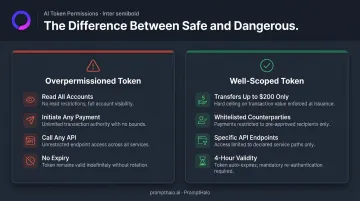
Scope should be defined at issuance , not left to the agent to self-regulate at runtime.
The Compliance Grey Zone
PCI DSS and PSD2 SCA were designed for human-initiated sessions. Neither framework specifically addresses agent token lifecycle management. That gap creates a compliance grey zone where attackers can operate without triggering existing controls , and where liability remains ambiguous when an agent causes harm.
How Attackers Exploit AI Agent Tokens in Payment Systems
Credential Theft and Lateral Movement
Stolen session tokens, compromised API keys, malicious browser extensions, and hijacked OAuth grants give attackers everything an agent needs to transact. Unlike human account takeover, a stolen agent token can be reused programmatically across every merchant or account the agent is authorized to reach. Lateral movement is instant — and fully automated.
Prompt Injection: The Legitimate Token Problem
OWASP rates prompt injection as the #1 risk for LLM-based systems — and in agentic payment workflows, it's particularly dangerous because the token remains valid. The attack works differently:
- An attacker embeds malicious instructions in content the agent reads (a product listing, retrieved document, invoice)
- The agent interprets those instructions as legitimate directives
- The agent executes actions beyond the user's intent — increasing amounts, routing to unauthorized destinations, calling prohibited APIs
The token isn't stolen. The agent is steered. Traditional fraud controls that verify credential validity cannot catch this class of attack.
OWASP separately identifies LLM06:2025 Excessive Agency as the risk of over-capable agents misusing tools — a direct consequence of overpermissioned tokens.
Multi-Agent Handoff Abuse
When agent A passes a token to agent B, an attacker who has compromised the intermediate message or retrieval layer can inject a forged or inflated token — granting agent B permissions that agent A never had authority to delegate.
This is a known "confused-deputy" attack pattern: the receiving agent acts with authority it was never granted, because it has no way to verify what the delegating agent was actually authorized to do.
Automation-Scale Abuse
LexisNexis Risk Solutions analyzed 116 billion online transactions in 2025 and found 450% growth in agentic traffic associated with credit card payments and logins, with a concurrent 8% rise in global fraud attacks. Fraud that would take a human attacker days now executes in minutes. Inventory denial, promo abuse, returns fraud, and mule transfers all scale with the agent.
The "Legitimate Token, Wrong Action" Attack
The most dangerous exploits involve technically valid tokens executing actions the user never authorized. No credential theft. No anomalous login. The fraud is invisible to any control that only checks whether the token is valid.
The attack surface is in the agent's behavior:
- An agent told to "buy the cheapest option" is manipulated into purchasing from a fraudulent seller
- A payment routing agent is nudged to route through a high-fee or compromised acquirer
- A refund agent is steered to approve claims outside its intended authorization scope
Security Controls That Contain AI Agent Token Risk
Token Scoping and Least-Privilege Design
Every agent token should encode the minimum permissions required for the specific task. The OWASP AI Agent Security Cheat Sheet recommends classifying high-impact actions like transfer_funds as critical and requiring explicit scope validation before execution.
A well-scoped payment agent token includes:
- Amount caps — maximum transaction value per action and per session
- Counterparty whitelists — permitted destination accounts or merchants
- Allowed API endpoints — specific tools the agent may call
- Time windows — validity period, not indefinite
- Geographic restrictions — permitted transaction origins and destinations
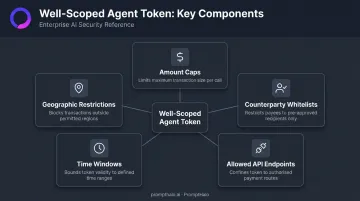
Scope must be defined at issuance. An agent should not be able to expand its own permissions at runtime.
Authority Decay and Time-Bound Credentials
Agent tokens should carry built-in expiration and automatic permission reduction over time or across usage. PromptHalo implements this through authority decay: budgets across time, steps, and accumulated risk that shrink as the agent operates, forcing re-authorization when any threshold is exceeded.
Short-lived credential patterns are standard in human OAuth flows. The IETF OAuth draft defines authorization_expires_in and requires that refresh tokens not outlive the original user authorization. Agentic deployments need the same discipline. An indefinitely valid agent token is a standing invitation for abuse.
Per-Action Enforcement at Runtime
Token validation cannot happen only at session initiation. Every individual tool call, API invocation, and agent-to-agent handoff needs independent evaluation against current context:
- Has the transaction amount changed since the token was issued?
- Is the destination endpoint one the agent is permitted to reach?
- Is the calling agent the same one that originally received the token?
PromptHalo's runtime enforcement sits inline on every inference, tool call, and handoff, making a per-action allow, restrict, challenge, deny, or monitor decision in under 100ms without touching the underlying model.
Step-Up Authentication and Human-in-the-Loop Thresholds
Not every action needs a human checkpoint. But high-consequence actions should not complete autonomously without an additional check. Recommended triggers for step-up authentication:
- Transaction above a defined amount threshold
- First-time counterparty
- Novel API call not in the agent's history
- Geographic anomaly
- Destination outside the counterparty whitelist
OWASP calls for human-in-the-loop approval on payment initiation specifically. The design principle is targeted friction on high-risk actions — applied precisely, not universally.
Tamper-Evident, Decision-Level Audit Trails
Every token issuance, validation, tool call, and agent-to-agent handoff should be logged with enough context to reconstruct the full decision chain. PromptHalo captures every decision with its reason, the acting agent's identity, session and tenant context, and a timestamp. The log is append-only and tamper-evident — once written, it cannot be modified.
These logs are the foundation for fraud investigations, chargeback disputes, and regulatory examinations. Both Mastercard's Agent Pay for Machines and Visa's Intelligent Commerce framework explicitly frame audit-ready agent transaction records as the mechanism for dispute resolution and liability review.
Why Perimeter Security Cannot Protect the Agent Token Attack Surface
Firewalls, DLP tools, and rule-based fraud engines were designed to inspect data at network or session boundaries. They were not built to evaluate whether an individual tool call is within an agent's authorized scope. When a token passes perimeter authentication, these controls see a valid credential and allow the action — regardless of whether the agent has been manipulated or the action exceeds its mandate.
The problem is architectural, not a gap in configuration:
- Rule-based systems require known signatures. Prompt injection steering, multi-agent handoff abuse, and scale-amplified token reuse produce no recognizable signature. Static rules cannot adapt to attack patterns they have never seen.
- Perimeter tools evaluate sessions, not actions. A session that starts legitimately can contain hundreds of unauthorized tool calls. The perimeter cleared the session. No control evaluated the individual calls.
- The "legitimate token, wrong action" class is structurally invisible to any system that only checks credential validity.
What's needed is a security layer that sits inline on every agent inference, tool call, and handoff — evaluating each action against defined scope before it executes. That requirement points to a fundamentally different class of control: one that operates at the agent layer, not the network edge.
PromptHalo's runtime enforcement works inline across any AI application from any vendor, with no model retraining and no code rewrite required. Its ML-based detection engine reaches over 95% catch rate with under 5% false positives — compared to roughly 35% catch rate and 15–20% false positives for rule-based approaches.
Existing fraud tools, transaction monitoring, and perimeter controls remain valuable — and none of that changes. The gap they cannot fill is per-action scope enforcement at the agent layer. That requires dedicated runtime enforcement sitting between the agent and every action it attempts to take.
Compliance and Regulatory Implications of Agent Token Security
The Accountability Gap
PCI DSS, PSD2, and AML regulations assign liability to identifiable human or institutional actors. When an AI agent initiates a fraudulent payment, existing frameworks struggle to assign responsibility. Regulators are beginning to address this:
- PCI DSS v4.0.1 Requirements 7, 8, and 10 cover least privilege, identity management, and audit logging — all applicable to agent credentials, though the standard does not name AI agents explicitly
- PSD2 SCA addresses payer authentication and dynamic linking for human-initiated payments; the regulation's text does not address AI-initiated payment authorization
- EU AI Act Articles 9, 12, 13, and 14 require risk management, record-keeping, transparency, and human oversight for high-risk AI systems
- NIST AI RMF provides a practical governance model: its Govern, Map, Measure, and Manage functions align directly to agent token lifecycle controls — covering how agents are authorized, scoped, monitored, and decommissioned
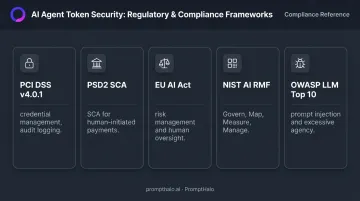
Payment operators who cannot demonstrate per-action control and auditability face both regulatory exposure and dispute-liability risk. The OCC issued a request for information on payment fraud in 2025; regulators are clearly moving toward AI-initiated payment accountability, even if specific rules aren't yet finalized.
What Auditable Agent Token Governance Requires
That regulatory pressure translates directly to an evidence burden. For any transaction involving an AI agent, operators must be able to produce:
- Which agent token authorized the action
- What permissions that token carried at the time
- What inputs the agent processed before making the decision
- What decision it made and why
- Which human or system issued the original mandate
PromptHalo generates decision-level, replayable audit logs mapped to OWASP LLM Top 10, NIST AI RMF, and EU AI Act requirements — producing exactly the evidence record regulators and dispute resolution processes will ask for.
Build Controls In, Not On
Organizations that wait for a fraud event before building agent token governance face compounding costs: the direct loss, plus remediation against live infrastructure that was never designed for it. The controls that carry the most weight are also the hardest to retrofit:
- Token scoping at issuance — constraining permissions before deployment, not after a breach
- Authority decay — automatically reducing token scope as time or context changes
- Per-action enforcement — validating each agent decision at runtime, not just at login
- Tamper-evident logging — creating an audit record that holds up under regulatory scrutiny
Getting these right from initial deployment costs a fraction of what incident response and regulatory remediation will demand later.
Frequently Asked Questions
What is an AI agent token and how does it differ from a payment card token?
Payment card tokens replace PAN data to protect card numbers in storage and transit. AI agent tokens are authorization credentials that define what actions an agent is permitted to take — they are access grants, not data substitutes. Securing them requires scope enforcement and runtime controls, not encryption alone.
How do attackers steal or abuse AI agent tokens in payment systems?
Two primary paths exist. Direct theft of credentials (API keys, session tokens, OAuth grants) enables programmatic reuse at scale across every system the agent can reach. Indirect manipulation through prompt injection leaves the token valid but steers the agent into unauthorized actions. Neither path triggers traditional fraud rules, which only check whether credentials are valid — not whether the agent's actions are authorized.
What is "authority decay" and why does it matter for agent token security?
Authority decay means agent tokens carry built-in expiration and automatic permission reduction over time, across steps, or as risk accumulates. A token stolen outside its permitted window carries no value. Most agentic deployments today use indefinitely valid credentials — that's the configuration attackers exploit most readily after a compromise.
How should security teams handle token revocation if an AI agent is compromised?
Security teams need the ability to instantly invalidate all tokens tied to a specific agent, session, or provider, paired with audit trail replay to reconstruct every action taken before revocation. IETF RFC 7009 defines the OAuth token revocation endpoint as the baseline mechanism for this capability.
Which compliance frameworks address AI agent token security in payments?
No single framework provides comprehensive coverage yet. The most relevant frameworks are:
- PCI DSS — credential management and audit logging
- PSD2 — authorization and SCA for human-initiated payments
- NIST AI RMF — AI-specific risk governance
- OWASP LLM Top 10 — prompt injection and excessive agency
- EU AI Act — accountability requirements for high-risk AI systems
Can existing fraud detection tools protect against agent token abuse?
Conventional fraud tools check credential validity and transaction patterns modeled on human behavior. They cannot evaluate whether an agent's tool call is within its authorized scope or whether the agent's reasoning has been manipulated by an injected instruction. Closing that gap requires runtime enforcement directly at the inference and action layer — where agent decisions actually execute.