Introduction
Enterprises are deploying multi-agent AI workflows faster than their security infrastructure can keep up. The problem isn't just speed — it's architecture. Every agent-to-agent handoff creates a trust boundary that traditional RBAC, DLP, and firewalls were never designed to evaluate.
A single overprivileged or compromised agent can cascade damage silently — invoking tools, accessing data, and delegating tasks without any human reviewing the individual decisions.
Machine identities now outnumber human identities by more than 80 to 1 in enterprise environments, according to CyberArk's 2025 research. Most organizations' access control and logging infrastructure was built for the other side of that ratio.
What follows is a practical breakdown of each layer: redesigning RBAC for agent autonomy, building audit logs that actually satisfy regulators, and mapping this infrastructure to OWASP LLM Top 10, NIST AI RMF, and the EU AI Act.
Key Takeaways
- Multi-agent RBAC requires per-action, per-handoff scope enforcement with authority decay built into the delegation chain
- Audit logs need reasoning context, delegation lineage, and guardrail decisions captured — API call metadata alone won't satisfy regulators
- OWASP, NIST AI RMF, and the EU AI Act each carry distinct evidence requirements that your audit infrastructure must meet separately
- Decision-level, tamper-evident logs are the minimum bar for surviving a regulatory review or forensic investigation
- Real-time inline enforcement on every agent action — tool calls, handoffs, and retrievals — is what closes the gap between policy and proof
Why Multi-Agent Systems Need a Purpose-Built Monitoring Stack
Why traditional RBAC and logging fail for autonomous agents
Traditional RBAC was designed for deterministic systems. A known user authenticates, receives a role, and performs predictable operations within a defined session. That model breaks entirely when the actor is an AI agent.
Agents are non-human identities that make autonomous decisions, chain tool calls dynamically, and operate continuously — often without human oversight at each step. The access pattern is non-deterministic and session-spanning.
An agent doesn't "log in" and "log out." It invokes tools, delegates subtasks, reads from knowledge bases, and calls external APIs across an extended, self-directed workflow.
Standard logging compounds this problem. Application logs record events: API call made, latency, status code. They don't record why the agent made that call, whose authority authorized it, or what guardrail decision was applied. That's not a logging gap. It's a forensic void.
The multi-agent attack surface
The agent-to-agent trust boundary is where privilege amplification happens silently. When Agent A delegates a subtask to Agent B, most access control systems don't evaluate whether Agent B should inherit Agent A's full permission scope. Most grant that inheritance by default.
Several runtime attack vectors make this worse, none of which traditional security stacks are built to detect:
- Prompt injection (OWASP LLM01:2025) — malicious instructions embedded in external content an agent reads, manipulating its behavior without touching the application code
- Retrieval poisoning (OWASP LLM08:2025 Vector and Embedding Weaknesses) — corrupting the knowledge base or vector store an agent draws from, so poisoned context influences model outputs at retrieval time
- Excessive agency (OWASP LLM06:2025) — an agent performing damaging actions in response to unexpected, ambiguous, or manipulated outputs, beyond its intended operational scope
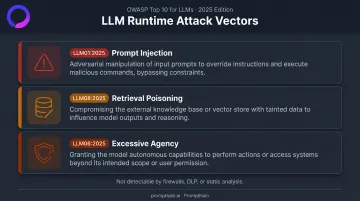
These are runtime behaviors, not code vulnerabilities. A firewall, DLP scanner, or static code analyzer cannot detect them.
Designing RBAC for Multi-Agent Architectures
Beyond least privilege — agent-specific RBAC concepts
Least privilege is necessary but not sufficient for agents. The principle must be enforced not just at authentication time, but at every action and every handoff. A role granted at session start should not automatically authorize every downstream tool call that agent might make.
NIST SP 800-207 defines zero trust as minimizing uncertainty in enforcing accurate, least-privilege, per-request access decisions. That per-request framing applies directly to multi-agent RBAC — not to user sessions, but to individual agent actions.
Two constructs are essential here:
Agent security passports bind a specific set of attributes to each agent identity: permitted tools, data scopes, risk thresholds, and behavioral limits. The passport travels with the agent across the system.
PromptHalo implements this directly: passports carry policy, budget, and authority decay as built-in credential attributes, not session-level configurations. Unlike a static IAM role, the passport's authority actively diminishes as the agent operates and requires re-authorization when defined thresholds are exceeded.
Authority decay is the principle that permissions automatically narrow as a request passes through more agents in a chain. The Cloud Security Alliance identifies scope attenuation as a primary defense against cross-agent privilege escalation and recursive delegation attacks.
In fintech workflows, the stakes are direct: no downstream agent in a payment chain should be able to initiate a transfer simply because the originating agent had that authorization.
Per-action scope and budget enforcement
Role definitions for agents need to map to specific tool invocations and API calls. A payment processing agent can read transaction records but cannot invoke a transfer endpoint — enforced at the call level, not the session level.
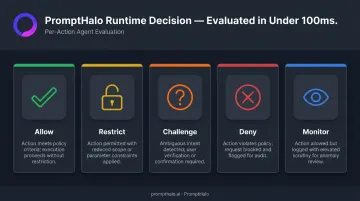
PromptHalo's Runtime Security solution sits inline on every inference, tool call, and agent-to-agent handoff, making a per-action decision in under 100ms. The five possible outcomes for any evaluation:
| Decision | Meaning |
|---|---|
| Allow | Action proceeds within defined scope |
| Restrict | Action proceeds with reduced capability |
| Challenge | Action requires additional authorization |
| Deny | Action is blocked before execution |
| Monitor | Action proceeds but flagged for review |
Budget enforcement adds a time, step, and risk dimension to scope control. As an agent operates, budgets decay across all three dimensions — forcing re-authorization when any envelope is exceeded. This prevents authority from persisting indefinitely within a session, even when the initial grant was legitimate.
What Multi-Agent Audit Logs Must Capture
From event logs to decision-level audit records
Standard application logs record system events. AI agent audit logs must record three additional things:
- Decision context — the reasoning or context that led the agent to take the action
- Delegation lineage — whose authority authorized the action and through what chain
- Policy decision — what the guardrail layer evaluated and whether it permitted, denied, or challenged
Without all three, logs are forensically incomplete. You can prove an API was called. You cannot prove whether it should have been.
Every audit record should implement a triple-identity pattern:
- The originating user or upstream agent
- The executing agent, including version or model hash
- The specific tool, resource, or API touched
All three are required to establish accountability and support non-repudiation. ISO/IEC 42001:2023 frames AI management systems around accountability and transparency — neither property is achievable without complete delegation attribution.
Delegation chain logging has its own requirements. When Agent A invokes Agent B, the log must record:
- The authority transfer event and timestamp
- What scope was granted to Agent B
- What scope Agent B exercised
- Whether any narrowing occurred
If this chain isn't logged, investigators have no way to reconstruct how a permission traveled through the workflow — or whether it was amplified along the way.
Tamper-evidence, replayability, and compliance-mapped logging
For regulated environments, the difference between a log and a legal record comes down to immutability. Audit records need timestamp authorities and immutability guarantees so that any alteration is detectable. A log that can be modified after the fact cannot serve as evidence.
PromptHalo's audit logs are append-only and tamper-evident. Once an event is written, it cannot be modified or removed. Each record captures the decision, the reason behind it, the acting agent or passport identity, session and tenant context, and a timestamp. The result is a replayable evidence trail: a security team or regulator can reconstruct the exact decision context months later without access to live systems.
Aligning With Compliance Frameworks: OWASP, NIST, and the EU AI Act
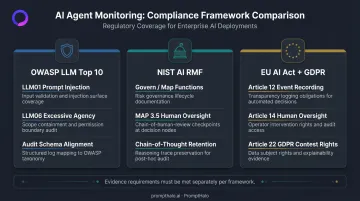
OWASP LLM Top 10
OWASP LLM Top 10 provides the most direct mapping to agent monitoring infrastructure. LLM01:2025 (Prompt Injection) and LLM06:2025 (Excessive Agency, previously numbered LLM08 in earlier OWASP material) are the two risks most directly addressed by RBAC and audit logging.
Audit logs serve as the primary detection mechanism for excessive agency: if an agent's tool calls consistently exceed its defined scope, logs surface this pattern. RBAC enforces the boundaries that prevent it from happening in the first place. Aligning audit schema fields — policy_decision, delegation_scope, tool_name — to OWASP's risk taxonomy simplifies compliance reporting considerably.
NIST AI RMF
NIST AI RMF governs traceability through its Govern and Map functions. MAP 3.5 specifically requires that processes for human oversight be defined, assessed, and documented. In practice, this means audit logs must retain chain-of-thought context alongside action metadata. Retention policies must also ensure logs remain accessible for the duration required by the organization's risk tier.
NIST requires accountability mechanisms that allow human operators to intervene. Audit logs support this directly by surfacing anomalies in real time.
EU AI Act and GDPR
The EU AI Act imposes the most specific obligations for high-risk AI systems. Article 12 requires automatic event recording across a system's operational lifetime. Article 14 requires that systems be designed so natural persons can effectively oversee them. High-risk use cases under Annex III include:
- Credit scoring and creditworthiness evaluation
- Life and health insurance risk assessment and pricing
- Recruitment, candidate filtering, and performance evaluation
- Employment decisions affecting promotion, termination, or task allocation
For organizations operating under both frameworks, GDPR Article 22 adds a parallel obligation. Data subjects have the right to contest decisions made solely through automated processing with legal or similarly significant effects. Audit logs that preserve decision context are what make those contest rights exercisable in practice.
From Audit Logs to Regulatory Evidence
Having audit logs and being able to use them as regulatory evidence are two different things. The gap comes down to structure, retention, and accessibility.
Logs must be:
- Structured — machine-readable with consistent field schemas, not free-text
- Time-stamped to an authoritative source, not just a server clock
- Retained on a schedule aligned with applicable regulations
- Exportable on demand to auditors or SIEMs
Retention schedules vary by regulation, but two benchmarks set the floor for financial services:
- PCI DSS: Audit trail history retained for at least one year, with three months immediately available for analysis
- SEC Rule 2-06: Audit and review records retained for seven years
These apply to different record types, but together they define the minimum planning horizon for regulated organizations.
Tiered storage is the practical approach: recent logs in hot storage for active incident investigation, older records in cold archival for long-term compliance. Full coverage, without paying hot-storage rates for data that auditors pull once a year.
For incident response, decision-level logs are what separate an investigation that takes days from one that takes weeks. When an agent security incident occurs, the audit trail should allow the team to:
- Isolate which agent took which action and under whose delegated authority
- Identify exactly where a permission boundary was crossed or a guardrail triggered
- Produce a forensic timeline suitable for regulatory notification or legal review
Logs that only capture API calls cannot support steps 2 or 3. The policy decision field — what was attempted, which guardrail evaluated it, and what the outcome was — makes the difference between a log and a forensic record.
Frequently Asked Questions
What is RBAC for multi-agent AI systems and how does it differ from traditional RBAC?
Traditional RBAC grants a static role at login and assumes predictable, human-initiated operations. Agentic RBAC enforces per-action, per-handoff permission scope (using constructs like security passports and authority decay) because agents operate autonomously and chain actions without human re-authentication at each step.
What should be included in an AI agent audit log for regulatory compliance?
At minimum, logs should capture agent identity and version, originating user or upstream agent, delegation scope, the specific tool or resource accessed, and the guardrail decision (permit/deny/challenge). A tamper-evidence mechanism that flags any post-write alteration is required, and all fields must be structured and machine-readable.
How do you enforce least privilege across multi-agent workflows without breaking agent functionality?
Per-action scope enforcement at runtime — not just a narrow role at session start — keeps agents functional within defined boundaries. Authority decay prevents permission amplification as tasks pass through the chain, and re-authorization triggers when budget envelopes are exceeded rather than blocking agents arbitrarily.
Which compliance frameworks apply to AI agent monitoring platforms?
The core frameworks are OWASP LLM Top 10 (vulnerability taxonomy), NIST AI RMF (traceability and human oversight), and the EU AI Act (logging and oversight evidence for high-risk systems). Industry-specific standards such as SOC 2, HIPAA, and PCI DSS layer on top depending on deployment context.
How do audit logs help during a security incident involving an AI agent?
Decision-level logs with delegation lineage let the security team reconstruct exactly which agent acted, under whose authority, what guardrail decision was applied, and where a permission boundary was crossed. That reconstruction supports faster containment and produces a defensible forensic record for regulatory notification.