

Key Takeaways
- AI anomaly detection uses ML models to identify deviations from established behavioral baselines, catching what no human team can monitor at scale
- Three anomaly types require different detection strategies: point, contextual, and collective anomalies
- Supervised, unsupervised, and semi-supervised methods each carry distinct tradeoffs between accuracy and scalability
- No single algorithm dominates across all datasets; the right choice depends on data type, label availability, and latency requirements
- Agentic AI introduces a new anomaly category: behavioral deviations within the AI system itself, not just in the data it processes
Introduction
Organizations today face a paradox: they have more data than ever, and more ways to monitor it — yet the anomalies that actually matter keep slipping through. A fraudulent transaction buried in millions of daily payments. A network intrusion disguised as routine traffic. A failing industrial sensor sending subtly wrong readings weeks before a breakdown.
Microsoft's 2025 Digital Defense Report reported processing 100 trillion security signals per day — a volume that makes manual review not just impractical, but impossible. This is exactly the problem AI anomaly detection solves.
By learning what "normal" looks like from historical data, ML-based detection systems flag meaningful deviations in real time — across thousands of variables simultaneously, without manually defined thresholds or rules that go stale.
This guide covers the definition of AI anomaly detection, the three types of anomalies and detection methods, the key algorithms, major industry use cases, and a frontier most guides miss entirely: detecting anomalies in agentic AI systems themselves.
What Is AI Anomaly Detection?
AI anomaly detection uses machine learning models to identify data points, events, or behavioral patterns that deviate significantly from an established baseline. Chandola, Banerjee, and Kumar's foundational survey defines it as finding patterns that do not conform to expected behavior.
That definition holds across wildly different domains — network traffic, financial transactions, sensor telemetry, and AI agent behavior all share the same underlying problem: something happened that shouldn't have.
The Three Anomaly Types
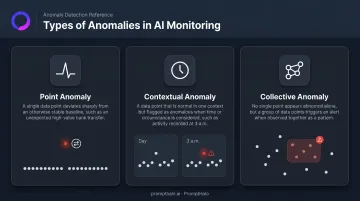
Most anomalies fall into one of three categories:
- Point anomalies: A single data instance is anomalous relative to the rest. A bank transfer 50 times larger than an account's average is the textbook example.
- Contextual anomalies: Data that looks normal in isolation but is abnormal given its context. High energy consumption at 3 a.m. in an office building isn't suspicious by magnitude — the time makes it suspicious.
- Collective anomalies: A group of individually normal events that are anomalous together. A coordinated traffic surge from dozens of endpoints might look routine per endpoint, but signals attack behavior as a group.
Why AI Outperforms Classical Methods
Rule-based systems require humans to predefine and continuously update thresholds. They miss novel anomalies, generate excessive false alerts, and can't evaluate relationships across hundreds of variables simultaneously. AI models:
- Continuously learn from new data without manual rule updates
- Detect non-linear relationships across thousands of variables
- Adapt to behavioral drift over time
- Reduce false positive rates by understanding feature relationships, not just individual dimensions
The Three Types of Anomaly Detection
The method used to train an anomaly detection model depends on whether labeled data is available. Each approach carries real tradeoffs between accuracy, scalability, and deployment effort.
Supervised Anomaly Detection
Supervised detection requires a labeled training dataset where examples are classified as "normal" or "anomalous." The model learns from these labeled pairs and makes precise predictions on new data.
In practice, this approach rarely scales. Labeled anomaly data is scarce — anomalies are infrequent by definition, labeling demands domain expertise, and the process is expensive. A 2024 self-supervised anomaly detection survey confirms supervised detection is rarely used in production because it's usually impossible to describe all anomaly classes in advance. When a novel anomaly type appears, supervised models may fail entirely.
Unsupervised Anomaly Detection
Unsupervised detection learns the structure of normal behavior from raw, unlabeled data — then flags whatever doesn't fit that pattern.
This is the most widely deployed approach because it:
- Deploys without expensive labeling
- Scales to large, complex datasets
- Detects entirely new anomaly patterns with no prior examples
The tradeoff: without ground truth labels, the model can't automatically distinguish benign anomalies from genuine threats. Output typically requires human review to interpret findings.
Semi-Supervised Anomaly Detection
Semi-supervised methods occupy the middle ground. A small portion of labeled data — usually only "normal" examples — anchors an initial boundary of expected behavior. The model then uses unsupervised learning to classify the rest.
A key technique here is pseudo-labeling: the partially trained model automatically classifies unlabeled data, which is then used to fine-tune the algorithm further. Google's SPADE research illustrates this approach — assigning pseudo-labels only when all ensemble members agree, reducing noise from uncertain classifications.
For most enterprise deployments, semi-supervised is the pragmatic choice: it runs without comprehensive labeled datasets while still letting teams encode domain knowledge through a small set of targeted examples — a meaningful advantage when anomaly patterns evolve faster than labeling can keep up.
Quick comparison:
| Method | Labels Required | Scalability | Best For |
|---|---|---|---|
| Supervised | Both normal + anomalous | Low | High-precision, low-volume classification |
| Unsupervised | None | High | Large-scale, novel anomaly discovery |
| Semi-supervised | Normal only (limited) | Medium-High | Most production enterprise systems |
Key AI Algorithms for Anomaly Detection
A 2022 VLDB benchmark study evaluated 71 algorithms across 976 time-series datasets and reached a clear conclusion: no single algorithm dominates. Algorithm selection depends on data type, label availability, latency requirements, and acceptable false positive rates.
Density and Proximity-Based Methods
These algorithms operate on a core principle: anomalies occupy sparse, low-density regions of the data space, distant from their neighbors.
- Local Outlier Factor (LOF): flags points with significantly lower density than their neighbors, effective for datasets with varying density clusters
- k-Nearest Neighbors (kNN): calculates average distance to nearest neighbors in high-dimensional space
- DBSCAN: identifies points that belong to no cluster, treating them as noise; well-suited for spatial data
Tree and Ensemble Methods
- Isolation Forest: randomly partitions the feature space; anomalies require fewer splits to isolate than normal points, making detection computationally efficient at scale
- One-Class SVM: learns a boundary encompassing normal data and treats anything outside it as an anomaly
Both perform well on tabular data at scale and are common first choices for structured datasets. Where tree methods hit their ceiling, though, is with unstructured or high-dimensional inputs. That's where neural approaches take over.
Neural Network Methods
For images, logs, and sensor streams, neural approaches handle complexity that tree-based models can't:
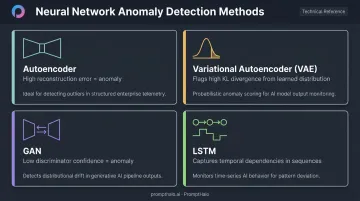
- Autoencoders: compress input into a lower-dimensional representation and reconstruct it; high reconstruction error signals an anomaly
- Variational Autoencoders (VAEs): extend autoencoders by modeling a probabilistic latent space; anomalies fall outside the learned distribution and produce both high reconstruction error and high KL divergence — first applied to medical imaging, now widely used across domains
- GANs (Generative Adversarial Networks): the discriminator learns to distinguish real from generated data; anomalies score low on the discriminator's confidence, flagging inputs that don't match the training distribution
- LSTM networks: purpose-built for sequential and time-series data, capturing temporal dependencies that static models miss
Statistical Baselines
Z-score, Grubbs' test, and kernel density estimation are fast, lightweight options for simpler datasets. They trade adaptability for speed — useful as a first-pass filter or for low-volume, well-understood data distributions.
Bayesian Networks
Worth a specific mention for high-dimensional anomalies where the deviation is subtle, distributed across multiple correlated variables, and invisible in any single dimension. Bayesian networks were first applied to intrusion detection; they model probabilistic dependencies between variables to catch anomalies that no threshold on any single feature would surface.
AI vs. Rule-Based Anomaly Detection
Rule-based systems require human experts to define every threshold and condition manually. They fail to detect anomalies that don't match predefined patterns, and they must be continuously re-tuned as behavior evolves. The Ponemon Institute's 2016 malware alert study found 29% of investigated malware alerts were false positives under traditional rule-based approaches — and that figure predates the complexity of today's environments.
Where ML Detection Wins
ML-based anomaly detection addresses each of these failure modes:
- Learns baselines automatically from historical data — no manual rule authoring required
- Adapts as normal behavior evolves, updating without human intervention
- Surfaces subtle deviations distributed across dozens of correlated features, catching multi-variable anomalies that per-dimension rules miss
- Evaluates feature relationships rather than isolated dimensions, which drives down false positives significantly
PromptHalo's ML-based detection engine combines Threat Library signatures with classifier-based risk scoring, achieving a catch rate above 95% at under 5% false positives — compared to roughly 35% catch rate and 15–20% false positives for rule-based approaches.
Real-Time vs. Batch Detection
The right processing mode depends on how costly detection delay actually is:
- Real-time: Sub-second decisions for fraud signals, prompt injection blocking, and security enforcement — speed takes priority over analytical depth
- Batch: Deeper analysis on accumulated data with accepted latency — appropriate for predictive maintenance, log review, and compliance reporting
A fraud signal needs a decision in milliseconds. An industrial sensor anomaly that informs next week's maintenance schedule does not.
AI Anomaly Detection Use Cases Across Industries
AI anomaly detection applies wherever deviation from a known baseline carries operational, financial, or safety risk. These use cases share one characteristic: data volume and pattern complexity exceed what human monitoring can handle in real time.
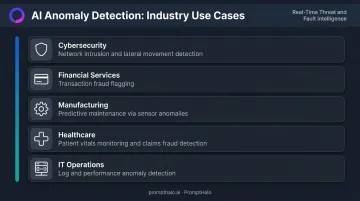
- Cybersecurity: ML models detect network intrusions and lateral movement by learning normal traffic patterns and flagging behavioral deviations. An ML intrusion detection model evaluated on benchmark datasets achieved accuracy of 99.3% on NSL-KDD and 99.5% on CIC-IDS-2017 — though production environments with noisier data will see different numbers.
- Financial Services: Fraud detection compares transaction velocity, geolocation, and spending patterns against account history to flag anomalous activity. A BIS working paper describes weakly supervised ML anomaly detection applied to money services businesses using geolocation and transaction data.
- Manufacturing: Sensor streams from industrial equipment generate signatures of early failure weeks before breakdowns occur. Catching these anomalies early is the foundation of predictive maintenance programs.
- Healthcare: Anomaly detection applies to patient vitals monitoring, EHR access log auditing, and healthcare claims fraud. Unsupervised methods including Isolation Forest and Local Outlier Factor have been applied to anomaly-based threat detection in smart health systems.
- IT Operations (AIOps): Application and infrastructure logs contain early signals of performance degradation and service failures. ML-based log anomaly detection catches these patterns before they affect users, reducing mean time to detection.
AI Anomaly Detection in Agentic AI Systems
Most anomaly detection literature focuses on finding deviations in business data — transactions, network packets, sensor readings. There's a category it almost entirely overlooks: behavioral anomalies in the AI system itself.
Gartner predicts that 40% of enterprise applications will include task-specific AI agents by 2026, up from less than 5% today. As these agents autonomously call external tools, access databases, coordinate with other agents, and execute real-world actions, a new attack surface emerges that traditional anomaly detection was never designed to see.
The Agentic Anomaly Types
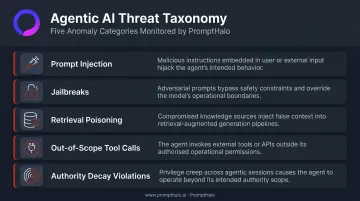
Prompt injection: Adversarial input that overrides an agent's system instructions. An attacker embeds commands in a document the agent retrieves; the agent executes those commands instead of the user's.
Jailbreaks: Inputs designed to bypass alignment constraints, causing the model to produce outputs its system prompt explicitly prohibits.
Retrieval poisoning: Malicious content inserted into a RAG knowledge base that distorts agent responses. PoisonedRAG research demonstrated 90% attack success by injecting just five malicious texts per target question — showing how low the barrier to entry actually is.
Out-of-scope tool and API calls — An agent invoking capabilities it was never authorized to use. Without enforcement, an agent processing a customer refund could query internal pricing tables or trigger API calls well outside its intended scope.
Authority decay violations: Permissions accumulate when agents operate beyond authorized budgets across time, steps, or risk thresholds. Authority granted for a single task can persist indefinitely without decay enforcement.
Why This Requires Purpose-Built ML Detection
The attack surface here is fundamentally different from traditional data anomaly detection:
- The surface is dynamic — prompt content and agent behavior vary with every inference; no static rule set can keep up
- Anomalies are context-dependent — a legitimate API call looks identical to a malicious one without behavioral context across the full agent session
- Missed detections are irreversible — an agent that executes an unauthorized action cannot be recalled after the fact
PromptHalo's runtime enforcement layer is built specifically for this environment. It sits inline on every inference, tool call, and agent-to-agent handoff — inspecting each action using embedding-based detection scored against a shared Threat Library, combined with classifier-based risk scoring. Every action receives a decision (allow, restrict, challenge, deny, or monitor) in under 100ms, without model retraining or code rewrites.
The platform issues agent security passports that travel with each request, carrying built-in policy, budget, and authority decay. When a budget envelope is exceeded, re-authorization is forced — preventing authority accumulation across multi-step workflows.
Compliance and Audit Requirements
Anomaly detection in agentic AI isn't only a security requirement — it's now a regulatory one. The EU AI Act's Article 12 requires high-risk AI systems to technically allow automatic recording of events over their system lifetime. NIST AI RMF and OWASP LLM Top 10 both address monitoring and audit requirements for AI systems in production.
Meeting these requirements demands logs that go beyond timestamps. PromptHalo's audit logs capture every decision with its reason, the acting agent identity, session and tenant context, and a timestamp — in an append-only, tamper-evident structure. Once an event is written, it cannot be modified or removed. Security teams can replay the full sequence of an agent's actions to reconstruct any incident, which is essential for regulatory reporting and forensic investigation.
Frequently Asked Questions
What is anomaly detection in AI?
AI anomaly detection uses machine learning models to identify data points, events, or behavioral patterns that deviate from an established "normal" baseline. It allows organizations to automatically flag fraud, system failures, and security threats at scale, without manually defining every rule or threshold.
What are the three types of anomaly detection?
The three categories map to how the model is trained:
- Supervised: Trained on labeled normal and anomalous examples — precise but data-intensive
- Unsupervised: Trained on unlabeled data — most widely used, scales well but requires human review
- Semi-supervised: Uses limited labeled data to anchor the model, then scales with unsupervised learning — the most practical balance for enterprise deployments
Which AI models are commonly used for anomaly detection?
Common algorithms vary by data type and use case:
- Isolation Forest and One-Class SVM — tabular data
- Local Outlier Factor and kNN — density- and proximity-based detection
- Autoencoders and LSTM networks — high-dimensional and sequential data
- Bayesian networks — subtle, multi-variable anomalies across correlated features
What is the difference between AI anomaly detection and traditional rule-based detection?
Rule-based systems require experts to predefine every threshold and must be manually updated as conditions change. They miss novel anomalies and generate high false positive rates. AI-based systems learn baselines from data, adapt over time, and detect multi-dimensional deviations no single rule could express — producing far fewer false alerts.
What industries benefit most from AI anomaly detection?
Financial services (fraud detection), cybersecurity (intrusion and behavioral threat detection), manufacturing (predictive maintenance), healthcare (patient monitoring and claims fraud), and IT operations (log and performance anomaly detection) are the most mature use cases — with agentic AI security emerging as a critical new frontier.
Can AI anomaly detection be applied to AI systems themselves?
Yes. As agentic AI becomes more common, anomaly detection must extend to the AI system's own behavior — identifying prompt injection, jailbreaks, out-of-scope tool calls, and retrieval poisoning in real time. Purpose-built runtime security platforms can inspect each agent action before it executes, catching AI-native threats that traditional anomaly detection was never designed to see.