Introduction
Enterprise AI deployments have crossed a threshold that traditional security infrastructure wasn't built for. When a human logs into a database, an access log captures it cleanly: who, what, when. But when an AI agent autonomously chains tool calls, retrieves documents from a vector store, passes instructions to a sub-agent, and generates outputs — all within seconds — that same log captures almost nothing meaningful.
Traditional IT logs were architected for deterministic software and human actors — they answer access questions. Agentic AI demands something different: decision-level accountability. Why did the agent act? Was the action within authorized scope? Can investigators replay it exactly as it happened? Existing logging infrastructure has no architecture for those questions.
What follows breaks down what AI-native audit logging must capture, how those requirements map to NIST AI RMF and the EU AI Act, and what the gap looks like between a passive logging tool and a real enforcement layer.
Key Takeaways
- AI audit logs must capture decision-level reasoning chains — not just access events
- Traditional SIEMs cannot reconstruct autonomous tool calls, RAG retrievals, or multi-agent handoffs
- NIST AI RMF and the EU AI Act now require traceable, explainable AI decision records
- Tamper-evident, replayable logs are the evidentiary foundation for security investigations and regulatory audits
- Audit logging and runtime enforcement must operate as a closed loop — detection that doesn't feed enforcement leaves gaps attackers exploit
Why Traditional Audit Logs Fall Short for AI Systems
The IT Security Log vs. the AI Agent Audit Trail
Traditional IT logs were built for a simpler world: a person authenticates, accesses a resource, and logs off. That model works for tracking a database login. It fails completely for an AI agent that autonomously chains tool calls, retrieves documents, generates outputs, and passes context to sub-agents — all without a human triggering each step.
The core failure is reconstruction. When an AI agent executes a sequence of actions, it produces a causally linked decision chain. Standard SIEMs and access logs capture individual events with no connective tissue between them. An investigator reviewing those logs sees timestamps and API calls, but cannot answer:
- What instruction drove this action?
- What did the agent retrieve before acting?
- Which policy applied at that decision point?
- Why did it invoke that specific tool?
Without those answers, forensic investigation stalls before it starts.
The Agentic Attack Surface Changes the Logging Requirement
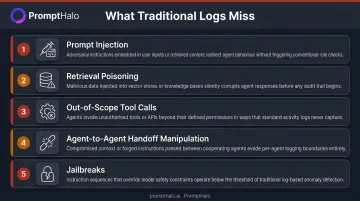
Agentic AI introduces threat vectors that traditional logging simply wasn't designed to capture:
- Prompt injection embedded in retrieved documents, invisible to access-event models
- Retrieval poisoning that corrupts RAG pipeline outputs before the agent ever acts
- Out-of-scope tool calls where an agent invokes APIs beyond its authorized boundaries
- Agent-to-agent handoff manipulation, where instructions passed between agents are tampered with or escalated
- Jailbreaks embedded in user inputs that bypass output filters entirely
None of these map to the access-event schema that traditional logs were designed to capture.
The scale of this exposure is accelerating. Gartner predicts that 40% of enterprise applications will include task-specific AI agents by 2026, up from less than 5% in 2025. By 2028, 33% of enterprise software applications are projected to include agentic AI — a massive expansion in autonomous decision-making that current logging infrastructure was never built to govern.
That governance gap is compounded by the limits of rule-based logging. Academic research on jailbreak guardrails shows rule-based methods generate high false positive rates and struggle against novel attack patterns, because they cannot model the semantic context of AI agent behavior. ML-based approaches can capture complex behavioral patterns and generalize to attack variants that static rules never anticipated.
What AI-Powered Audit Logging Tools Actually Capture
Decision-Level Logging vs. Event-Level Logging
Decision-level audit logging captures the complete context of an AI agent action — not just that something happened, but the full chain of what drove it.
Consider the difference:
- Event-level log: "AI agent made an API call at 14:32:07"
- Decision-level log: The agent was instructed to retrieve customer account data, queried a vector store, retrieved three documents, attempted to output account numbers — that output was flagged as a data leakage risk, and a deny decision was applied with the specific policy rule that triggered it
The second record is what investigators and regulators actually need.
The Core Data Points an AI Audit Log Must Contain
An IETF Internet-Draft on agent audit trails proposes a structured format for AI agent logging that includes fields traditional logs simply don't have:
| Field | Purpose |
|---|---|
timestamp |
Chronological anchoring of the event |
agent_id / agent_version |
Identity and version of the acting agent |
session_id |
Links actions across a multi-step workflow |
action_type |
Tool call, decision, RAG retrieval, handoff, error |
action_detail |
Specifics of what the agent attempted |
outcome |
What actually happened as a result |
parent_record_id |
Links to the prior decision in the chain |
prev_hash |
Tamper-evidence via hash chaining |
trust_level |
Authorization scope at the time of action |
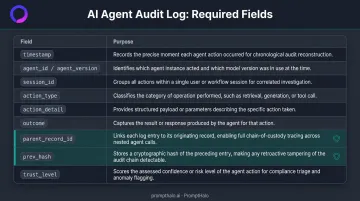
Reconstructing exactly what an AI agent did — step by step, with policy context at each decision point — is the prerequisite for meaningful incident investigation, internal audits, and regulatory inquiries.
PromptHalo's audit logs are built on this decision-level model. Each entry captures the decision, its rationale, the acting agent's security passport identity, and session and tenant context. The log is append-only — records cannot be modified or removed after they're written, creating a replayable evidence trail for security response and regulatory export.
Tamper-Evident Integrity and Chain of Custody
For regulated industries, a mutable log is not evidence — it's a liability. Producing defensible records means guaranteeing that nothing in the audit trail has been altered after the fact.
Tamper-evident audit logs use cryptographic guarantees to ensure records cannot be altered, deleted, or backdated after they're written. The IETF draft proposes hash chaining via prev_hash fields, SHA-256 hashing, and digital signing — with an estimated overhead of roughly 2ms per record. The result: any modification to a prior record breaks the chain, making tampering detectable.
For financial services, healthcare, and other regulated sectors, auditors require records with demonstrable chain of custody. Hash-chained, cryptographically signed logs are what satisfy that bar.
Mapping AI Audit Logs to Regulatory Compliance Frameworks
OWASP LLM Top 10
The OWASP LLM Top 10 defines the primary attack categories targeting AI systems. Compliance-grade audit logs should tag and classify logged events against these categories, enabling rapid incident classification and structured reporting:
- LLM01 – Prompt Injection: Log prompts, retrieved context, tool calls, and policy decisions to investigate direct and indirect manipulation
- LLM04 – Data and Model Poisoning: Log data-source lineage, retrieval events, and model version used
- LLM05 – Improper Output Handling: Log outputs and downstream API actions to confirm validation occurred before execution
- LLM06 – Excessive Agency: Log agent permissions, tool invocations, autonomous actions, and multi-step decision chains
- LLM08 – Vector and Embedding Weaknesses: Log vector retrieval, embedding-source provenance, and RAG context used in each response
Threat-classified logs let security teams trend incidents by attack category, report to leadership with structured evidence, and investigate without manual triage — directly from the audit record.
NIST AI Risk Management Framework
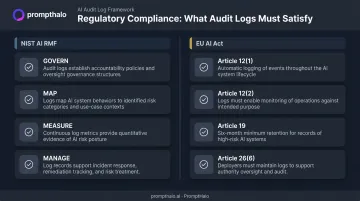
The NIST AI RMF organizes AI risk governance across four functions — GOVERN, MAP, MEASURE, and MANAGE. Decision-level audit logs supply the primary evidence layer for each:
- GOVERN: Logs document organizational policies, roles, accountability, and risk governance in practice — not just on paper
- MAP: Logs provide evidence of actual AI use against intended use, satisfying MAP 1.1's documentation requirements
- MEASURE: Decision-level logs supply measurement evidence for prompts, outputs, tool use, and incidents — exactly what NIST describes as "tools and methods to analyze, assess, benchmark, and monitor AI risk"
- MANAGE: Logs support risk response, incident review, and systematic documentation that increases transparency
NIST AI 600-1 reinforces this directly: logging and analyzing generative AI incidents is the mechanism for sharing threat intelligence across relevant AI actors — making the audit log a compliance artifact, not just an operational one. The EU AI Act takes this further by mandating specific retention requirements.
EU AI Act
The EU AI Act imposes mandatory logging requirements on high-risk AI systems under Article 12:
- Article 12(1): High-risk AI systems must technically allow automatic recording of events over the system lifetime
- Article 12(2): Logging must enable traceability appropriate to intended purpose, including identifying risk situations and supporting post-market monitoring under Article 72
- Article 19: Providers must retain automatically generated logs for at least six months
- Article 26(6): Deployers face the same six-month minimum retention obligation
AI systems used for credit scoring, risk assessment, and insurance pricing are explicitly listed in Annex III as high-risk — which means structured, framework-mapped audit logs are an active compliance obligation for financial services organizations right now.
Key Features to Evaluate in AI Audit Logging Tools
When assessing AI audit logging tools, three capabilities separate adequate from defensible:
1. Real-time, inline capture over batch logging
A delay between an AI agent action and its log entry creates an investigation gap. Events that occur between batch cycles are either unrecorded or unrecoverable. For runtime security, that gap is unacceptable. An attack that completes before it's logged cannot be stopped or fully reconstructed.
2. Semantic classification of logged events
A log that labels an interaction as a potential prompt injection attempt, an out-of-scope tool call, or a data exfiltration signal is actionable. An unstructured data dump requiring manual analyst interpretation is not.
That distinction directly affects how quickly security teams can triage incidents and how clearly they can report to regulators.
3. Vendor and model agnosticism
The logging layer should operate at the inference or API gateway level, not inside the model. This enables coverage across any AI application or provider without model retraining, code rewrites, or access to proprietary model weights.
PromptHalo deploys this way: API gateway, agent mode, or inline middleware, all feeding the same inspection pipeline, with no access to underlying models required.
From Passive Logging to Active Security Enforcement
Logging what happened is not the same as preventing what shouldn't have. The architectural shift that separates a monitoring tool from a security tool is where in the workflow the log decision gets made.
When audit logs feed real-time detection that issues allow, restrict, challenge, deny, or monitor decisions before an agent action executes — rather than recording it afterward — logging becomes part of the enforcement layer. The Gartner framing captures this directly: organizations must move from policy-based governance to enforceable technical controls as AI expands.
A closed-loop model changes what's possible over time. Anomalies and attack patterns captured in audit logs continuously train and update detection logic, making the system progressively more accurate at distinguishing legitimate agent behavior from adversarial activity. Static rule sets can't do that — they degrade as attacker tactics evolve.
That principle is what PromptHalo's architecture is built around. Its red-teaming capability discovers exploitable attack paths, and every attack found feeds the runtime enforcement engine through a shared threat library. Key capabilities that make this work:
- Newly discovered attack patterns become runtime defenses without waiting for a new release cycle
- Audit-driven intelligence feeds enforcement directly — not a separate reporting silo
- Detection operates inline on every inference, tool call, and agent-to-agent handoff
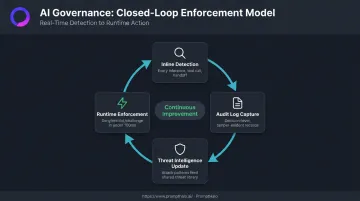
Decisions issue in under 100ms — fast enough to enforce before execution, not just report after the fact.
Frequently Asked Questions
What is the difference between traditional audit logs and AI-powered audit logs?
Traditional logs capture user access events against static systems — who accessed what and when. AI-powered audit logs capture the full decision chain of an AI agent's actions: inputs, outputs, tool calls, RAG retrievals, policy decisions, and threat classifications. That coverage comes with semantic context and tamper-evident integrity that conventional logs cannot provide.
How do AI audit logging tools help meet NIST AI RMF and EU AI Act requirements?
Decision-level, framework-mapped logs supply the evidence layer for NIST AI RMF's MEASURE and MANAGE functions. They also satisfy the EU AI Act's traceability and post-market monitoring obligations under Articles 12 and 72 for high-risk AI deployments.
What should AI agent audit logs capture that standard security logs miss?
AI agent logs need to capture autonomous tool calls, RAG retrieval chains, agent-to-agent handoffs, prompt injection attempts, policy enforcement decisions, and the causal linkage between what an agent was instructed to do and what it actually produced. Standard logs were built for access events — that schema was never designed to represent any of these.
How do tamper-evident audit trails support regulatory investigations?
Cryptographically secured, append-only logs cannot be altered post-hoc, establishing chain of custody and making records defensible in regulatory reviews, internal audits, and incident investigations. Regulators and investigators require exactly this level of integrity — a log that can be edited after the fact provides no reliable chain of custody.
Can AI audit logging tools work across multiple AI vendors and models without accessing the model itself?
Yes. Vendor-agnostic logging layers operate at the inference or API gateway layer, enabling coverage across any AI provider or model without model retraining, integration into model weights, or proprietary model access.
How quickly can AI audit logging be deployed without disrupting existing AI systems?
Modern AI audit logging tools deploy inline at the API or gateway layer — PromptHalo's deployment completes in under a day, with no model retraining and no code rewrite required to existing infrastructure.