Introduction
IBM reported in July 2025 that 13% of organizations experienced breaches of AI models or applications — and 97% of those breached organizations lacked proper AI access controls. The average breach cost sits at $4.44M globally, with shadow AI deployments adding another $670,000 on top.
Those numbers look different when you understand what's actually at risk. A misconfigured human user account creates one exposure point. A misconfigured AI agent creates dozens — simultaneously. Agents call tools, chain actions across systems, invoke APIs, and process sensitive data in seconds. The exposure doesn't scale linearly; it compounds.
Traditional access control wasn't built for agents. OAuth and SAML were designed for humans who authenticate once and stay trustworthy for a session. Agents don't work that way — they select tools dynamically, delegate to other agents, and accumulate permissions across multi-step workflows. Static role assignments and session-scoped trust weren't designed for any of that.
That gap is what this post addresses — both the implementation best practices and the architectural mistakes that leave teams exposed when they apply human-oriented security models to agentic AI systems.
Key Takeaways
- AI agents require dynamic, per-action RBAC — static session-level roles create unacceptable privilege accumulation risk
- Every tool call, handoff, and data access must appear in structured, identity-linked audit logs — not basic application logs
- Enforce least privilege at the point of action execution, with permissions expiring automatically at task completion
- Audit logs must capture agent identity, delegation scope, policy decisions, and reasoning context to satisfy NIST AI RMF, OWASP LLM Top 10, and the EU AI Act
- Shadow agents deployed without security review bypass every governance control you've built
Why Traditional RBAC Falls Short for AI Agents
OAuth 2.0, SAML, and OIDC were built around a specific assumption: once an entity authenticates, it remains trustworthy for the duration of the session. That assumption works for humans who log in, complete a task, and log out. It breaks entirely for agents.
The Cloud Security Alliance confirmed in 2025 that traditional IAM protocols are insufficient for the autonomous and ephemeral nature of agentic AI. The CSA recommends verifiable agent identity, Zero Trust IAM, fine-grained delegation, and detailed audit logging as replacements — none of which map neatly onto existing OAuth flows.
The Service Credential Bypass Problem
The core failure pattern is structural, not configurational. When agents execute tool calls using broadly privileged service accounts, the human user's role only constrains what the agent is asked to do. What the agent can actually do at the infrastructure level is a separate question entirely.
That gap is where regulated data leaks happen. An agent operating under a service account with database read access can retrieve far more than the requesting user is entitled to see. The user's role looks correct. The agent's effective capability does not.
Why Action-Level Authorization Is the Fix
OWASP LLM06:2025 Excessive Agency identifies this directly: agent and tool systems become risky when they receive excessive functionality, permissions, or autonomy. The recommendation is pre-execution authorization checks — not just authentication at session start.
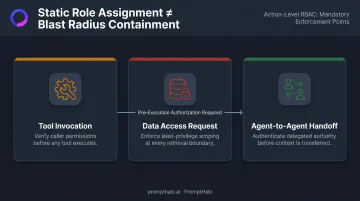
RBAC enforcement must cover:
- Every individual tool invocation
- Every data access request
- Every agent-to-agent handoff
Static role assignment is the baseline. Pre-execution, per-action authorization is what actually contains the blast radius when an agent is compromised or manipulated.
RBAC Best Practices for Agentic AI Systems
Apply Least Privilege at the Per-Action Level
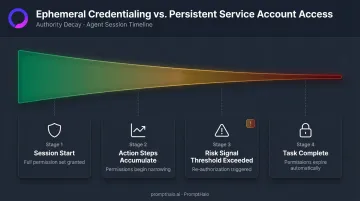
Each agent should receive only the permissions needed for its current task. Those permissions should expire automatically when the task completes — ephemeral credentialing rather than persistent service account access.
The difference becomes critical when an agent is compromised mid-session. With ephemeral permissions, the attacker's window is bounded by the task scope. With persistent service account access, the entire account's permission set is exposed for as long as the account lives.
NIST SP 800-207 Zero Trust Architecture codifies the underlying principle: authentication and authorization should occur before access to each protected resource, not just at session initiation.
Design Roles That Reflect Regulatory Constraints, Not Just Org Charts
Effective agentic RBAC encodes both function and purpose restriction. Consider the difference:
| Role | Permissions | Restrictions |
|---|---|---|
| Compliance Reviewer | Read flagged conversations | Cannot edit agent workflows; permitted for incident response only |
| AI Admin | Full configuration access | Requires MFA elevation; audit-logged for all changes |
| Analytics Agent | Aggregate query access | No bulk export; no cross-tenant queries |
Roles should answer two questions: what can this agent do, and what is it for? Purpose restrictions prevent role reuse in contexts that weren't reviewed.
Route All Tool Calls Through a Centralized Authorization Broker
Letting agents call tools directly — using service credentials that bypass user-role enforcement — is the most common source of regulated data leaks in agentic deployments. The fix isn't better logging after the fact; it's interception before execution.
A centralized authorization broker intercepts every tool call, attaches identity context, and checks the intended resource against role policy. It blocks or redacts based on entitlements — decisions made before the action runs, not recorded after.
PromptHalo's inline Runtime Security solution does exactly this: sitting on every inference, tool call, and agent-to-agent handoff, making allow/restrict/challenge/deny/monitor decisions in under 100ms, before the action executes.
Implement Authority Decay for Long-Running Agents
Permissions should narrow as agent sessions extend or as risk signals increase. Without authority decay, multi-step agents accumulate privileges across chained actions — each step inheriting the full permission set of the last.
Containing that accumulation requires enforcement that travels with the agent, not just policy defined at session start. PromptHalo enforces budgets across elapsed time, action steps, and accumulated risk signals — forcing re-authorization when any threshold is exceeded. Agent security passports travel with each request and carry policy, budget, and scope constraints, so authority is scoped per action and enforced externally. Agents cannot grant themselves more access than they were originally given.
Access controls deploy without model retraining or code rewrites, so teams can introduce granular trust boundaries without stalling feature releases.
Extending RBAC to Multi-Agent Handoffs
When one agent delegates a subtask to another, the receiving agent must not automatically inherit the delegating agent's full permissions. That's not delegation — that's permission laundering.
Every handoff requires explicit constraints on three dimensions:
- Scope: transfer only the permissions the subtask actually requires, nothing broader
- Expiration: delegated access terminates automatically when the subtask completes
- Lineage: log the originating identity, transferred scope, and stated purpose in the audit trail
Without delegation-aware logging, investigators cannot reconstruct the authorization chain that produced a given action. This is a forensic gap that regulators increasingly treat as a control failure.
Shadow Agents: The Largest Blind Spot
Delegation gaps are compounded when agents aren't in your registry at all. According to IBM's 2025 X-Force Threat Intelligence Index, one in five organizations experienced a breach tied to shadow AI. Shadow agents — deployed by business teams without security review — operate entirely outside established RBAC and audit frameworks, bypassing every governance control you've built.
Continuous agent discovery across SaaS, cloud, and endpoint environments is a prerequisite to any effective access control program. You cannot enforce RBAC on agents you don't know exist.
Audit Logging Best Practices for AI Agents
Standard application logs record system state: HTTP status codes, error messages, latency. For agentic AI, that baseline captures nothing useful for investigation. Audit logs must capture something fundamentally different.
The Minimum Required Field Set
Every AI agent audit event must include:
- Agent ID and version — which agent, running which build
- Parent user identity — the human principal on whose behalf the agent is acting
- Delegation scope — permissions granted for this session or task
- Tool name and hashed input parameters — what was called and with what (hashed, not raw)
- Policy decision outcome — permit or deny, and which rule matched
- Trace ID — linking distributed sub-actions across systems (OpenTelemetry's LogRecord supports TraceId and SpanId for exactly this purpose)
- Timestamp — with sufficient precision for forensic sequencing
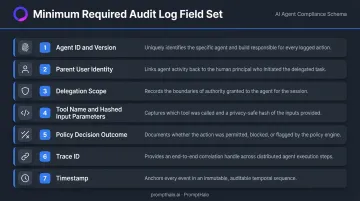
The LoginRadius AI Agent Audit Field Matrix provides a practical schema reference for teams building this structure. NIST SP 800-53 AU-3 sets the authoritative baseline: audit records must establish what occurred, when, where, the source, the outcome, and associated identity.
PromptHalo's decision-level audit logs capture the acting agent or passport identity, session and tenant context, and the reason for each decision — stored in an append-only, tamper-evident format that cannot be modified after writing.
Capture Reasoning Traces as Distinct Artifacts
The difference between a defensible audit trail and a collection of API call records is the reasoning trace. Logging the agent's plan or intent before tool execution, not just the tool call outcome, is what satisfies NIST AI RMF's traceability requirements.
Reasoning traces answer the question regulators and incident responders always ask first: why did the agent do that? Without them, you have evidence of what happened but no context for why — and attribution becomes guesswork.
Apply Strict Privacy Boundaries
Over-logging creates its own compliance exposure. GDPR Article 5(1)(c) requires data minimization. HIPAA's minimum necessary standard applies equally to audit infrastructure.
What to log:
- Hashed or masked PII — not raw values
- File metadata and content hash — not full document payloads
- Parameterized tool call references — not raw API inputs
What never to log:
- Raw API keys or bearer tokens
- Unmasked PII in tool parameters
- Full regulated document content
Beyond storage overhead, raw PII in audit logs creates a second regulated dataset — one that requires its own access controls, retention management, and breach notification obligations.
Retention Requirements by Regulatory Framework
| Framework | Retention Requirement |
|---|---|
| HIPAA (Security Rule documentation) | 6 years from creation or last effective date |
| FINRA Rule 4511 | 6 years minimum for records without a specified period |
| EU AI Act (Article 19) | At least 6 months; Article 18 requires technical documentation for 10 years |
| SOC 2 | Organization-defined; no universal fixed period |
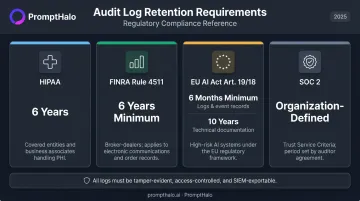
Logs must be tamper-evident, access-controlled, cryptographically verifiable, and exportable to your SIEM for each framework to accept them as evidence.
Enforcing Controls at Runtime
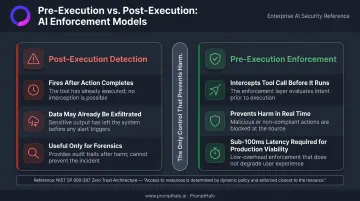
Pre-Execution Enforcement vs. Post-Execution Detection
This distinction matters more for agentic systems than anywhere else in security. By the time a post-execution alert fires, data may already have been exfiltrated or a destructive command completed. Post-execution detection is forensics — useful for understanding what happened, not for preventing it.
Real-time inline policy checks that intercept a tool call before it executes are the only control that actually prevents harm. NIST SP 800-207 builds this into the Zero Trust model: policy enforcement happens before access, not after. This is why latency matters for inline enforcement: checks that add 500ms per action don't survive production. PromptHalo's Runtime Security applies these inline policy checks at sub-100ms latency, making pre-execution enforcement viable at production scale without throttling agentic workflows.
Behavioral Anomaly Detection Alongside Rule-Based RBAC
Static rules catch known-bad patterns. Behavioral baselines catch novel deviations. Both are necessary.
Per-agent behavioral baselines should track:
- Typical tool invocation frequency
- Normal data volume accessed per session
- Expected delegation patterns and target agents
When significant deviations occur — an agent querying 10x its typical data volume, or delegating to an agent it's never contacted — automated containment (session suspension, token revocation) should trigger without waiting for analyst review. Analyst review at that point is triage, not prevention.
Treat Intermediate Artifacts as Production Data
The same runtime controls that govern live tool calls need to extend to what gets stored afterward. Reasoning traces, tool call histories, and cached outputs are a common leak vector that inline enforcement alone doesn't address. Engineers who cannot legally access the underlying dataset often have unrestricted access to trace viewers — which contain exactly that data.
Apply the same role-based enforcement to trace storage and access as to production data retrieval. Intermediate artifacts are not debugging infrastructure. They're regulated data in a different container.
Common RBAC and Audit Logging Mistakes to Avoid
Most failures in agentic AI security trace back to the same handful of missteps. These are the ones that show up repeatedly in post-incident reviews.
Skipping the authorization broker. Allowing agents to call tools directly with service credentials decouples the user's role from what the agent can actually do. The consequence isn't just a configuration error — it's regulatory exposure and incident attribution failure. When something goes wrong, you cannot reconstruct which user's intent produced which agent action.
Treating audit logging as a compliance checkbox. Teams that configure logging once at deployment and never validate completeness, tamper-evidence, or SIEM integration leave gaps that both attackers and auditors will find. Logging without real-time monitoring is post-incident forensics at best — it tells you what happened after the fact, not while it's happening.
Assuming output filtering is sufficient. In agentic workflows, intermediate steps may have already accessed, cached, or logged regulated content before output reaches the filtering layer. OWASP LLM02:2025 covers sensitive information disclosure in exactly this context. Access must be controlled at the action level — not only at the response layer.
Neglecting scope enforcement on tool calls. Agents granted broad tool permissions at provisioning time retain that access even as workflows evolve. Without per-action budget and scope enforcement, a low-risk workflow change can quietly expand an agent's blast radius into sensitive systems it was never meant to touch.
Frequently Asked Questions
How is RBAC for AI agents different from traditional RBAC for human users?
Traditional RBAC assigns static session-level roles — once authenticated, a user retains those permissions until logout. Agentic RBAC must enforce permissions at the per-action and per-tool-invocation level, with ephemeral credentialing and authority decay to prevent privilege accumulation across multi-step workflows where no re-authentication checkpoint exists.
What should every AI agent audit log include?
At minimum: agent identity and version, parent user identity, delegation scope, tool name with hashed parameters, policy decision (permit/deny with the matched rule), a trace ID linking distributed sub-actions, and a reasoning trace capturing the agent's intent before tool execution. Raw credentials and unmasked PII must never appear in log entries.
How do audit logs support compliance with NIST AI RMF or the EU AI Act?
Structured, tamper-evident logs satisfy NIST AI RMF's Govern 1.1, Measure 2.4, and Manage 4.3 functions by documenting monitoring, traceability, and incident tracking. Under the EU AI Act, Article 12 mandates automatic event recording for high-risk systems and Article 19 sets a six-month minimum retention period.
What is least privilege for AI agents, and how does it differ from the human-user version?
For agents, least privilege means granting only the permissions needed for the current task, with automatic expiration when that task completes. Unlike human users, agents chain actions dynamically and accumulate privileges across multi-step workflows with no re-authentication checkpoint — so ephemeral credentialing and authority decay are non-negotiable controls, not optional hardening.
How should audit logging work in multi-agent handoff scenarios?
Each handoff must log the originating agent's identity, permissions explicitly transferred (not inherited wholesale), delegation purpose, and duration constraints. Every subsequent action by the receiving agent must trace back through the full authority chain, so investigators can reconstruct exactly which delegation decision produced which outcome.
What is shadow agent discovery and why does it matter for RBAC programs?
Shadow agents — deployed by teams without security review — operate entirely outside established RBAC and audit frameworks. They aren't misconfigured systems; they're simply invisible to your governance controls entirely. IBM's 2025 data found one in five organizations experienced a breach due to shadow AI. Continuous discovery across SaaS, cloud, and endpoint environments is a prerequisite to enforcing any access control program — you cannot govern what you haven't found.