
Without proper audit logging, you cannot answer that question. The AI operated, but left no evidence trail. According to Gartner's 2025 survey, 29% of cybersecurity leaders reported attacks on enterprise generative AI infrastructure in the prior 12 months—and Gartner projects that by 2028, 25% of enterprise GenAI applications will experience at least five minor security incidents per year, up from 9% in 2025.
This guide covers what audit logging means in the context of generative AI, what specifically to capture, how to build a logging architecture that satisfies regulators, and the unique challenges posed by LLMs, RAG pipelines, and agentic systems.
Key Takeaways:
- GenAI audit logs must capture prompts, model versions, retrieved documents, guardrail decisions, and tool calls—not just final outputs
- Compliance-grade logs require immutability, structured schemas, and separation from the AI application they monitor
- Agentic AI demands pre-execution logging; post-hoc records miss the critical decision moment
- Regulatory frameworks including the EU AI Act, HIPAA, and SR 11-7 each carry specific logging and retention requirements
- Retrofitting logging onto a deployed AI system is expensive and incomplete—design for auditability from day one
What Is Audit Logging in Generative AI?
An AI audit log is a structured, chronological, tamper-resistant record of every AI system event: inputs, outputs, model version, decisions made, guardrail actions, tool calls, and metadata. Its purpose is to provide verifiable evidence of how and why the system behaved at any given moment — the kind that holds up in a regulatory examination or legal proceeding.
How GenAI Logging Differs from Traditional Application Logging
Traditional software is deterministic. Call the same function with the same inputs and you get the same output. You can reconstruct what happened by replaying the code path.
Generative AI does not work this way. As NIST AI 800-4 states, deployed AI outputs are non-deterministic—the same input conditions can produce a range of behaviors depending on model version, temperature settings, retrieved context, and conversation history. A single missing log field can make an incident impossible to reconstruct after the fact.
Audit logs for GenAI must therefore capture the full context of every decision — the model state, the retrieval results, the guardrail actions — not only the raw input and output.
Compliance-Grade Audit Trails vs. Operational Logging
Organizations routinely conflate two distinct logging needs, and end up with neither:
- Operational logs track performance, latency, errors, and debugging signals. They are useful for engineers and are often short-lived.
- Compliance-grade audit trails are structured, immutable, queryable records designed to satisfy regulators, auditors, and legal discovery. They answer: what did the AI decide, why, and under what conditions?
Architecturally, compliance records require separate storage, longer retention periods, cryptographic integrity, and strict access controls — requirements that operational logs are rarely built to meet.
What to Log in Generative AI Systems
The logging scope for GenAI is substantially broader than most teams expect — and gaps in any of these categories will leave you without the evidence you need when something goes wrong.
Core LLM Interaction Fields
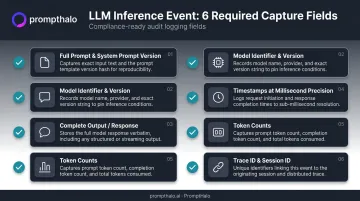
Every inference event should capture:
- Full prompt and system prompt (with version identifier)
- Model identifier and version
- Complete output or response
- Timestamps for both the start and end of inference, at millisecond precision
- Token counts — prompt, completion, and total
- Trace ID and session ID for correlating events across multi-turn conversations
RAG Retrieval Evidence
For retrieval-augmented generation architectures, the retrieved context is as important as the prompt itself. Log:
- Document identifiers, source, and version
- Retrieval timestamp and relevance scores
- Provenance metadata (which knowledge base, which index)
Without this, you cannot determine post-incident whether a poisoned or manipulated document influenced the AI's output.
Retrieval evidence answers what the model saw. Guardrail logs answer what your controls did about it.
Guardrail and Policy Enforcement Actions
This is the evidence layer that proves your safety controls worked. For every guardrail evaluation:
- Which guardrail triggered
- The detection confidence score
- The action taken: allow, restrict, challenge, or deny
- Whether a human override was applied
Tool Calls and Agentic Actions
For agentic systems, every external action must be logged before execution:
- Tool or API called, with full parameters
- Agent identity and passport credentials
- Authorization scope at time of call
- Response received
- Whether the action fell within the agent's permitted authority
Tool call logs capture what the agent did. Session and configuration metadata captures the context in which it acted — essential for reproducing incidents and demonstrating control to auditors.
Session and Configuration Metadata
- User identity and session identifiers
- Active system prompt version
- Model hyperparameters (temperature, sampling settings)
- Any human operator overrides
- Versions of libraries and external services active at decision time
LLM and Agentic AI: Unique Audit Logging Challenges
Standard logging practices were designed for deterministic software. Generative and agentic AI introduce several challenges that require purpose-built approaches.
Prompt Injection and Adversarial Input Evidence
OWASP LLM01:2025 defines prompt injection as user or external inputs that alter LLM behavior in unintended ways. Traditional logs capture what the system did, but not whether an adversarial input manipulated the behavior that led to it.
Audit logs for GenAI must capture attack indicators and preserve each element as a connected chain of evidence:
- Anomalous prompt patterns and policy violations attempted
- Out-of-character outputs linked to the specific input that triggered them
- Raw prompt content and system messages
- Retrieved context, filter decisions, and downstream actions
RAG Retrieval Poisoning
When retrieved documents influence AI outputs, those documents become part of the causal chain of every response they touch. Logging the retrieval record—source, version, retrieval timestamp, relevance score—enables post-hoc verification of whether a compromised document contributed to a problematic output.
Without document provenance in the audit log, RAG poisoning investigations are guesswork.
Multi-Agent Handoff Traceability
In agentic pipelines, one AI agent delegates tasks to another. Without explicit logging at each handoff boundary, accountability collapses in complex chains. Each handoff should record:
- Originating agent identity
- Delegated authority scope and any budget constraints
- Receiving agent identity
- Whether authority decay or scope reduction was enforced at the boundary
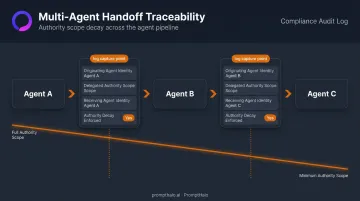
PromptHalo's Runtime Security solution addresses this by issuing signed agent security passports that travel with each request. Authority is scoped per action, budgets decay as agents operate, and the audit log captures the acting agent's passport identity at every decision point—creating a traceable chain across the entire agent pipeline.
Pre-Execution vs. Post-Hoc Logging
Agentic AI systems can execute consequential actions—sending emails, transferring data, calling APIs—faster than any human reviewer can intervene. Post-hoc logging records what happened after the fact, when remediation options are already limited.
Pre-execution logging captures the intended action before it runs, which is the only approach that creates a meaningful intervention point. PromptHalo enforces this by intercepting every inference, tool call, and agent-to-agent handoff inline, making a per-action security decision in under 100ms. Each decision is recorded with the reason, agent identity, session context, and timestamp before the action executes.
Hallucination and Factual Claim Logging
OWASP LLM09:2025 covers misinformation risk from false or misleading AI outputs. Organizations should log AI-generated factual claims with verification signals to support both accuracy monitoring and regulatory defensibility:
- Retrieval context used to ground the response
- Grounding scores and confidence signals
- User corrections or dispute events
- Timestamps linking claims to specific model versions
This record exposes systematic accuracy failures before they compound and gives compliance teams documented evidence when liability questions arise.
Best Practices for Generative AI Audit Logging
Design for Auditability Before Deployment
Retrofitting audit logging onto a running AI system is expensive and structurally incomplete. System prompts, model versions, and guardrail configurations must be under version control before logging is meaningful—because logs without versioned context cannot reconstruct decisions.
Build logging into the design phase. Define your required fields, schema, and retention tiers before the first production inference runs. Once that foundation is in place, immutability becomes the next non-negotiable.
Enforce Immutability and Tamper-Evidence
NIST SP 800-53 AU-9 requires that audit information and logging tools be protected from unauthorized access, modification, and deletion. For AI systems, this means:
- Append-only storage: once written, records cannot be altered
- Cryptographic integrity verification: protecting the log from undetectable modification
- Separate storage: audit records stored independently from the AI application they monitor
PromptHalo's audit logs are append-only and tamper-evident by design—once an event is written, it cannot be modified or removed, creating a replayable evidence trail for compliance exports and post-incident investigations.
Use Structured, Machine-Readable Log Schemas
Free-text logs are not auditable at scale. Every GenAI audit record should use a structured schema with defined fields. Industry standards like OpenTelemetry, OpenInference, and MLflow provide reference schemas—core fields should include:
| Field | Purpose |
|---|---|
timestamp |
Precise event time |
trace_id / session_id |
Correlation across multi-turn conversations |
model_id + version |
Reconstruct which model was used |
input / output |
Full prompt and response |
guardrail_actions |
Safety decisions and outcomes |
tool_calls |
Agent actions with parameters |
user_id |
Identity of the human or system initiating the request |
token_counts |
Usage and cost attribution |
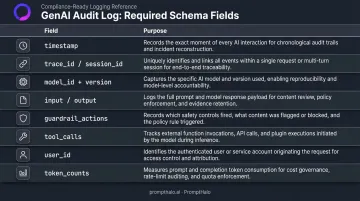
Structured schemas make the difference between a log you can query in under a minute and one that requires manual review across thousands of raw entries during an incident investigation.
Apply Tiered Retention Policies
Not all logs need the same lifespan. A practical tiered approach:
- Operational logs: 30–90 days of hot storage for debugging and performance monitoring
- EU AI Act (Articles 19 and 26): High-risk AI logs retained for a minimum of six months
- HIPAA Security Rule (45 CFR 164.316(b)(2)(i)): Documentation retained for six years from creation or last effective date
Separate operational logs from compliance audit records architecturally. Mixing them creates access control problems and muddies retention policy enforcement. That architectural separation also directly shapes who can touch those records — which brings access control into the picture.
Enforce Separation of Duties
AI system operators and model owners must not have the ability to modify or delete audit logs. Access to audit data should be:
- Role-based, with minimum necessary permissions
- Itself audited (audit the audit)
- Encrypted at rest and in transit
- Stored separately from the AI application being monitored
When the same team controls both the AI system and its audit records, the logs stop functioning as evidence — they become a liability. Enforcement here is structural, not procedural.
Regulatory Compliance and Framework Alignment
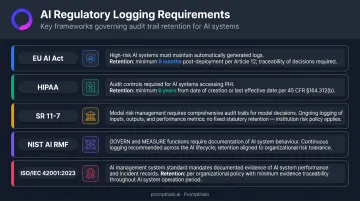
Key Regulatory Requirements
| Framework | Logging Requirement |
|---|---|
| EU AI Act (Art. 12, 19, 26) | Automatic event logs for high-risk AI systems; providers and deployers must retain logs for at least six months |
| HIPAA (45 CFR 164.312(b)) | Audit controls recording and examining activity in systems containing or using ePHI; documentation retained six years |
| SR 11-7 | Model development, implementation, and use documentation sufficient to support understanding, limitations, assumptions, and controls; ongoing monitoring and outcomes analysis |
| NIST AI RMF | GOVERN, MEASURE, and MANAGE categories address accountability, production monitoring, incident response, and documentation |
| ISO/IEC 42001:2023 | AI management system standard covering monitoring, risk management, lifecycle controls, transparency, and accountability |
Mapping Logs to OWASP LLM Threat Categories
Generic HTTP access logs cannot support investigations into AI-specific threats. Audit log design should explicitly address:
- LLM01 (Prompt Injection): Raw prompt, system messages, retrieved context, filter decisions, affected outputs
- LLM02 (Insecure Output Handling): Model output, destination component, validation result, blocked or executed action
- LLM04 (Data and Model Poisoning): Document provenance, ingestion time, retrieval results, output grounding
- LLM06 (Excessive Agency): User intent → agent plan → tool called → credentials used → authorization decision → outcome
What Regulators Actually Ask For
When an examiner reviews an AI system, they want the ability to replay a specific past decision with full context: what was the input, what did the system know, which model version ran, what did it decide, and what did it do. This requires structured, versioned, replayable records—not raw log files.
That's the standard to design toward. PromptHalo's audit logs capture each decision with its reason, agent identity, session context, and timestamp in an append-only, tamper-evident format — structured specifically for regulatory export and examination, with mappings to OWASP LLM Top 10, NIST AI RMF, and the EU AI Act built in.
Audit Log Architecture: From Design to Implementation
Core Architectural Components
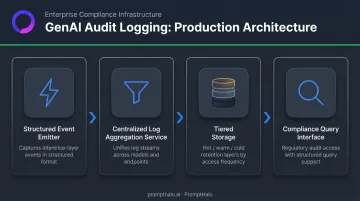
A production-grade GenAI audit logging system requires four components working together:
- Structured event emitter at the inference layer — captures every LLM call, guardrail evaluation, and tool invocation before or at the moment of execution
- Centralized log aggregation service — consolidates events across all AI services, models, and agent frameworks into a unified, searchable record
- Tiered storage — hot storage for recent records (active investigations), warm/cold tiers for older records subject to long-term retention requirements
- Compliance query interface — enables evidence export by user, session, model, document, tool call, or time range
Centralized Aggregation Across Multi-Model Environments
Most enterprises do not run a single AI model from a single vendor. Audit logging must aggregate across different LLM providers, RAG systems, and agent frameworks into one searchable record. Model-agnostic logging layers are architecturally preferable to model-specific implementations, because they remain consistent as the organization's AI stack evolves.
NIST SP 800-92 recommends centralized log management infrastructure specifically to improve analysis and retention consistency. In practice, this means a single query interface that can surface every agent action, tool call, and model response across your entire AI stack — regardless of which vendor or framework produced it.
Implementation Pitfalls to Avoid
Getting the architecture right is only half the problem. These are the most common logging failures that undermine incident investigation even in well-designed systems:
- Final outputs only — prompt injection, RAG poisoning, and excessive agency investigations all depend on intermediate evidence: the original prompt, retrieved documents, tool arguments, and authorization decisions. Log all of it.
- Application-layer logging — this misses guardrail evaluations, tool-call parameters, and agent handoff metadata entirely. Logging must happen at the inference layer.
- No session-level correlation — per-turn logs without a shared session ID make it nearly impossible to reconstruct what happened across a multi-turn interaction
- Storing logs in the same system as the AI application — this creates a conflict of interest and a single point of failure; as NIST AU-9 supports, audit records should be stored in a repository separate from the audited system
Frequently Asked Questions
What is an AI audit log?
An AI audit log is a structured, immutable record of every AI system event—inputs, outputs, model versions, decisions, guardrail actions, and tool calls. It provides accountable, queryable evidence of how the system behaved, designed for compliance reporting, security investigation, and regulatory examination.
How can AI be used in audits?
AI can accelerate audit processes by automatically classifying log entries, flagging anomalous decision patterns, and correlating events across large volumes of interactions. It can also generate structured reports mapped to specific regulatory requirements, turning raw log data into usable compliance evidence.
What should be included in a generative AI audit log?
Essential fields include: user identity, session ID, timestamp, full prompt and system prompt version, model ID and version, retrieved context documents (for RAG architectures), the generated output, guardrail decisions with confidence scores, tool calls with parameters, and any human overrides or approvals applied.
What makes generative AI audit logging different from traditional software logging?
Unlike deterministic software, generative AI outputs are probabilistic and context-dependent. Audit logs must capture prompts, retrieved documents, model versions, and safety decisions—not just function calls and errors—to enable meaningful reconstruction of any past AI decision.
How long should AI audit logs be retained?
Retention requirements vary by jurisdiction and industry. The EU AI Act requires at least six months for high-risk AI systems, HIPAA's Security Rule sets a six-year documentation baseline, and SR 11-7 requires sufficient records to support ongoing monitoring and outcomes analysis. Tier your storage infrastructure to match whichever applicable regulation is most stringent.
How do you ensure audit logs are tamper-proof?
Four controls are required:
- Append-only storage so records cannot be altered after writing
- Cryptographic integrity verification per NIST SP 800-53 AU-9
- Strict access controls preventing modification by system operators
- Architectural separation of the audit log infrastructure from the AI application it monitors