Introduction
Enterprise AI assistant adoption is outpacing compliance readiness by a wide margin. According to McKinsey's 2024 survey, 65% of organizations regularly use generative AI in at least one business function—yet only 18% have an enterprise-wide responsible AI governance council with actual authority. That gap is where compliance exposure lives.
The problem is structural, not just procedural. Enterprise AI assistants are not traditional software. They interpret natural language, retrieve context from connected data stores, call external APIs autonomously, and make decisions that affect customers, employees, and financial outcomes.
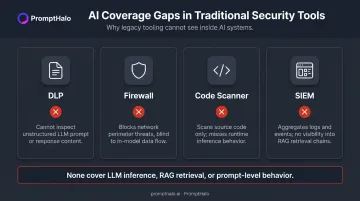
None of that behavior is visible to conventional security stacks. DLP tools, firewalls, and code scanners were built for a different threat surface entirely.
That mismatch between existing tooling and AI-native risk is exactly what this guide addresses. It covers the specific compliance risks that agentic AI assistants introduce, the regulatory frameworks that apply, how AI-native attack vectors convert into reportable compliance events, and what a defensible deployment program actually requires.
Key Takeaways
- Enterprise AI assistants introduce compliance risks traditional software never created: unauthorized data access, agentic scope creep, and missing decision-level audit trails
- The EU AI Act, NIST AI RMF, and OWASP LLM Top 10 now directly apply to AI assistant deployments in regulated industries
- Prompt injection and retrieval poisoning can escalate a security incident into a reportable compliance event within minutes
- Defensible compliance requires real-time monitoring and tamper-evident, decision-level audit logs—policy documents alone are not enough
Why Enterprise AI Assistants Create a Distinct Compliance Challenge
Traditional software compliance is largely about auditing code behavior and access controls. Enterprise AI assistants operate on different logic entirely: they interpret natural language, retrieve context dynamically from connected data stores, and call external APIs without explicit per-action human instruction. Their behavior at inference time cannot be predicted from their code.
The Agentic Action Problem
When an AI assistant executes a multi-step workflow—querying a customer database, drafting a disclosure, triggering a downstream payment API—each action creates a potential compliance touchpoint. Most platforms log none of these at the decision level. What happened, what context was retrieved, what the model reasoned from it, and what action it took are typically invisible after the fact.
Deloitte's 2026 survey of 3,235 leaders across 24 countries found that only 21% of organizations have mature governance for agentic AI—even as 74% expect at least moderate AI-agent use by 2027. That governance gap is closing fast, and the consequences for regulated industries are already concrete.
Why Existing Tools Miss AI-Specific Risks
- DLP tools inspect file transfers and outbound data flows—not LLM output streams or RAG retrieval responses
- Firewalls operate at the network layer and cannot inspect prompt-level behavior
- Code scanners analyze source code before deployment—they do not evaluate what a model decides at inference time
- SIEM platforms aggregate logs after the fact, but only if the AI layer generates structured logs in the first place
In financial services, healthcare, and payments, AI assistants now touch credit decisions, customer disclosures, and transaction approvals. The FTC, DOJ, CFPB, and EEOC issued a joint statement in April 2023 making clear that automated systems provide no regulatory cover—violations are violations, regardless of whether a model or a person made the decision.
That shifts the question from whether to address AI compliance risk to how fast organizations can build the infrastructure to do it.
The Top Compliance Risk Categories for Enterprise AI Assistants
Sensitive Data Leakage and Privacy Violations
AI assistants with access to enterprise data stores—CRM systems, HR records, financial databases—can surface or transmit restricted information through several vectors:
- Poorly scoped RAG retrieval that returns records the querying user has no right to see
- Prompt injection-driven exfiltration, where a crafted input redirects the assistant to output sensitive data
- Over-permissioned tool calls that give the AI access to data stores beyond its intended scope
A single query can cause an assistant to output PII, trade secrets, or protected health information to an unauthorized user. The EchoLeak vulnerability (CVE-2025-32711), a zero-click prompt injection exploit in Microsoft 365 Copilot, demonstrated that production AI assistants can be weaponized to exfiltrate data without any user interaction.
The regulatory consequences are immediate. GDPR Article 33 requires breach notification to supervisory authorities within 72 hours. HIPAA Security Rule safeguards apply any time an AI assistant processes electronic PHI. California's CPPA finalized automated decision-making technology regulations in September 2025, with significant-decision compliance requirements starting January 1, 2027.
PromptHalo's data leakage prevention capability addresses this by inspecting AI responses inline—before they reach the user—and enforcing data-access policy across multi-step and multi-session interactions, where data can otherwise leak gradually across conversation turns.
Algorithmic Bias and Discriminatory Outputs
Data leakage is only one dimension of AI compliance exposure. Outputs themselves carry liability—particularly when AI assistants trained on or augmented with biased data discriminate based on protected characteristics. In HR, lending, and customer service contexts, regulators treat bias from a deployed AI system the same as bias from a human decision-maker.
The Derek Mobley v. Workday, Inc. case (Case No. 23-cv-00770-RFL) illustrates the exposure. A July 2024 order allowed discrimination claims to proceed under an agency theory against the AI hiring tool vendor, and a May 2025 decision allowed the lawsuit to proceed as a class action. Amazon scrapped an internal AI recruiting tool in 2018 after it demonstrated systematic bias against women—including penalizing resumes that contained the word "women's."
The regulatory exposure spans multiple frameworks:
- EU AI Act: AI assistants providing "recommendations" rather than final decisions can still constitute a regulated automated decision-making process
- CFPB Circular 2022-03: Creditors using complex algorithms must provide specific adverse-action reasons under ECOA and Regulation B — algorithmic complexity is not an exemption
- Title VII / ECOA: Direct liability applies to discriminatory outputs in hiring, lending, and customer service contexts
Lack of Audit Trails and Decision Transparency
Most enterprise AI assistants generate no decision-level audit log. There is no record of what context was retrieved, what tool calls were made, or what reasoning led to a specific output. In a regulatory examination, that absence is itself a compliance deficiency—independent of whether any harm occurred.
The frameworks requiring traceability are specific:
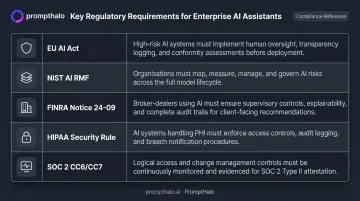
| Framework | Relevant Requirement |
|---|---|
| EU AI Act (Articles 9, 12, 13) | Automatic logging, technical documentation, transparency obligations for high-risk AI |
| NIST AI RMF | Measure and Manage functions require output monitoring and incident response |
| FINRA Notice 24-09 | GenAI use subject to supervision, recordkeeping, and communications obligations |
| HIPAA Security Rule | Audit controls apply when AI processes ePHI |
| SOC 2 (CC6/CC7) | Access, monitoring, and processing integrity criteria apply to AI system controls |
For teams facing this gap, PromptHalo captures each decision along with its reason, the acting agent or passport identity, session and tenant context, and timestamp. Logs are append-only and tamper-evident — once written, they cannot be modified — creating a replayable evidence trail for regulatory review and post-incident investigation.
Unauthorized Actions and Agentic Scope Creep
Agentic AI assistants with tool-calling capabilities can take actions well beyond their intended scope—sending emails, modifying records, executing financial transactions—if their authority is not explicitly bounded. OWASP LLM06:2025 defines this as "excessive agency": risk arising from granting LLM systems excessive functionality, permissions, or autonomy.
The compliance implications are dual:
- SOX/internal controls: Unauthorized automated execution of financial-reporting transactions can violate SEC rules implementing SOX Section 404 and PCAOB standards requiring documented automated control assessment
- Contractual obligations: An AI assistant that modifies records or triggers transactions outside its defined scope may violate data processing agreements or service contracts
Security passports — signed credentials that travel with each agent request — contain embedded policy, budget, and authority scope, giving PromptHalo granular control over what each agent can do. Authority decay shrinks permissions over time, number of steps, and accumulated risk exposure, forcing re-authorization when any threshold is exceeded.
Third-Party Model and Supply Chain Risks
Enterprises typically deploy AI assistants built on foundation models or retrieval pipelines they do not fully control. If the underlying model has been fine-tuned with poisoned data, has known jailbreak vulnerabilities, or transmits data to external endpoints, the enterprise bears compliance liability even when the technical failure originated upstream.
KPMG's 2024 survey of senior leaders at companies with $1B+ revenue found 76% cited data privacy and security risk and 52% cited regulatory non-compliance risk as concerns when engaging external partners for AI solutions. NIST AI 600-1 specifically includes guidance to inventory foundation models, versions, and data provenance. OWASP LLM03:2025 and LLM04:2025 cover supply-chain vulnerabilities and data and model poisoning as distinct risk categories.
Because PromptHalo operates as an external security layer, it requires no access to the underlying model. Its red-teaming capability continuously probes RAG layers and tool chains for exploitable paths, with discovered attack patterns encoded into a shared Threat Library that trains the runtime enforcement engine — so protection compounds as new threats emerge.
How AI-Native Attack Vectors Become Compliance Events
Security incidents at the AI layer do not stay contained to IT. They convert into regulatory events quickly.
Three attack vectors drive most of these conversions:
- Prompt injection — A crafted input overrides the AI assistant's system prompt, directing it to exfiltrate sensitive records, bypass access controls, or take unauthorized actions. Each outcome maps to a regulatory trigger: GDPR Article 33 breach notification, a fair lending violation, or an unauthorized transaction under SOX. CVE-2025-32711 (EchoLeak) demonstrated this in a live Microsoft 365 Copilot environment.
- Retrieval poisoning (RAG poisoning) — Corrupted source documents cause the AI to produce decisions based on manipulated information. In a KYC check, credit risk assessment, or regulatory disclosure workflow, a poisoned retrieval creates a materially incorrect output and triggers regulatory liability — no network intrusion required.
- Jailbreaking and policy bypass — Users extract model behavior that violates organizational policies, data governance rules, or regulatory prohibitions. Because the output comes from the enterprise's deployed system, the enterprise is accountable — regardless of who crafted the prompt.
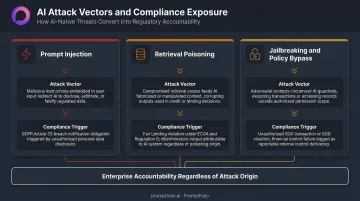
That accountability gap is where runtime enforcement matters. PromptHalo sits inline on every inference, tool call, and agent-to-agent handoff — blocking these attacks before they execute and logging every decision in tamper-evident audit trails mapped to OWASP LLM Top 10, NIST AI RMF, and the EU AI Act.
Regulatory Frameworks Every Enterprise Must Map Against
EU AI Act
Regulation (EU) 2024/1689 classifies AI systems used in employment, creditworthiness, education, and essential services as high-risk, requiring:
- Mandatory conformity assessments before deployment
- Automatic logging sufficient to reconstruct decisions post-hoc
- Human oversight mechanisms
- Detailed technical documentation
- Transparency obligations toward affected individuals
Non-compliance penalties reach EUR 35 million or 7% of global annual turnover for prohibited practices. The enforcement timeline is phased, but high-risk system requirements are already active for many categories.
NIST AI Risk Management Framework
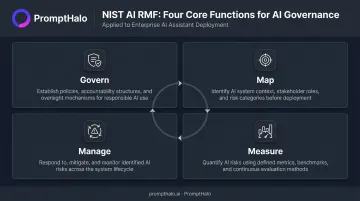
Where the EU AI Act sets legal minimums, NIST AI RMF gives enterprises a practical operating structure. Its four functions map directly to AI assistant governance:
- Govern: Define AI system roles, accountability chains, and organizational policies
- Map: Identify the context, intended use, and potential harms of each AI system
- Measure: Monitor outputs for accuracy, drift, and adverse impacts
- Manage: Maintain incident response playbooks for AI-specific failure modes
NIST AI 600-1 (the GenAI Profile) adds specific actions including foundation model inventory, adversarial red-teaming, and logging of errors and negative impacts.
OWASP LLM Top 10
Beyond governance frameworks, OWASP LLM Top 10 (Version 2025) addresses the attack surface directly — and is the primary security reference for LLM-based enterprise applications. Key risks include:
- LLM01: Prompt Injection
- LLM03: Supply Chain Vulnerabilities
- LLM04: Data and Model Poisoning
- LLM06: Excessive Agency
- LLM08: Vector and Embedding Weaknesses
Mapping internal controls to OWASP LLM Top 10 is becoming a baseline expectation in enterprise AI procurement and vendor security assessments.
Industry-Specific Regulatory Overlays
Horizontal frameworks like NIST and OWASP establish the foundation — but regulated industries carry additional obligations that sit on top of them. Failing to account for these sector-specific rules is where many compliance programs break down in practice:
- FINRA Notice 24-09: GenAI use by broker-dealers remains subject to supervision, recordkeeping, and suitability obligations
- GDPR Article 22 / CCPA ADMT: Explicit restrictions on solely automated decisions with legal or similarly significant effects
- HIPAA Security Rule: Risk analysis, access controls, audit controls, and transmission security apply when AI processes ePHI
- SOC 2 Type II: CC6/CC7 criteria increasingly require evidence of AI system controls for access, monitoring, and processing integrity
In a financial services audit, for instance, examiners will pull on FINRA and CCPA obligations regardless of how thorough your NIST AI RMF documentation is.
Building a Compliance-Ready Enterprise AI Deployment Program
Risk Assessment Before Deployment
Start with an inventory: every AI assistant in use, classified by the sensitivity of data it can access and the autonomy of actions it can take. For each system, assess:
- What data stores does it have access to, and is that access scoped correctly?
- What tool calls can it make, and are those bounded by explicit authority limits?
- What is the likelihood and potential impact of each compliance risk category?
This process recurs continuously—AI systems drift, integrations change, and new attack patterns emerge after launch.
Governance Roles and Accountability Structures
Effective compliance programs assign named human ownership for AI system outputs—someone identifiable when a decision is challenged. Both NIST AI RMF and the EU AI Act require documented governance structures with verifiable accountability, not just written policies on a shelf. Key elements:
- Named responsible owner per AI system
- Documented escalation paths for AI-related incidents
- Clear human oversight mechanisms for high-risk AI decisions
- Regular governance reviews as the system's scope or integrations change
Continuous Monitoring and Evidence-Grade Audit Logging
This is where most organizations currently fail. Application-level logging captures user interactions. Decision-level audit trails capture what context the AI retrieved, what action it took, and why. That distinction matters: regulators don't audit chat logs—they audit decisions.
For agentic AI, monitoring must cover:
- Every inference and model response
- Every tool call and its outcome
- Every agent-to-agent handoff in multi-agent workflows
- Any re-authorization event triggered by authority decay
Logs must be tamper-evident, append-only, and replayable for regulatory review. PromptHalo's runtime monitoring covers each of these touchpoints inline, generating decision-level logs that capture the reason for each decision, agent identity, session context, and timestamp in a format built for compliance export and regulatory examination.
Frequently Asked Questions
What are the compliance concerns associated with AI?
The four core categories are: bias and discrimination in automated decisions, privacy risks from data collection and use, lack of transparency in how AI reaches conclusions, and accountability gaps when AI-driven decisions cause harm. Severity varies by industry and how much autonomy the AI system exercises.
What is the main security concern when using AI assistants in enterprise environments?
Prompt injection is the most critical concern—it allows attackers to override an AI assistant's instructions and direct it to take unauthorized actions or disclose sensitive data. Unlike traditional vulnerabilities, it exploits the AI's own instruction-following behavior, making it invisible to conventional security tools.
How does prompt injection create a compliance violation?
When prompt injection causes an AI assistant to exfiltrate records, bypass access controls, or produce a false output in a regulated workflow, the enterprise is accountable for the resulting harm. That accountability holds whether the outcome is a data breach notification, a fair lending violation, or an unauthorized transaction, even when the root cause was an AI-layer attack.
Which regulatory frameworks directly apply to enterprise AI assistant deployments?
The EU AI Act (particularly high-risk AI classifications for HR, credit, and essential services), NIST AI RMF, and OWASP LLM Top 10 form the horizontal baseline. Most regulated enterprises must also satisfy FINRA, GDPR, CCPA, or HIPAA requirements simultaneously, depending on their sector and geography.
What kind of audit trail do regulators expect for AI-assisted decisions?
Regulators expect decision-level audit trails capturing what data was retrieved, what the AI reasoned from it, what action was taken, and whether a human reviewed the output. Tamper-evident, replayable logs mapped to specific regulatory controls (not just application activity logs) are the evidentiary standard emerging from the EU AI Act and NIST AI RMF.