Introduction
Enterprises are deploying AI faster than compliance programs can track it. Security and legal teams heading into 2026 face a concrete set of deadlines: EU AI Act high-risk obligations take effect in August, Colorado's algorithmic discrimination requirements go live in February, and US federal procurement is increasingly citing the NIST AI RMF in vendor evaluations.
The problem isn't a shortage of governance principles. Most enterprise AI programs have those. The gap is operational: missing audit trails, ungoverned agentic workflows, and AI inventories that don't reflect what's actually running in production.
This guide is a practical compliance checklist structured by functional domain — governance, data privacy, security controls, agentic AI-specific risks, and audit logging — so teams can close operational gaps without waiting for a legal interpretation of every applicable statute. The output is a defensible AI program built to hold up under regulatory scrutiny.
Key Takeaways
- EU AI Act high-risk obligations apply from August 2026, with fines up to €35M or 7% of global turnover for prohibited practices
- An incomplete AI inventory is the most common compliance gap found in enterprise readiness assessments
- Agentic AI introduces attack surfaces (prompt injection, tool misuse, RAG poisoning) that static governance documents cannot address
- Compliance-grade audit logs differ from operational logs: they must capture decision rationale, agent identity, and tool calls
- Technical controls reduce live exposure immediately; governance documentation can catch up
Why AI Compliance Can't Wait: The Regulatory Stakes in 2025–2026
The EU AI Act entered into force in August 2024. Prohibitions on unacceptable-risk AI practices applied from February 2025. General-purpose AI and governance requirements from August 2025. Most high-risk AI system obligations — logging, human oversight, conformity assessments — apply from August 2026. Treat that date as an execution deadline.
What Non-Compliance Actually Costs
Under Article 99 of the EU AI Act, penalty tiers are:
| Violation Category | Maximum Fine |
|---|---|
| Prohibited AI practices | €35M or 7% of global annual turnover |
| High-risk system obligations | €15M or 3% of global annual turnover |
| Incorrect or misleading information | €7.5M or 1% of global annual turnover |
These are not sector-specific fines — they apply across industries.
The Extraterritorial Trap US Enterprises Miss
The EU AI Act's scope mirrors GDPR's architecture. Article 2 applies to any provider where the AI system's output is used in the EU — regardless of where the company is headquartered. The operative question is whether EU users consume your AI outputs, not whether you have an EU legal entity.
US-only enterprises that serve EU customers, work with EU-based partners, or sell through platforms reaching EU users are already in scope.
The US Regulatory Picture
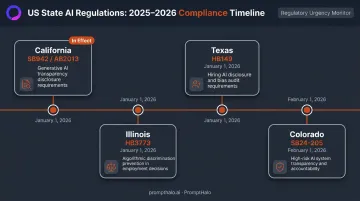
State-level obligations are operationalizing fast:
- Colorado SB24-205: High-risk AI deployers must implement risk-management programs and conduct impact assessments for algorithmic discrimination, effective February 1, 2026
- Illinois HB3773: Employer AI use in hiring decisions regulated from January 1, 2026
- Texas HB149: The Texas Responsible AI Governance Act, effective January 1, 2026, with an affirmative defense for organizations that substantially comply with NIST AI RMF
- California SB942 and AB2013: Generative AI transparency and training-data disclosure requirements already in effect
Financial services firms face an additional layer: the Federal Reserve's SR 26-2 and OCC Bulletin 2026-13 updated model risk management guidance in April 2026, applying directly to AI and ML systems used in credit, fraud, and operations decisions.
Key Compliance Frameworks Every Enterprise AI Team Must Understand
No single framework covers all obligations. Enterprises that treat these as alternatives rather than overlapping layers end up with gaps.
| Framework | What It Does | Key Enterprise Obligation |
|---|---|---|
| EU AI Act | Binding risk-tiered regulation | Prohibited/high-risk/GPAI classification, logging, human oversight, penalties |
| NIST AI RMF 1.0 | Voluntary governance structure | Govern, Map, Measure, Manage functions; cited in Texas safe harbor and federal procurement |
| GDPR / CCPA | Data privacy | Legal basis for AI data processing, automated decision rights, data subject requests |
| OWASP LLM Top 10 (2025) | AI security taxonomy | LLM01 Prompt Injection, LLM06 Excessive Agency, LLM07 System Prompt Leakage |
The 2025 OWASP edition renumbered several risks: LLM06 is now Excessive Agency (over-permissioned agentic systems) and LLM07 is System Prompt Leakage — not the "Insecure Plugin Design" label from earlier versions. Documentation citing outdated numbering will create audit confusion.
Financial services enterprises carry additional surface area beyond these four frameworks:
- SR 11-7 / SR 26-2 — Model risk governance requirements covering AI validation and documentation
- CFPB adverse-action rules — AI credit decisions must meet specificity standards that generic model outputs often fail
- FINRA Notice 24-09 — Existing supervision and records obligations apply to generative AI use without exception
The practical response is to build one evidence set — AI inventory, risk assessments, oversight design, log retention, incident procedures — and map it across all applicable frameworks simultaneously. Teams that maintain separate documentation per framework spend audit cycles recreating artifacts instead of closing gaps.
The Enterprise AI Compliance Checklist
This checklist is organized by functional domain. Each domain maps to one or more frameworks to support rapid regulatory cross-referencing.
Governance and AI Inventory
Frameworks: EU AI Act, NIST AI RMF (Govern), Colorado SB24-205
- Establish a centralized AI system registry documenting every model, tool, and dataset in production — including third-party APIs and shadow AI introduced by business units
- Assign named owners and risk classifications (low/medium/high) to each registered system
- Designate an executive accountable for AI governance with a cross-functional committee reporting to the board
- Maintain an AI acceptable use policy that is documented, communicated, and reviewed at minimum annually
An incomplete or stale inventory is the single most common compliance gap found in enterprise readiness assessments. You cannot classify, govern, or audit systems you haven't catalogued. This is the starting point — not an administrative formality.
Vendor management note: Third-party AI tool compliance must be verified at procurement and reviewed periodically. Vendor marketing claims are not compliance evidence. EU model contractual clauses for AI procurement have been updated to align with the AI Act and provide a template for this vetting process.
Data Privacy and Protection
Frameworks: GDPR, CCPA, EU AI Act (transparency obligations)
- Document the legal basis for all data processing activities involving AI (consent, legitimate interest, contractual necessity)
- Conduct Privacy Impact Assessments for AI systems that process personal data
- Enforce data minimization and purpose limitation in training data pipelines
- Ensure user rights — access, deletion, correction — can be fulfilled for data used in AI inference
- Implement cross-border data transfer mechanisms where training or inference data crosses jurisdictions
GDPR and CCPA compliance for AI goes beyond standard data protection. For automated decisions affecting hiring, credit, or insurance, enterprises must also be able to explain those decisions, provide appeal pathways, and document how individual data subjects can challenge AI-driven outcomes.
PromptHalo's data leakage prevention enforces data-access policy in real time so protected data isn't surfaced in AI responses — including across multi-step and multi-session agentic interactions where gradual data exposure is particularly difficult to track.
Security and Technical Controls
Frameworks: OWASP LLM Top 10, NIST AI RMF (Measure), EU AI Act (Article 14)
- Implement access controls and encryption for all AI infrastructure, data at rest, and data in transit
- Deploy input validation and output filtering to prevent harmful or policy-violating AI responses
- Establish PII detection and redaction mechanisms on AI outputs
- Conduct regular adversarial testing — red teaming — for prompt injection, jailbreaking, and unauthorized tool call behavior
- Maintain a kill-switch or emergency shutdown capability for high-risk AI systems
Traditional firewalls, DLP, and code scanners were not designed to detect AI-native attack vectors. Prompt injection, retrieval poisoning, and unauthorized agent tool calls don't look like traditional network intrusions — they arrive as seemingly valid inputs and execute through model behavior. Purpose-built controls are required, not retrofitted ones.
PromptHalo's AI red teaming covers adversarial task chains across multi-step, multi-agent workflows, including prompt injection, jailbreak, poisoning, and data leakage probes. Reports map findings to specific risk scenarios with prioritized, actionable fixes — so security teams spend time remediating, not triaging raw output.
Transparency, Human Oversight, and Incident Response
Frameworks: EU AI Act (Articles 13, 14), Colorado SB24-205, NIST AI RMF (Govern)
- Inform users when they are interacting with an AI system; label AI-generated content where required
- Provide explanation interfaces or appeal pathways for AI decisions that materially affect users
- Establish human-in-the-loop validation for AI outputs in high-stakes domains: lending, hiring, healthcare, fraud detection
- Document and test an AI incident response plan covering hallucination reports, biased decision reversals, unauthorized access events, and regulatory disclosure timelines
One point regulators consistently push back on: "human oversight" must be operationally real, not nominal. EU AI Act Article 14 requires named individuals with actual authority to override AI outputs — the ability to disregard, override, reverse, interrupt, or stop use. A policy statement that oversight exists is not the same thing.
Agentic AI Compliance: The Gap Most Enterprise Programs Miss
Gartner predicts that 40% of enterprise applications will include task-specific AI agents by 2026, up from less than 5% in 2025. The same firm predicts over 40% of agentic AI projects will be canceled by end-2027 — primarily due to inadequate risk controls. Deployment is accelerating. Governance isn't keeping pace. That's where compliance exposure accumulates.
Why Traditional Frameworks Don't Cover This
Existing AI compliance frameworks were designed for predictive models and static chatbots. They don't account for agents that:
- Autonomously call external tools and APIs
- Execute multi-step workflows across multiple systems
- Retrieve from dynamic knowledge bases (RAG)
- Hand off tasks to other agents with context carrying across sessions
Each of these capabilities introduces a distinct compliance exposure. A governance document that describes what an agent is permitted to do cannot enforce it at runtime.
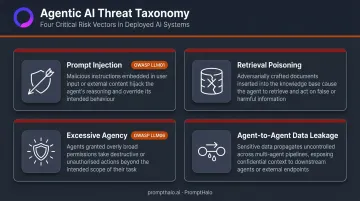
The Specific Risk Vectors
- Prompt injection (OWASP LLM01): Malicious inputs alter agent behavior mid-workflow. CVE-2024-5184 documents a real prompt injection vulnerability in EmailGPT; research on EchoLeak (CVE-2025-32711) described a zero-click indirect prompt injection path affecting an enterprise AI assistant connected to organizational data
- Retrieval poisoning: RAG pipelines feed malicious or misleading content into agent reasoning, corrupting downstream decisions
- Excessive agency (OWASP LLM06): Over-permissioned agents take damaging actions through tools, functions, or APIs beyond their intended scope
- Agent-to-agent data leakage: Sensitive context passes between agents without appropriate controls across handoffs
What Agentic AI Compliance Requires in Practice
Each of these risk vectors requires enforcement at the moment of action — not a policy document reviewed quarterly. Effective agentic AI compliance means runtime controls:
- Scope enforcement: Agents access only tools, data, and APIs within pre-authorized boundaries
- Authority decay: Agent permissions narrow over time as task scope resolves, rather than persisting indefinitely
- Per-action budget controls: Resource usage limits prevent runaway tool calls
- Security passports: Signed credentials that travel with each agent request, enabling verification of instruction legitimacy at each handoff step
PromptHalo's runtime security sits inline on every inference, tool call, and agent-to-agent handoff — making allow, restrict, challenge, deny, or monitor decisions in under 100ms, without model access or code rewrites. In a multi-agent commerce workflow, each agent request carries a signed security passport with policy, budget, and authority decay built in. An agent authorized to browse a catalog and add items to a cart cannot escalate to payment processing; the action is blocked at the enforcement layer, not deferred to a policy document.
This enforcement model directly addresses regulatory requirements. NIST AI RMF's Govern and Measure functions require AI systems to behave within defined bounds. EU AI Act Article 14 human oversight requirements cannot be practically satisfied if agents take consequential actions faster than any human reviewer — without inline controls, those obligations remain theoretical.
Audit Logging and Reporting: The Compliance Backbone Regulators Will Examine
Governance principles without audit trails aren't compliance evidence — they're intentions. Regulators examine the record, not the policy.
What Regulations Require
Key regulatory requirements span multiple frameworks:
- EU AI Act Article 12 requires automatic event logging for high-risk AI systems, with records sufficient for traceability
- EU AI Act Article 19 requires providers to retain automatically generated logs for at least six months, unless applicable law specifies longer
- NIST AI RMF (Govern function) requires documented traceability of AI decisions
- Financial services regulators expect model documentation capable of supporting forensic investigation under SR 11-7 and equivalent guidance
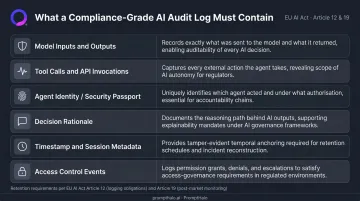
What a Compliance-Grade AI Audit Log Must Contain
| Log Element | Why It Matters |
|---|---|
| Model inputs and outputs | Basic traceability for all AI systems |
| Tool calls and API invocations | Essential for agentic systems; often absent from standard APM tools |
| Agent identity / security passport | Links actions to authorized principals |
| Decision rationale | Supports adverse-action explanations and human override documentation |
| Timestamp and session metadata | Enables timeline reconstruction |
| Access control events | Demonstrates enforcement of authorization policies |
Operational Logs vs. Compliance Logs
Most enterprises have operational logs. Very few have compliance-grade logs.
Operational logs monitor system health — latency, errors, throughput. Compliance logs provide regulatory evidence: what decision was made, by which agent or model, on what input, under what authorization, with what outcome. They must be tamper-evident (events cannot be modified after writing), replayable (the decision sequence can be reconstructed), and retained for the applicable regulatory window.
PromptHalo's audit logging is append-only and tamper-evident by design. Every decision is captured with its reason, the acting agent's passport identity, session and tenant context, and timestamp — creating a replayable evidence trail suited for compliance export and post-incident investigation.
How to Prioritize and Execute Your AI Compliance Program
Most enterprise security teams cannot tackle everything simultaneously. Sequencing matters.
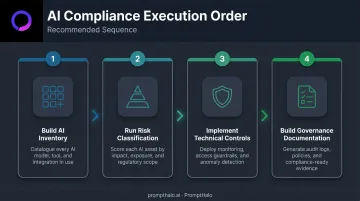
The Execution Order
- Start with the AI inventory — govern what you've catalogued, nothing else
- Run risk classification using EU AI Act tiers or NIST AI RMF categories — identify your two or three highest-risk systems and concentrate initial controls there
- Implement technical controls first (access control, PII detection, red teaming, runtime enforcement) — these reduce live exposure immediately while documentation catches up
- Build governance documentation that maps to multiple frameworks simultaneously — one evidence set, multiple regulatory mappings
On Ongoing Operations
AI compliance is not a project with a completion date. Enterprises that treat the first audit cycle as the end state will find themselves rebuilding from scratch when regulators return or frameworks update.
Lightweight structures sustain better than heavy ones:
- A chartered AI governance committee with explicit decision authority
- A living AI registry updated continuously, not annually
- Quarterly risk reviews focused on new deployments and material changes
The Cost Framing
That governance continuity also has a direct financial argument behind it. IBM and Ponemon's 2025 data breach research reports a global average breach cost of $4.44M, with shadow AI involvement associated with higher costs (around $4.63M average). Compare that against EU AI Act Article 99 penalty exposure — up to 7% of global annual turnover for prohibited practices — and the investment case is concrete, not theoretical.
The controls that satisfy regulators also reduce incident exposure, prevent costly production rollbacks, and protect the enterprise's ability to expand AI features into regulated markets. Compliance infrastructure and risk reduction aren't separate budget lines — they're the same spend.
Frequently Asked Questions
What regulations apply to enterprise AI compliance in the US in 2026?
US enterprises face NIST AI RMF (voluntary but cited in federal procurement and Texas's affirmative defense), state laws including Colorado SB24-205 (February 2026), Illinois HB3773 (January 2026), and Texas HB149 (January 2026), plus the EU AI Act's extraterritorial reach for any AI output consumed by EU users. Financial services firms additionally face SR 26-2, OCC Bulletin 2026-13, and CFPB adverse-action guidance for AI credit decisions.
What is the difference between AI governance and AI compliance?
Governance is the internal structure (policies, roles, accountability frameworks, and risk management processes) that organizations build to manage AI responsibly. Compliance is the external obligation to meet specific regulatory and legal requirements. Effective compliance requires governance as its foundation; you cannot demonstrate regulatory adherence without the internal structures to evidence it.
How is agentic AI compliance different from traditional AI compliance?
Traditional compliance frameworks were designed for models that receive inputs and return outputs. Agentic AI systems take autonomous actions (tool calls, API executions, multi-agent handoffs) that static governance documents cannot control in the moment. Agentic compliance requires runtime enforcement on every action, scope controls, authority decay, and audit logs capturing the full decision chain, not just final inputs and outputs.
How often should enterprises conduct AI compliance audits?
High-risk AI systems require continuous monitoring, not periodic spot checks; EU AI Act post-market monitoring requirements make one-time audits insufficient. Formal compliance reviews should occur at least annually and whenever material changes occur to a model, its training data, or its intended use case. Treat compliance as an operational discipline with ongoing review cycles, not a project milestone.
What should an enterprise AI audit trail include for regulatory purposes?
At minimum: tamper-evident logs of all model inputs, outputs, tool calls, and agent actions; decision rationale with agent identity and authorization context; and retention periods aligned to applicable regulations (minimum six months under EU AI Act Article 19). Compliance-grade logs go beyond operational monitoring by capturing policy enforcement decisions, not just performance data.
Can existing security tools handle AI compliance requirements?
No. Traditional firewalls, DLP, and code scanners were built for network threats, not AI-native attack vectors like prompt injection, retrieval poisoning, or unauthorized tool calls. These attacks arrive through valid input channels and execute through model behavior, making them invisible to signature-based detection. Agentic AI deployments require purpose-built runtime controls with compliance-grade logging across every inference and agent action.