Introduction
Organizations are deploying AI to automate compliance workflows at scale — and creating an entirely new category of risk in the process. The AI systems meant to make compliance easier are themselves generating exposures that traditional GRC tools, firewalls, and DLP solutions were never built to see.
This creates a dual obligation that most compliance programs haven't fully reconciled: you need AI to manage compliance at scale, and you need to keep your AI deployments compliant with fast-moving regulations like the EU AI Act, NIST AI RMF, and an expanding patchwork of state-level laws.
According to PwC's 2025 Global Compliance Survey, 85% of organizations say compliance requirements became more complex in the prior three years, yet 71% believe AI will have a net positive impact on compliance operations. Both things are true simultaneously — and navigating that tension is what this guide is about.
What follows is a practical breakdown of the risks, frameworks, and program-level steps that matter most right now.
Key Takeaways
- AI compliance covers two parallel obligations: governing the AI you use and using AI to govern your compliance program
- The EU AI Act, NIST AI RMF, and ISO 42001 are the three most consequential frameworks shaping enterprise AI compliance strategy
- AI-native risks — prompt injection, retrieval poisoning, and opaque automated decisions — require controls that go beyond traditional GRC and security tooling
- Agentic AI creates real-time compliance exposure at the moment of execution, not just at the design stage
- Decision-level audit trails are the compliance foundation under the EU AI Act and NIST AI RMF
What Is AI Compliance and Risk Management?
AI compliance is the process of ensuring that all controls, practices, and system designs related to developing and deploying AI meet applicable laws, regulations, and internal governance standards — spanning both transparency and security.
Three related concepts often get conflated, but they're distinct:
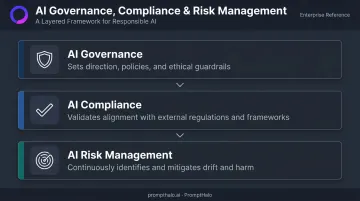
- AI governance — the internal, proactive strategy for responsible AI use; sets policies, accountability structures, and ethical guardrails
- AI compliance — alignment with external regulations and frameworks; proves that governance commitments are being met
- AI risk management — the continuous, operational process of identifying and mitigating harm from AI systems
Think of them as layers: governance sets the direction, compliance validates that you're on track, and risk management catches drift before it becomes a regulatory event.
Why AI Demands Specialized Compliance Attention
Conventional software compliance assumes deterministic outputs, fixed logic, and stable behavior. AI systems break all three assumptions:
- They learn from data, meaning behavior can shift as inputs change
- They produce probabilistic outputs that are inherently harder to predict and audit
- They can be manipulated through ordinary-looking inputs
- They make consequential autonomous decisions that are difficult to reconstruct after the fact
A misconfigured database is a compliance problem with a clear cause and a clear fix. An AI model that drifts into discriminatory outputs over time, with no visible system change triggering the shift, is a different category of problem — one that most traditional tooling was never built to catch.
The AI Risk Landscape: Threats Compliance Teams Cannot Ignore
Training Data and Intellectual Property Risk
AI models trained on unlicensed or improperly acquired data expose organizations to copyright liability and data protection violations. This is no longer theoretical.
In 2025, a U.S. court ruled in Thomson Reuters v. ROSS Intelligence that using Westlaw headnotes to train a competing AI legal research tool was not fair use — infringing 2,243 headnotes. That same year, Anthropic settled a class action brought by authors alleging copyright infringement tied to AI training data.
Organizations procuring or building AI systems need to verify training data provenance, document the legal basis for data use, and assess ongoing copyright and GDPR exposure before deployment.
Bias, Discrimination, and Fairness Failures
Biased training data produces biased outputs — and in consequential decisions, that's both a legal and a regulatory problem.
In 2023, the EEOC required iTutorGroup to pay $365,000 after its recruiting software allegedly rejected applicants automatically based on age. In healthcare, research published in Science found a widely used health-risk algorithm systematically underserved Black patients — correcting the bias would have increased the share receiving additional care from 17.7% to 46.5%.
Under the EU AI Act, AI systems used in hiring, credit, healthcare triage, and similar high-stakes domains are classified as high-risk, triggering mandatory bias testing and human oversight requirements.
Transparency and Explainability Failures
The "black box" problem is a compliance problem. When an organization cannot explain how its AI reached a decision, it cannot defend that decision to regulators, customers, or courts.
GDPR Articles 13, 14, and 15 require controllers to provide meaningful information about the logic and consequences of automated decision-making. The EU AI Act's Article 13 mandates that high-risk systems be designed so deployers can interpret outputs. The CFPB's Circular 2022-03 makes clear that "we don't understand our model" is not a valid defense for failing to provide specific adverse-action reasons.
AI-Native Security Vulnerabilities
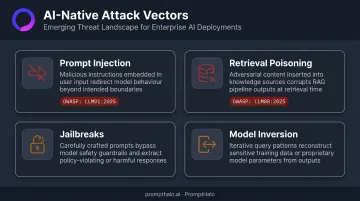
AI systems face attack vectors that traditional security tools were never designed to detect:
- Prompt injection — adversarial inputs that override system instructions and alter model behavior (OWASP LLM Top 10: LLM01:2025)
- Retrieval poisoning — corrupted content injected into RAG pipelines that carries hidden instructions (OWASP LLM08:2025)
- Jailbreaks — inputs designed to push a model outside its intended behavioral guardrails
- Model inversion — techniques that extract sensitive training data from a model's outputs
A 2025 Gartner survey found 29% of cybersecurity leaders reported an attack on enterprise GenAI application infrastructure in the prior 12 months. Data protection regulations hold organizations liable for breaches regardless of whether the attack vector was a conventional exploit or an AI-specific one.
PromptHalo's platform sits inline on every inference, tool call, and agent-to-agent handoff — blocking prompt injection, retrieval poisoning, and data leakage before they execute, at a layer firewalls and DLP tools cannot reach.
Accountability and Audit Gaps
Regulators under the EU AI Act don't just want your assurance that your AI is safe — they require documented evidence. Without version histories, risk assessment records, and decision logs, even a well-functioning model is a compliance failure.
Specifically, Article 9 requires a functioning risk management system, Article 11 mandates technical documentation, and Article 12 requires automatic logging of events throughout the system's lifecycle — records that must be retained and produced on request.
Navigating the AI Regulatory and Framework Landscape
EU AI Act
The EU AI Act classifies AI systems into four risk tiers — unacceptable, high, limited, and minimal, with compliance obligations scaling at each level.
High-risk designation (covering AI used in hiring, credit, healthcare, law enforcement, and critical infrastructure) requires:
- A formal risk management system maintained throughout the AI lifecycle
- Technical documentation before market placement (Article 11)
- Transparency sufficient for deployers to interpret outputs (Article 13)
- Human oversight mechanisms
- Conformity assessments
Penalties under Article 99 reach €35 million or 7% of global annual turnover for prohibited AI practices. Full high-risk obligations apply from August 2, 2026.
NIST AI Risk Management Framework
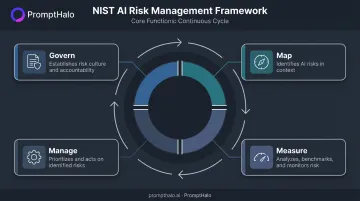
The NIST AI RMF organizes enterprise AI risk programs around four core functions:
| Function | Purpose |
|---|---|
| Govern | Establishes risk culture, policies, and accountability |
| Map | Identifies AI risks in context |
| Measure | Analyzes, benchmarks, and monitors risk |
| Manage | Prioritizes and acts on identified risks |
Although voluntary, the NIST AI RMF has become the practical standard for enterprise AI risk programs in the US. OMB M-24-10 directs federal agencies to incorporate it, and OMB M-25-22 addresses its role in AI procurement. As a result, it appears with growing frequency in government contracts and enterprise vendor requirements.
ISO/IEC 42001 and ISO/IEC 27001
ISO/IEC 42001:2023 is the first international management system standard for AI, covering ethical considerations, transparency, and continuous improvement. Organizations already certified under ISO 27001 will find significant overlap in management system structure, risk frameworks, supplier oversight requirements, and audit evidence standards, making combined implementation more efficient than pursuing separate certifications.
ISO 42001 certification is becoming a standard proof point for AI governance maturity in enterprise and government procurement.
US State-Level Laws
Without a federal AI law, US-based organizations face a growing patchwork:
- Colorado SB 189 — effective January 2027, disclosure-based framework for consequential AI decisions
- NYC Local Law 144 — requires bias audits for automated employment decision tools; enforcement active since July 2023
- Texas HB149 (TRAIGA) — effective January 2026, prohibits specified high-risk AI uses
- Illinois HB3773 — effective January 2026, addresses AI use in employment decisions
- GDPR — applies to any organization processing EU residents' personal data in automated decision-making, regardless of where the organization is headquartered
Any AI system that uses personal data for profiling or automated decisions falls under GDPR, requiring lawful basis, data minimization, and the right to meaningful explanation. For most enterprises, this means AI governance and data privacy programs need shared ownership, not parallel silos.
How AI Powers Modern Compliance Operations
Compliance teams are using AI to close the gap between the pace of regulatory change and the capacity of human teams. The five areas below show where that impact is showing up most clearly:
- Continuous regulatory monitoring — NLP tools scan regulatory feeds, guidance updates, and enforcement actions across jurisdictions in real time, translating changes into actionable control updates instead of waiting for quarterly manual reviews
- Dynamic risk scoring — ML models analyze internal data, control performance, and external signals to produce continuously updated risk scores, replacing static annual assessments with live visibility
- Automated evidence collection — AI-powered platforms pull evidence from integrated systems, classify it against control requirements, and surface gaps — compressing audit preparation from weeks to days
- Vendor risk screening at scale: AI tools analyze documentation, sanctions lists, adverse media, and financial signals simultaneously, surfacing risks that manual review often catches too late. Under GDPR and the EU AI Act, organizations are accountable for AI systems their vendors deploy on their behalf
- Control mapping across frameworks: Large language models identify NIST AI RMF controls that simultaneously satisfy ISO 42001 requirements, cutting redundant mapping work across overlapping standards
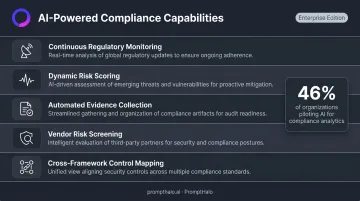
The adoption curve is real: PwC's 2025 survey found 46% of organizations were piloting or using AI for compliance data and predictive analytics, with 82% planning to increase technology investment in compliance.
The Agentic AI Compliance Gap: A New Frontier
What Makes Agentic AI Different
A chatbot responds to prompts. An agentic AI system autonomously sequences decisions, calls external tools and APIs, retrieves from knowledge bases, and hands off tasks between agents, all without continuous human guidance.
Every one of those steps is a potential compliance event: a data access decision, an action with real-world consequences, a transaction in a regulated workflow. Traditional GRC platforms, DLP tools, and firewalls were not designed to see this attack surface.
Gartner estimates that over 40% of agentic AI projects will be canceled by end of 2027 due to escalating costs, unclear business value, or inadequate risk controls. As of early 2025, 61% of organizations had already made significant or conservative investments in agentic AI. The governance gap is already open.
The Runtime Enforcement Gap
Most AI compliance frameworks focus on pre-deployment documentation and post-incident review. Agentic AI creates exposure at the moment of execution.
A prompt injection in a customer interaction, retrieval poisoning in a compliance workflow, or an out-of-scope tool call in a financial transaction can occur and complete before any static control fires. Federal agencies and NIST are already examining agentic-specific risks — the NIST/CAISI January 2026 RFI highlighted agent hijacking, indirect prompt injection, data poisoning, and specification gaming as priority concerns.
Organizations shipping agentic features in fintech, payments, or regulated enterprise environments need real-time enforcement, not just governance documentation. PromptHalo addresses this directly, enforcing trust on every agent decision inline before it executes. Key enforcement mechanisms include:
- Security passports that travel with each agent request, carrying embedded policy and authority decay parameters
- Risk budgets across time, steps, and scope that automatically expire when an agent exceeds its envelope
- Forced re-authorization at expiry, preventing compromised agents from retaining elevated access indefinitely
What Good Agentic AI Compliance Evidence Looks Like
Regulators now expect audit trails that go beyond AI outputs. Evidence should show:
- What inputs the agent received
- What tools it called and what data it accessed
- What authority it was operating under at the time
- What guardrails were active — and whether they fired
PromptHalo's audit logs are append-only and tamper-evident, capturing the decision, its reason, the acting agent identity, session and tenant context, and a timestamp for every inference, tool call, and handoff. Once written, entries cannot be modified or removed, creating a replayable evidence trail for compliance export and post-incident investigation.
Building an AI Compliance Program: Best Practices
Assess Before You Deploy
Conduct an AI impact assessment (AIA) or data protection impact assessment (DPIA) before development begins — not after the fact. This forces the organization to:
- Classify the AI system's risk level under applicable regulations
- Identify which specific obligations apply (EU AI Act Article 27, GDPR Article 35, sector-specific rules)
- Document the rationale for design decisions and risk mitigations
- Plan human oversight mechanisms before they're needed in a crisis
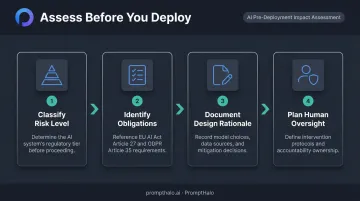
The EU AI Act's Article 9 requires a formal, documented risk management system for high-risk AI — maintained as a continuous iterative process throughout the system's lifecycle, not a one-time pre-launch exercise.
Build In Transparency, Human Oversight, and Data Governance
Retrofitting explainability into a deployed model is expensive and often incomplete. Build it in from the start:
- Collect only what the AI genuinely needs, and document the legal basis for every data source used in training (data minimization)
- Choose architectures that support interpretable outputs for high-risk decisions — explainability is far harder to retrofit than to design in
- Build real human oversight: override capabilities, escalation paths, and human review for consequential automated decisions — not a checkbox exercise
For vendor AI systems, apply the same scrutiny. Organizations are accountable for the AI their vendors deploy on their behalf.
Getting the build phase right sets the foundation — but compliance obligations don't end at launch.
Monitor, Audit, and Iterate Post-Deployment
Ongoing obligations include:
- Model drift and bias emergence: behavior compliant at launch may not be compliant six months later as inputs and context shift
- Control effectiveness testing that goes beyond documentation reviews — live tests of whether controls actually work
- Regulatory horizon scanning, since new state laws, EU AI Act implementation guidance, and sectoral rules continue to emerge
PromptHalo's behavioral drift detection tracks how AI outputs change session over session, catching gradual shifts before they become compliance or reliability failures. Because the platform operates without touching underlying models, it monitors third-party vendor AI systems with the same depth as internally built ones.
Frequently Asked Questions
What is the difference between AI compliance and AI governance?
Governance is the internal, proactive strategy for responsible AI use — covering policies, accountability structures, and ethical standards. Compliance is alignment with external regulations and frameworks that proves those commitments are being met. In practice, governance defines what responsible AI looks like inside your organization; compliance shows regulators that you're living up to it.
Which AI regulations apply to US-based companies right now?
There is no federal AI law. Colorado's SB 189 takes effect January 2027, NYC Local Law 144 is already enforced for automated employment tools, Texas TRAIGA and Illinois HB3773 both take effect January 2026. Organizations serving EU residents must also comply with the EU AI Act regardless of where they're headquartered.
How does AI help compliance teams work more efficiently?
AI enables continuous regulatory monitoring, automated evidence collection, dynamic risk scoring, and cross-framework control mapping. Together, these capabilities replace manual, periodic reviews that typically lag months behind active regulatory change.
What is the NIST AI Risk Management Framework, and is it mandatory?
The NIST AI RMF is voluntary, but it functions as the practical standard for enterprise AI risk programs in the US. Its four functions (Govern, Map, Measure, Manage) address AI risk from initial design through active deployment, and it's increasingly required in government procurement and enterprise vendor contracts.
What makes agentic AI harder to govern than traditional AI tools?
Agentic AI systems act autonomously — sequencing decisions, calling tools, and executing actions without human review at each step. This creates real-time compliance exposure that pre-deployment documentation and static controls alone cannot address. By the time a static control would trigger, the action has already occurred.
Can AI compliance tools replace human compliance officers?
No. AI tools automate high-volume, repetitive tasks — evidence collection, regulatory monitoring, risk scoring — but cannot replace human judgment on policy interpretation, ethical tradeoffs, or final decisions on high-risk matters. What AI does is free compliance officers to focus on the decisions that actually require their expertise.