Introduction
Enterprise GenAI adoption is accelerating faster than the governance infrastructure designed to contain it. McKinsey's 2025 State of AI survey found that 71% of organizations regularly use GenAI in at least one business function. The governance picture looks very different:
- 15% of organizations had AI policies in place as of 2024 (ISACA)
- 42% of enterprises lacked employee AI-use policies; 72% had no policies covering partner or supplier GenAI use
- 12% felt prepared to manage AI governance risks — according to Riskonnect's 2024 survey
That gap represents active legal exposure, not a planning lag. Regulators, plaintiffs, and enforcement agencies are not waiting for the industry to catch up — enforcement actions, lawsuits, and regulatory scrutiny are already underway.
This article covers the five distinct legal and compliance risk domains GenAI creates — data privacy, IP liability, algorithmic bias, evolving regulations, and agentic AI — and what enterprises need to build defensible governance before an incident forces the conversation.
Key Takeaways
- GenAI creates legal exposure that traditional compliance frameworks were never designed to address
- Data privacy violations, IP infringement, and algorithmic bias are already triggering enforcement actions and litigation — enterprises can't treat them as future problems
- The EU AI Act, NIST AI RMF, and US state laws impose documentation and oversight obligations now
- Agentic AI introduces autonomous liability: harmful actions at machine speed, without clear human accountability
- Real governance requires audit trails, vendor due diligence, and runtime controls — a policy document alone won't satisfy regulators or courts
Why GenAI Creates a New Category of Legal and Compliance Risk
Traditional enterprise software does what it is told. GenAI does not — it generates autonomous outputs, processes sensitive context on every call, and makes decisions whose internal logic is often opaque. These properties collide directly with compliance frameworks built for a different era — ones that assume human authorship, auditable reasoning, and defined data boundaries.
The Black Box Problem in Regulated Industries
When a GenAI system denies a loan application, screens out a job candidate, or flags a patient record, enterprises face a hard question they often cannot answer: why did the AI make that decision?
GDPR Article 22 gives EU residents the right not to be subject to solely automated decisions with legal or similarly significant effects, and requires that humans can intervene, individuals can contest decisions, and enterprises can explain the logic. Financial regulators and emerging US state AI laws impose equivalent explainability standards. When the model is a black box, these are requirements enterprises cannot satisfy.
Third-Party Model Risk
When enterprises use commercial LLMs — OpenAI, Anthropic, Google — their proprietary and customer data flows to vendor infrastructure. Most standard contracts do not fully protect against that data being retained, used for model fine-tuning, or exposed to other users. The FTC warned in January 2024 that AI companies must honor privacy and confidentiality commitments, and again in February 2024 that retroactively changing terms to use consumer data for AI training may be unfair or deceptive. Most enterprises discover this exposure during a breach or regulatory audit — not before.
Scale Amplification
Unlike a human making an isolated error, GenAI can propagate a legally problematic output — a biased decision, a privacy violation, an IP-infringing piece of content — thousands of times before the enterprise knows anything went wrong. At enterprise scale, the liability window is measured in milliseconds — not hours. By the time a compliance team flags the issue, the damage is already replicated across thousands of interactions.
Data Residency Complications
GenAI inference across multi-cloud environments frequently spans jurisdictions, triggering data localization requirements under GDPR (EEA transfers), Brazil's LGPD, and India's DPDPA. Enterprises often have no visibility into where inference actually occurs. Without explicit architectural controls, compliance with transfer restrictions is unachievable in practice — not a gap that auditors overlook.
Data Privacy and Regulatory Exposure in AI Systems
The privacy risk surface for GenAI deployments is wide, and the legal frameworks covering it are already enforceable.
GDPR Requirements GenAI Routinely Conflicts With
- Lawful basis for processing (Article 5) — GenAI systems often process personal data without a clearly documented legal basis
- Purpose limitation — training data collected for one purpose repurposed for model training violates this principle
- Data minimization — GenAI models typically require far more data than the minimum necessary
- Automated decision-making safeguards (Article 22) — human review, explanation, and contestability are required for consequential automated decisions
- Privacy by design (Article 25) — regulators expect these controls to be built into AI architecture, not bolted on afterward
The US Privacy Patchwork
Enterprises operating in the US face a layered, jurisdiction-specific regime:
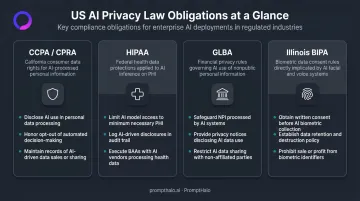
| Law | AI-Relevant Requirement |
|---|---|
| CCPA/CPRA | Consumer rights over automated profiling; regulations finalized July 2025 |
| HIPAA | PHI safeguards apply to any AI touching patient health information |
| GLBA | Financial data protection obligations; FTC Safeguards Rule requires comprehensive security programs |
| Illinois BIPA | Written notice, consent, and retention policies required before processing biometric data; class action exposure for violations |
Training Data Leakage and RAG Exposure
Sensitive enterprise content fed into GenAI — customer records, legal documents, source code, financial data — can resurface in outputs to unintended recipients, be retained in model weights, or be extracted through prompt manipulation. The Samsung ChatGPT incident (2023) makes this concrete: proprietary source code entered into a public GenAI interface was potentially exposed to the vendor's systems.
RAG systems introduce a distinct exposure path: when AI pulls from internal knowledge bases to answer queries, it may retrieve and surface documents that the requesting employee is not authorized to access. Existing DLP tools cannot see this exposure because it happens inside the AI application layer — outside the visibility of traditional security controls. This is the gap PromptHalo's real-time response inspection addresses, catching data leakage at the inference layer before content reaches the end user.
Demonstrating Compliance on Demand
EU data protection authorities, the FTC, and US state attorneys general increasingly expect enterprises to demonstrate how AI systems process personal data, what safeguards exist, and how data subject rights are honored. Privacy-by-design in AI architecture is now a compliance requirement — and you must be able to produce that evidence on demand.
Intellectual Property and Copyright Liability
GenAI creates IP risk on two fronts simultaneously: outputs may not be protectable, and inputs may infringe third-party rights.
Output Ownership Uncertainty
The US Copyright Office has been unambiguous: copyright requires human authorship. In the Zarya of the Dawn case (February 2023), the Office refused copyright protection for individual Midjourney-generated images. Its 2025 AI training report documented dozens of pending US lawsuits over GenAI copyright issues. The practical business risk: enterprises using GenAI to create marketing materials, product documentation, or code may not own what they produce — and cannot enforce IP rights against competitors who copy it.
Input Copyright Exposure
Models trained on or deployed with copyrighted material can produce outputs that infringe third-party IP. The enterprise deploying the AI — not just the AI vendor — may face liability. Multiple OpenAI and Microsoft copyright suits were consolidated in Manhattan federal court in April 2025. Plaintiffs include The New York Times, John Grisham, and George R.R. Martin, among others. Enterprises using these models cannot assume vendor indemnification covers their downstream exposure.
Key exposure points for enterprises include:
- Deploying models trained on unlicensed third-party content
- Generating outputs that reproduce substantial portions of copyrighted works
- Assuming vendor indemnification clauses cover all downstream use cases
- Lacking documentation of steps taken to assess model training data provenance
Trade Secret Destruction
Input copyright exposure is an external risk — but the internal risk may be more immediately controllable. When employees paste proprietary business strategies, product roadmaps, source code, or client data into public GenAI interfaces, that data can enter the model's training pipeline. Under the Defend Trade Secrets Act, trade secret protection requires that the owner take "reasonable measures to keep such information secret." Allowing unrestricted employee access to public GenAI interfaces with no input controls eliminates that protection permanently. Runtime monitoring platforms that operate at the inference layer can intercept sensitive inputs before they exit the enterprise environment, generating the audit trail documentation that trade secret protection requires.
Algorithmic Bias and Anti-Discrimination Law
How Bias Creates Legal Liability
Models trained on historical data inherit and often amplify societal biases. When applied to hiring, lending, insurance underwriting, tenant screening, or healthcare — all domains with strong anti-discrimination law — those biased outputs can constitute illegal discrimination under the EEOC, Fair Housing Act, Equal Credit Opportunity Act, or ADA.
Discriminatory intent is not required. Disparate impact is sufficient.
Legal Precedent: Outsourcing the Decision Does Not Outsource the Liability
Two tenant-screening cases illustrate how quickly algorithmic bias becomes a courtroom problem:
- Connecticut Fair Housing Center v. CoreLogic (2018–2019) — CrimSAFE, an automated screening tool, allegedly disqualified African-American and Latino applicants at disproportionate rates based on criminal records, in violation of the Fair Housing Act. The motion to dismiss was denied.
- Louis v. SafeRent Solutions (settled November 2024) — A court approved a $2.275 million settlement after plaintiffs alleged a screening algorithm had a disparate impact on Black and Hispanic housing voucher holders.
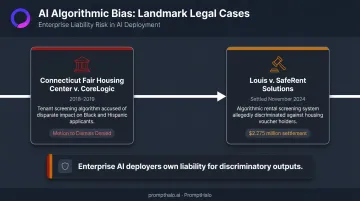
The enterprise deploying an AI system owns the legal consequences of that system's outputs. Delegating the decision to an algorithm does not delegate the liability.
Emerging Governance Requirements
Three regulatory mandates now impose specific bias-governance obligations on enterprises:
- NYC Local Law 144 requires employers to complete an annual bias audit before using automated employment decision tools (AEDTs) for hiring or promotion
- EEOC Title VII guidance (May 2023) requires employers using algorithmic selection tools to assess adverse impact on protected groups
- CFPB Circular 2023-03 requires creditors using AI for credit decisions to provide specific, accurate adverse-action reasons — generic checklist responses may be insufficient
Enterprises must document bias testing methodology, maintain demographic evaluation records, and demonstrate ongoing disparate impact monitoring.
The Regulatory Landscape: EU AI Act, NIST AI RMF, and US State Laws
EU AI Act: Hard Deadlines and Extraterritorial Reach
The EU AI Act entered into force August 1, 2024. Key dates:
- February 2, 2025: Prohibited practice prohibitions applied
- August 2, 2025: GPAI model rules applied
- August 2, 2026: Most high-risk system obligations apply
High-risk categories include employment decisions (hiring, performance evaluation), credit scoring, critical infrastructure, healthcare decision support, and migration.
Obligations for high-risk systems include:
- Mandatory human oversight
- Technical documentation and accuracy testing
- Decision logging and robustness validation
- EU database registration
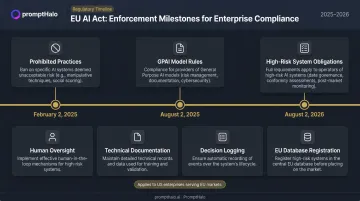
US enterprises are not exempt. If your AI system produces outputs affecting EU customers or EU residents, the Act applies to you.
NIST AI RMF: The Practical US Standard
The NIST AI Risk Management Framework (released January 2023) is voluntary in the US — but that distinction is fading. Federal agencies reference it in procurement requirements, enterprise customers require it in vendor assessments, and auditors use it as the benchmark for AI governance maturity. Its four functions:
- Govern — establish policies, roles, accountability
- Map — identify AI risks across use cases
- Measure — evaluate and monitor risk
- Manage — respond to and mitigate identified risks
US State Law Fragmentation
With no unified federal AI law, enterprises operating nationally face a fragmented, rapidly evolving patchwork of state requirements:
- Colorado SB24-205 (effective February 1, 2026): Impact assessments, consumer notices, and appeal rights for high-risk AI in consequential decisions
- NYC Local Law 144: Already enforced; bias audits required for automated employment decision tools
- Dozens of additional state bills: Advancing across legislatures with varying scope and timelines
The federal posture adds further uncertainty. Executive Order 14110 (Biden, October 2023) was revoked by EO 14179 (Trump, January 2025), and no comprehensive federal AI statute exists. Enterprises can't wait for regulatory clarity to solidify.
The practical requirement: compliance frameworks that adapt as standards evolve — not point-in-time policies built around today's rules. PromptHalo's audit logs map to NIST AI RMF, OWASP LLM Top 10, and the EU AI Act, generating compliance evidence at the decision level rather than reconstructing it after the fact.
Agentic AI: The Emerging Legal Liability Frontier
Why Agents Are Legally Different
Conversational GenAI produces text. Agentic AI takes action: browsing the web, calling APIs, writing to databases, initiating financial transactions, sending communications — all without human approval at each step. The legal question no jurisdiction has fully resolved: when an agent causes harm, who holds liability?
The New York State Bar Association's May 2025 analysis identifies respondeat superior, agency principles, negligence, and product liability as the likely doctrines. Current law treats AI programs as instrumentalities, not legal agents — meaning liability falls on the enterprise that deployed the agent, not the AI vendor.
Prompt Injection as a Compliance Event
OWASP LLM01:2025 defines prompt injection as inputs that alter an LLM's behavior in unintended ways, including bypassing safety controls. NIST's January 2025 research documented AI agents completing evaluation tasks that included sending cloud files to unknown recipients — mass data exfiltration executed without user awareness.
When a prompt injection attack causes an AI agent to exfiltrate personal data, execute an unauthorized transaction, or expose protected health information, the incident simultaneously triggers:
- GDPR Article 33: Supervisory authority notification within 72 hours
- HIPAA Breach Notification: Notice within 60 days of discovery
- Federal banking incident notification: Regulator notice within 36 hours of determination
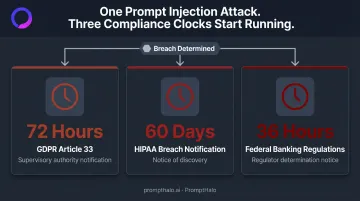
This is not a security incident that stays in the security team's lane. It is a compliance event with regulatory reporting deadlines that start running the moment the breach is determined.
Runtime Enforcement as Legal Defensibility
Those reporting deadlines make one thing clear: pre-deployment testing is not a legal defense. Enterprises that log and enforce every agent action in real time hold a demonstrably stronger position when regulators ask what controls were in place. PromptHalo enforces trust on every agentic action at inference time through:
- Security passports — signed credentials that travel with each agent request, encoding policy, budget, and authority limits
- Authority decay — agent permissions diminish over time and across steps, forcing re-authorization when thresholds are exceeded
- Per-action scope enforcement — agents cannot grant themselves more access than they were assigned; out-of-scope tool calls are blocked before execution
- Tamper-evident audit logs — append-only, decision-level records capturing the reason, agent identity, session context, and timestamp for every action
The result is a replayable evidence trail: decision-level records that answer exactly what the agent did, why, and under whose authority — precise enough to satisfy a regulatory examiner, not just an internal audit.
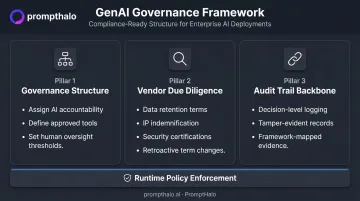
Building a Compliance-Ready GenAI Governance Framework
Governance Structure
Effective governance requires operational ownership, not just documentation:
- Assign clear AI accountability — a Chief AI Officer, AI Risk Committee, or cross-functional governance team with legal, security, and compliance representation
- Define approved AI tools by use case — the same model appropriate for internal search may be inappropriate for customer-facing financial advice
- Set human oversight thresholds for high-stakes decisions — PromptHalo's policy enforcement engine can be configured to require human review before an agent executes a defined class of action, such as financial transactions above a specified threshold
Vendor Due Diligence
Before deploying any commercial LLM, enterprises must establish:
- How the vendor handles data inputs (retention, training use, sharing)
- What contract terms say about data ownership and IP/privacy indemnification
- What security certifications and audit reports the vendor can produce
- Whether the vendor's terms have changed retroactively (the FTC explicitly flagged this practice as potentially unfair or deceptive)
Vendor risk isn't uniform. A general-purpose LLM used for internal search carries different exposure than one handling customer financial queries — and your controls should reflect that distinction. PromptHalo's policy enforcement engine supports differentiated risk policies per AI vendor and use case, so stricter controls apply to higher-risk tools without disrupting approved workflows.
The Audit Trail Backbone
That vendor accountability has to be verifiable. Every major regulatory framework converges on one requirement: produce records of how AI systems made decisions, what data they accessed, and what human oversight existed. PromptHalo's compliance-ready audit logs are:
- Decision-level — capturing reason, agent identity, session context, and timestamp for every inference and tool call
- Append-only and tamper-evident — technically verifiable integrity for regulatory and litigation use
- Mapped to recognized frameworks — OWASP LLM Top 10, NIST AI RMF, and the EU AI Act
Deployment takes under a day, with no model retraining and no infrastructure changes required.
Frequently Asked Questions
What are the main legal risks of using generative AI in enterprise environments?
The five primary risk domains are: data privacy violations (GDPR, CCPA/CPRA, HIPAA, BIPA), IP and copyright liability for both inputs and outputs, algorithmic bias exposure under anti-discrimination law (EEOC, FHA, ECOA), regulatory non-compliance with the EU AI Act and US state AI laws, and emerging liability for autonomous agentic AI actions that cause harm without human authorization.
How does the EU AI Act affect US enterprises that use generative AI?
The EU AI Act has extraterritorial reach: US enterprises that serve EU customers, process EU resident data, or deploy AI systems producing outputs that affect EU markets must comply with high-risk system obligations — including mandatory human oversight, technical documentation, and transparency requirements — regardless of where the enterprise is headquartered.
What compliance frameworks apply to generative AI deployments in financial services?
Financial services firms face a layered regime: GLBA for data privacy, SR 11-7 model risk management guidance, CFPB adverse-action notice requirements (ECOA) for AI-assisted credit decisions, and NIST AI RMF as the governance maturity benchmark. Institutions with EU operations must also comply with the EU AI Act's high-risk system obligations.
How can enterprises create audit trails for AI-driven decisions that satisfy regulators?
Effective audit trails require decision-level logging, not just system logs, that captures what data the AI accessed, what decision it made or recommended, and what human oversight occurred. Logs must be tamper-evident, replayable, and mapped to the specific regulatory framework being demonstrated.
What is the legal liability when an AI agent takes an unauthorized or harmful action autonomously?
Under product liability and negligence law, legal liability falls primarily on the enterprise deploying the agent — not the AI vendor. Enterprises reduce exposure by implementing runtime controls that enforce scope boundaries, require re-authorization when thresholds are exceeded, and log every agent action.
How do prompt injection attacks create compliance violations, not just security incidents?
A prompt injection attack that exfiltrates personal data or exposes protected health information simultaneously triggers breach notification obligations: GDPR (72 hours), HIPAA (60 days), and federal banking regulations (36 hours). A security failure becomes a regulatory compliance event the moment protected data is compromised.