Introduction
Most enterprises have an acceptable use policy for generative AI. Far fewer have anything that actually stops a prompt injection attack, a jailbreak attempt, or unauthorized data exfiltration at the moment it happens. A policy document sitting in a SharePoint folder is not compliance — it's documentation.
The gap matters. According to IBM's 2025 Cost of a Data Breach report, 63% of organizations lacked AI governance policies to manage AI or prevent shadow AI — and 97% of organizations that experienced an AI-related security incident lacked proper AI access controls.
Meanwhile, Lakera's 2025 GenAI Security Readiness Report found that 15% of organizations reported a GenAI-related security incident in the prior year — up from roughly 9% in 2024.
This guide covers what an enterprise generative AI compliance policy must actually contain:
- The core components every policy needs
- Regulatory frameworks that apply to AI deployments
- How to tier AI applications by risk level
- How to operationalize policy across the full AI lifecycle — from pre-deployment gates through runtime enforcement
Key Takeaways
- A compliant AI policy defines permitted tools, data handling rules, IP ownership, human oversight thresholds, and a clear accountability matrix.
- Compliance requires mapping deployments to applicable frameworks (EU AI Act, NIST AI RMF, GDPR/CCPA) and assigning risk tiers accordingly.
- Runtime enforcement must cover every inference, tool call, and agent-to-agent handoff — not just policy documents.
- Agentic AI systems demand stricter governance because they act autonomously and can cause real-world harm before any human reviews the output.
- Audit trails must be decision-level, tamper-evident, and mapped to EU AI Act, NIST AI RMF, or OWASP LLM Top 10 to survive regulatory review.
Why Generative AI Demands a New Compliance Framework
Traditional IT acceptable use policies were written for human-operated software. A person opens an application, takes an action, and a system records it.
Generative AI breaks that model entirely: the system itself produces outputs, makes inferences, and in agentic configurations, executes tool calls and API requests without a human approving each step.
Existing controls weren't built for this surface. Data loss prevention tools inspect files and network traffic. Firewalls filter by destination and protocol. Code scanners check static syntax. None of them can inspect a natural-language prompt, detect that it carries hidden instructions, or block a retrieval-poisoned document from hijacking an LLM's behavior mid-workflow.
The Attack Vectors Traditional Tools Miss
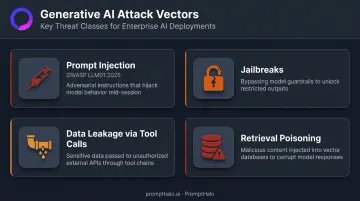
The compliance risks specific to generative AI include:
- Prompt injection (OWASP LLM01:2025): adversarial instructions embedded in user inputs or retrieved documents that redirect model behavior
- Jailbreaks: techniques that bypass model guardrails, causing the system to ignore its operating constraints
- Data leakage through tool calls: agents passing sensitive data to external APIs that were never scoped to receive it
- Retrieval poisoning: malicious content injected into vector databases carrying hidden instructions — one controlled benchmark recorded a 90% attack success rate when just five poisoned texts entered a knowledge base
A dedicated generative AI compliance framework isn't optional overhead. These attack classes require controls that can inspect model behavior at runtime — not just files, traffic, or code.
Core Components of an Enterprise Generative AI Policy
Scope and Permitted Tools
The policy must explicitly enumerate which AI tools are approved — specific enterprise LLM platforms, internally hosted models, approved API integrations — and which are prohibited. Shadow AI is a real exposure: employees using personal or unapproved AI accounts for work tasks fall completely outside any monitoring or data handling controls. Define the contexts in which each approved tool is appropriate, not just a blanket list.
Data Handling and Confidentiality Rules
Specify what categories of data cannot enter AI prompts, be used for fine-tuning, or appear in retrieval corpora:
- Personally identifiable information (PII)
- Financial records and transaction data
- Protected health information (PHI)
- Trade secrets and proprietary business data
- Any data subject to sector-specific regulation (HIPAA, GLBA, PCI-DSS)
The policy should also address what happens to data the AI system generates — not just what goes in.
Intellectual Property and Output Ownership
The US Copyright Office's 2025 Part 2 report on AI copyrightability is clear: copyright protects human-authored expression, not material generated solely by AI. The policy must address three obligations directly:
- Who owns AI-generated content within the organization
- What disclosures are required when AI-generated material is published or submitted externally
- How training data copyright risk is managed for any fine-tuned models
Human Oversight and Escalation Thresholds
Define when AI-generated outputs require mandatory human review before any action is taken. At minimum, that threshold should apply to:
- Customer-facing decisions that affect individual rights
- Financial transactions above defined value limits
- Legal documents, regulatory filings, or compliance certifications
- Any output flagged as anomalous by monitoring systems
Escalation paths must be named and tested, not just written down.
Accountability Matrix and Enforcement
Assign ownership clearly: who owns the AI system, who owns the data feeding it, and who is accountable for compliance violations. Document the consequences for policy breaches and the procedure for reporting and investigating incidents. A policy with no named owners and no enforcement mechanism will not survive its first audit.
Regulatory Frameworks That Apply to Generative AI
The Four Frameworks Every Enterprise Must Understand
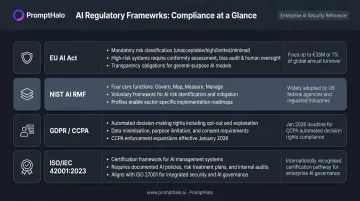
| Framework | What It Requires | Why It Matters |
|---|---|---|
| EU AI Act | Risk classification (Unacceptable/High/Limited/Minimal), mandatory logging for high-risk systems, human oversight, pre-market documentation | Fines up to €35M or 7% of global turnover for prohibited practices |
| NIST AI RMF | Govern, Map, Measure, Manage functions across the AI lifecycle | Widely adopted commercial standard; increasingly referenced by US regulators |
| GDPR / CCPA | Data subject rights, restrictions on solely automated decision-making, right to explanation | CCPA's automated decision-making rules take effect January 2026 |
| ISO/IEC 42001:2023 | AI management system requirements for establishing, implementing, and improving AI governance | Certification framework for demonstrating mature AI governance |
Mapping Your Deployment to the Right Obligation
The EU AI Act's risk classification determines your compliance burden. A customer-facing generative AI application in financial services that materially supports credit decisions, for example, falls under Annex III's high-risk classification.
That classification triggers mandatory automatic logging (Article 12), human oversight requirements (Article 14), and pre-market technical documentation (Article 11). Log retention must cover at minimum six months.
Regulatory Change Is Continuous
Compliance cannot be treated as a one-time exercise. Three developments from the past year alone illustrate the pace of change:
- Colorado SB26-189 repeals and replaces SB24-205, governing automated decision-making technology affecting consumers
- Texas Responsible AI Governance Act signed into law, adding state-level obligations for AI deployments
- California CPPA ADMT regulations finalized September 2025, with business compliance required by January 2027
The regulatory map shifts annually. Build a quarterly review cadence into your AI governance program — not an annual one.
Risk-Tiering Your AI Applications for Policy Governance
Not all generative AI applications carry the same compliance burden. Applying the same controls to an internal text summarizer as to an autonomous financial agent over-engineers the former and leaves the latter exposed.
A Practical Three-Tier Model
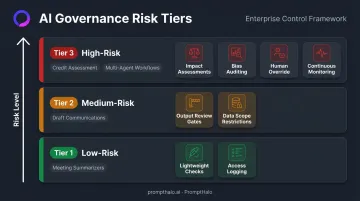
| Tier | Description | Examples |
|---|---|---|
| Low-risk | Internal productivity tools, no regulated data, human reviews all outputs | Meeting summarizers, internal knowledge search |
| Medium-risk | Customer-facing but outputs are human-reviewed before action | Draft customer communications, AI-assisted support suggestions |
| High-risk | Autonomous decision-making over sensitive workflows or regulated data | Credit assessment, autonomous payment processing, multi-agent workflows |
The tier designations only hold if the criteria are applied consistently — especially when classifying what qualifies as high-risk.
What Elevates an Application to High-Risk
An AI system moves to the high-risk tier when it meets any of these criteria:
- Executes tool calls or API requests without per-action human approval
- Processes regulated data categories (health, financial, biometric)
- Produces outputs that directly affect individual rights or financial outcomes
- Operates in a multi-agent configuration where one agent triggers downstream agents
Controls by Tier
- Low-risk: Lightweight automated checks, periodic sampling review, standard access logging
- Medium-risk: Output review gates before customer delivery, data scope restrictions, regular audit sampling
- High-risk: Formal AI impact assessment, pre-deployment bias auditing, mandatory human override capability, continuous post-deployment monitoring, evidence-grade audit logs retained per applicable law
Treat risk tiering as ongoing: re-evaluate any time the system's scope, data inputs, or deployment context shifts.
Operationalizing Compliance Across the AI Lifecycle
Pre-Deployment Gates
Compliance must begin before a model reaches production. Minimum pre-deployment requirements:
- AI impact assessment — documents the system's purpose, data inputs, decision scope, and risk profile; required for high-risk systems under EU AI Act Article 27
- Data lineage verification — confirms training and fine-tuning data is consented, traceable, and legally cleared for use
- Bias auditing — tests against representative benchmarks for any system that makes decisions affecting protected groups
A fourth gate that compliance frameworks often underspecify is adversarial testing. PromptHalo's red teaming capability attacks agents, RAG layers, and tool chains the way a real adversary would — running prompt injection, jailbreak, poisoning, and data-leakage probes — then delivers risk-scenario-mapped reports with prioritized fixes before anything reaches production.
Deployment with Automated Guardrails
Policy-as-Code is the mechanism that makes compliance enforceable rather than advisory. When governance rules are encoded into configuration templates and embedded directly in CI/CD pipelines, they:
- Automatically block non-compliant builds at the pipeline stage
- Validate model lineage before any model reaches production
- Convert compliance from a review checklist into an automated gate
Post-Deployment Monitoring and Drift Detection
Real-world data distributions shift, and model behavior drifts from its validated baseline with them. NIST AI RMF explicitly identifies data drift, model drift, and concept drift as risks requiring ongoing monitoring across the AI lifecycle.
Organizations need continuous telemetry that tracks behavioral change across sessions and surfaces anomalies before they compound into compliance failures. PromptHalo's behavioral drift detection monitors how outputs change session over session, drawing on per-tenant context to identify when behavior diverges from expected patterns.
Incident Response for AI
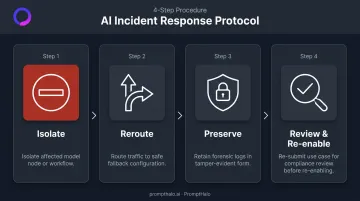
A generative AI compliance policy must include an AI-specific incident response procedure. When a data leakage event, a hallucination affecting a regulated decision, or an adversarial attack is detected, the response steps are:
- Isolate the affected model node or workflow
- Route traffic to a safe fallback configuration
- Preserve forensic logs in tamper-evident form
- Re-submit the use case for compliance review before re-enabling
Policy Review Cadence
AI policies must be reviewed at minimum annually. Trigger an additional review whenever:
- A new AI system is deployed
- A regulatory change affects applicable obligations
- A material incident occurs
Ownership belongs to a named cross-functional body (legal, security, and business owners at minimum), not a single team.
Closing the Gap: Runtime Enforcement of AI Policy
Policy documents define what should happen. Without technical enforcement at the inference layer, a determined insider, an adversarial prompt, or a misconfigured agent can bypass every written rule. None of it leaves a trace in any system traditional security tools monitor.
What Runtime Enforcement Requires
The capabilities required for runtime enforcement:
- Inline inspection on every model call and tool invocation — decisions made before execution, not logged after the fact
- Detection of prompt injection and jailbreak attempts — including indirect injection through retrieved content
- Data scope enforcement — blocking unauthorized retrieval or exfiltration at the point of access
- Per-action authority controls for agentic workflows — limiting what an autonomous agent can do even if it attempts to exceed its mandate
PromptHalo's runtime enforcement layer sits inline on every inference, tool call, and agent-to-agent handoff, making allow/restrict/challenge/deny/monitor decisions in under 100ms. The ML-based detection engine achieves a stated catch rate above 95% at under 5% false positives — compared to roughly 35% catch rates and 15-20% false positives for rule-based approaches.
What a Defensible Audit Trail Requires
For regulatory purposes, session-level logs are not sufficient. A defensible audit trail requires:
- Decision-level logging — every enforcement decision captured individually, not aggregated at session level
- Tamper-evident records — append-only logs that cannot be retroactively modified
- Full decision context — the decision, its reason, the acting agent identity, session and tenant context, and timestamp
PromptHalo's audit logs function as replayable evidence trails: each entry captures the complete context of an enforcement decision, and the append-only structure means the record cannot be altered after the fact. That distinction matters in a regulatory review — a log that tells you something happened is not the same as a log you can present as evidence.
Agentic AI Raises the Stakes
Autonomous agents execute multi-step tool chains, interact with external APIs, and can spin up sub-agents — and that's precisely where complete audit trails become critical. A single policy violation in step one of a ten-step workflow can cascade across the entire chain before any human sees the output.
Runtime enforcement for agentic systems must operate at the individual action level. PromptHalo addresses this through three mechanisms:
- Security passports — signed credentials that travel with each agent request, carrying policy, budget, and authority scope across agent boundaries
- Authority decay — agent permissions diminish over time and across steps, forcing re-authorization when limits are exceeded
- Per-action scope enforcement — an agent cannot grant itself access beyond what it was explicitly given
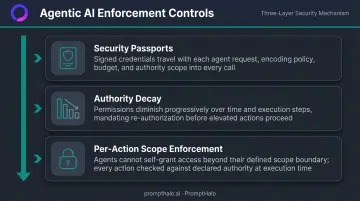
Even if an agent is compromised or manipulated mid-workflow, it cannot escalate its own privileges or execute actions outside its defined scope — the enforcement boundary holds at every step.
Frequently Asked Questions
What should a generative AI compliance policy include?
A complete policy covers five areas: permitted tools and scope (approved vs. prohibited AI), data handling rules (what data categories cannot enter prompts or training), IP and output ownership, human oversight thresholds for high-stakes decisions, and an accountability matrix with named owners and enforcement consequences.
How does generative AI policy compliance differ from traditional IT policy compliance?
Generative AI introduces autonomous output generation, agentic tool execution, and attack vectors (prompt injection, jailbreaks, retrieval poisoning) that traditional IT policies and security controls were never designed to address. Compliance requires AI-specific governance and technical enforcement at the inference layer, not just access controls and DLP.
What regulatory frameworks apply to enterprise generative AI deployments?
The four most directly applicable frameworks are:
- EU AI Act — risk classification and high-risk system requirements
- NIST AI RMF — Govern, Map, Measure, Manage
- GDPR/CCPA — automated decision-making restrictions and data subject rights
- ISO/IEC 42001:2023 — AI management system certification
US state-level laws (Colorado, Texas, Illinois) add jurisdiction-specific obligations.
How often should an AI compliance policy be reviewed and updated?
At minimum annually, and immediately when a new AI system is deployed, a regulatory change is enacted, or a material incident occurs. A named cross-functional governance body (legal, security, and business) should own the review process and hold authority to trigger off-cycle updates.
How do you enforce a generative AI policy at runtime, not just on paper?
Runtime enforcement requires technical controls operating inline on every inference, tool call, and agent handoff : prompt inspection, data scope enforcement, real-time allow/deny decisions in under 100ms, and tamper-evident decision-level audit logging. Employee training and access controls alone cannot close this gap.
What makes agentic AI systems harder to govern than traditional generative AI?
Agentic AI acts autonomously across multi-step workflows, executes tool calls, and can trigger downstream sub-agents, meaning a single policy violation can cascade across an entire chain before any human reviews it. Effective governance requires per-action authority controls, authority decay mechanisms, and runtime monitoring at each handoff point, not just session boundaries.