Key Takeaways
- AI audits cover data quality, model behavior, decision logic, and operational governance—not just IT controls
- Financial services, healthcare, and government each operate under distinct frameworks with specific documentation requirements
- Agentic AI creates audit surface areas that traditional checklists and logging tools were never designed to handle
- Continuous audit readiness is now a regulatory expectation, not an annual checkbox
- Decision-level audit trails require inputs, context, and reasoning—system-level logs alone don't meet the bar
What Is an AI Audit and Why Does It Matter for Regulated Industries
An AI audit is a structured, evidence-based examination of how AI systems are designed, trained, and deployed. That means data quality, model behavior, decision logic, and operational governance—not the IT infrastructure audit your team already runs.
The distinction matters because AI systems in regulated industries make consequential decisions. Credit approvals. Patient triage. Fraud detection. Regulators don't just want to know that a system was deployed—they want organizations to justify, trace, and reproduce automated decisions on demand.
Why Traditional IT Audits Fall Short
A standard IT audit verifies that access controls are in place and that systems are patched. An AI audit asks a different set of questions:
- Can you explain why the model made a specific decision?
- How has model performance changed since last month's data distribution shift?
- Were demographic groups affected differently by the model's outputs?
- Is human review actually enforced where your policy says it should be?
These aren't IT questions. They require audit methods built specifically for AI systems.
Continuous vs. Point-in-Time Auditing
One-time compliance audits aren't sufficient in regulated environments. Model behavior drifts, training data distributions shift, and regulatory expectations evolve faster than annual review cycles can track.
The numbers reflect the gap: McKinsey's 2025 State of AI survey found 88% of organizations used AI in at least one business function—up from 78% in 2024—yet 51% reported at least one negative AI-related consequence. Deloitte found that only 20% of companies had a mature oversight model for autonomous AI agents.
Enforcement actions show what happens when deployment outpaces oversight:
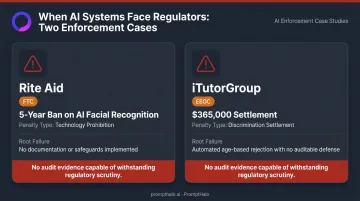
- Rite Aid: FTC banned the company from using AI facial recognition for five years after it deployed the technology without adequate safeguards or documentation
- iTutorGroup: EEOC secured a $365,000 settlement over automated age-based applicant rejection—an AI decision the company couldn't sufficiently audit or defend
Both cases share the same root failure: no audit evidence capable of withstanding regulatory scrutiny.
AI Audit Requirements by Industry Sector
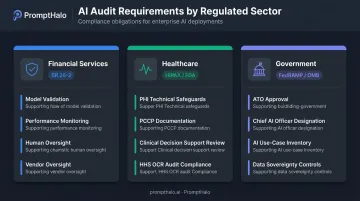
Core audit principles apply everywhere, but each regulated sector operates under distinct frameworks with specific documentation, validation, and oversight requirements. What satisfies a bank examiner won't satisfy an FDA reviewer.
Financial Services: SR 26-2 and Model Risk Management
On April 17, 2026, the Federal Reserve, OCC, and FDIC jointly issued SR 26-2, superseding the long-standing SR 11-7. The revised guidance moves to a risk-based cadence tied to model materiality and places greater interpretive responsibility on each institution to determine validation frequency based on model purpose, complexity, and conditions.
What financial AI audits must demonstrate:
- How models were trained and what data was used
- How performance is monitored over time across relevant segments
- How human oversight is maintained for credit scoring, fraud detection, and AML decisions
- Independent validation, conceptual soundness review, and outcomes analysis
- Vendor oversight for third-party models
One critical caveat: SR 26-2 explicitly excludes generative AI and agentic AI systems. Banks deploying those systems need separate governance frameworks, and most don't have them yet.
Healthcare: HIPAA and FDA Oversight
HHS requires that any AI system processing protected health information (PHI) implement technical safeguards including access controls, audit controls, integrity controls, entity authentication, and transmission security—documented throughout design, deployment, and ongoing monitoring.
For AI used in clinical settings, FDA oversight applies. The agency's December 2024 guidance on Predetermined Change Control Plans for AI-enabled device software addresses planned modifications, validation methodology, and impact assessments. Clinical decision support AI must also allow healthcare professionals to independently review the basis for each recommendation.
HHS OCR's 2024–2025 audit program is actively reviewing 50 covered entities for Security Rule compliance. Healthcare organizations treating these requirements as theoretical are already behind.
Government: FedRAMP, ATO, and OMB Requirements
Federal AI deployments must obtain Authority to Operate (ATO) approval before going live. OMB M-24-10 (March 2024) sets additional requirements for safety-impacting and rights-impacting AI systems.
Key compliance requirements include:
- FedRAMP-aligned security controls: identity management, detailed logging, and incident response
- Designated Chief AI Officers and documented AI use-case inventories
- Minimum risk management practices for safety-impacting and rights-impacting systems
- Data sovereignty rules governing where AI-processed government data can reside
Core Components of an AI Audit
Every regulated AI audit addresses three interdependent domains: data, model, and deployment. Missing any one of them leaves material gaps.
Data Auditing
Data auditing examines the foundation your models are built on:
- Dataset accuracy and quality — Is the training data fit for purpose?
- Bias and fairness testing — Are outcomes consistent across demographic groups?
- Privacy and consent compliance — Does data collection satisfy GDPR, HIPAA, and applicable state requirements?
- Metadata traceability — Can you trace each model output back to its raw data source?
- Retention and access controls — Are documented policies actually enforced?
NIST SP 1270 sets out technical and socio-technical processes for identifying and managing AI bias. CFPB Circular 2023-03 makes bias testing non-optional for credit models — creditors using AI must provide accurate, specific reasons for adverse action.
Model Auditing
Model auditing focuses on what the system actually does — and whether it holds up under pressure:
- Algorithm transparency and explainability — Can the decision logic be justified to regulators?
- Error-rate analysis — Do error rates vary significantly across population segments?
- Red-teaming and stress-testing — Where are the exploitable vulnerabilities?
- Drift detection thresholds — At what point does performance degradation trigger re-validation?
- Documented model versioning — Is there a defensible record of every model version in production?
Deployment and Runtime Auditing
Deployment auditing examines whether the live environment matches your governance documentation:
- Governance structures and monitoring workflows in production
- Conformity assessments against applicable regulations (EU AI Act, NIST AI RMF)
- Incident response simulations and documented outcomes
- Verification that human-in-the-loop review is enforced where required
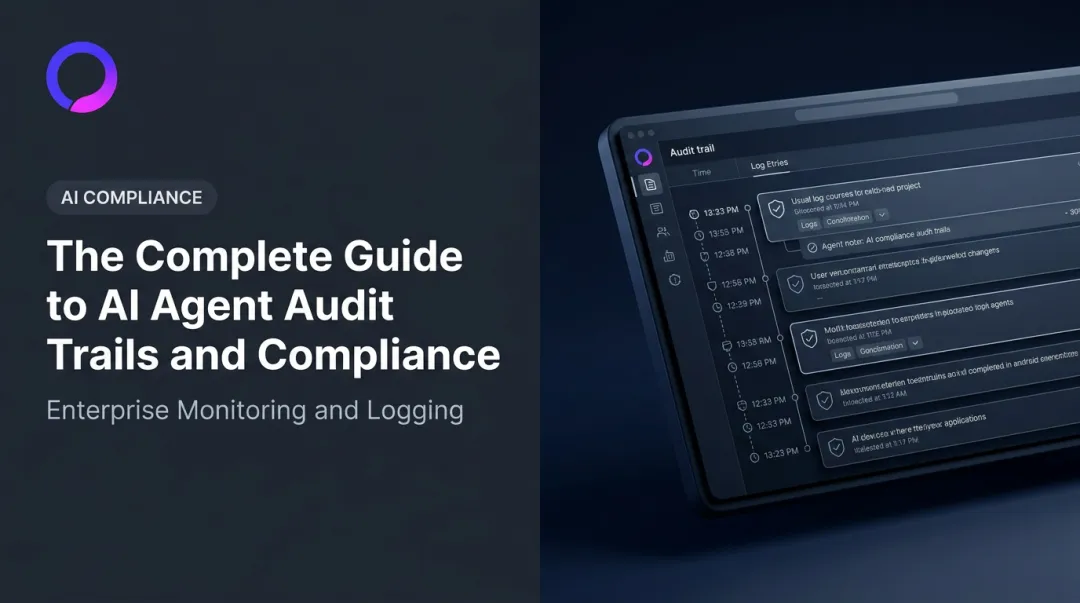
Decision-level audit trails are the most critical output of deployment auditing. EU AI Act Article 12 requires high-risk AI systems to support automatic event logging over the system lifetime — capturing period of use, input data or reference databases, and persons involved in verification. Logs must be tamper-evident, timestamped, and replayable for regulatory review.
For agentic AI specifically, audit trails must capture tool calls, API interactions, and agent-to-agent handoffs — not just model inferences. Each action in an autonomous workflow is a potential compliance event.
This is where many existing security tools fall short. PromptHalo generates decision-level, replayable audit logs across every inference, tool call, and agent handoff, mapped to OWASP LLM Top 10, NIST AI RMF, and the EU AI Act. It deploys without model retraining or code rewrites.
Key AI Auditing Frameworks for Regulated Industries
Most regulated enterprises blend elements from multiple frameworks rather than applying one in isolation. The practical starting point is identifying which frameworks map directly to your regulatory obligations — then layering from there.
| Framework | Core Focus | Best For |
|---|---|---|
| NIST AI RMF 1.0 | Govern, Map, Measure, Manage | US federal agencies, financial institutions, cross-sector baseline |
| COBIT 2019 | Enterprise IT governance with AI controls | Organizations connecting AI risk to existing IT audit programs |
| GAO AI Accountability Framework | Governance, data, performance, monitoring | Government contractors, agencies, public-sector accountability |
| EU AI Act | Risk-tiered classification with mandatory documentation | Any organization operating in or with EU markets |
NIST AI RMF (January 2023) is voluntary but widely referenced by US federal agencies. The companion NIST AI 600-1 (July 2024) extends it for generative AI risks — covering data provenance, harmful bias, hallucination, and misuse. NIST also publishes crosswalk documents mapping the RMF to other standards, which makes it a practical anchor before adding sector-specific requirements.
EU AI Act classifies AI into four risk tiers: prohibited, high risk, limited risk, and minimal risk. High-risk applications — credit scoring is explicitly named — carry mandatory requirements including:
- Risk management systems
- Data governance documentation
- Technical documentation and automatic logging
- Human oversight mechanisms
- Conformity assessments before deployment
The Agentic AI Audit Gap: What Traditional Approaches Miss
Most AI audit frameworks were designed for static, single-model deployments. A model receives an input, produces an output, and that exchange gets logged. Agentic AI doesn't work that way.
In an agentic system, AI autonomously calls tools, accesses APIs, retrieves data from RAG pipelines, and coordinates with other agents. Each of those actions is a potential compliance event. Traditional audit checklists and logging tools capture none of those intermediate steps.
New Audit Requirements for Agentic AI
Agentic deployments introduce attack vectors with direct regulatory implications:
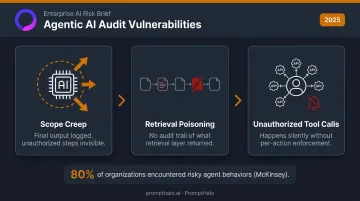
- Scope creep — An agent takes actions outside its authorized boundaries. Traditional logs show the final output, not the unauthorized steps taken to get there.
- Retrieval poisoning — Manipulated RAG outputs influence decisions. Without action-level logging, there's no audit trail of what the retrieval layer returned.
- Unauthorized tool calls — An agent invokes APIs beyond its intended scope. Without per-action enforcement, this happens silently.
McKinsey's agentic AI security research found that 80% of organizations encountered risky behaviors from AI agents, including improper data exposure and unauthorized system access. The OWASP 2025 Top 10 for LLMs specifically calls out Excessive Agency (LLM06), Vector and Embedding Weaknesses (LLM08), and Prompt Injection (LLM01) as priority risks.
SR 26-2 explicitly excludes generative and agentic AI from its scope, acknowledging these systems are "novel and rapidly evolving." Organizations shouldn't read that exclusion as clearance — it's a gap in coverage, not permission to proceed without controls.
Closing that gap requires enforcement that operates at the action level — not just at the model boundary. PromptHalo sits inline on every inference, tool call, and agent-to-agent handoff, making per-action decisions (allow, restrict, challenge, deny, or monitor) in under 100ms.
Security passports travel with each agent request, authority decays over time to force re-authorization, and every action generates a tamper-evident audit record that can be replayed for regulatory review.
How to Implement an AI Audit in a Regulated Environment
Step 1 — Establish Governance and Inventory Your AI Systems
Define roles across audit, legal, data science, and compliance teams before the first audit meeting. Then catalog every AI model and agentic workflow in use—including third-party and vendor-supplied systems—documenting:
- Training data sources and provenance
- Intended use and actual deployment context
- Risk classification under applicable frameworks
- Responsible owner and review cadence
OMB M-24-10 requires federal agencies to maintain exactly this kind of inventory. Private-sector organizations should treat it as a baseline expectation—the regulatory direction is clear across industries.
With your inventory in place, the next step is deciding where to focus your audit effort.
Step 2 — Conduct a Risk-Tiered Assessment
Not all AI systems carry equal regulatory exposure. Prioritize audit depth based on two factors: how consequential the decisions are, and how autonomous the system is.
- Deeper scrutiny: Credit decisioning, patient triage, fraud detection, AML monitoring
- Moderate scrutiny: Customer-facing AI with compliance implications
- Lighter scrutiny: Internal productivity tools with limited downstream impact
SR 26-2 explicitly requires model risk management practices tailored to model risk, complexity, use, and organizational size. The same logic applies outside banking—risk-proportionate oversight is the expectation across regulated sectors.
Risk tiers directly shape what documentation your audit must produce. Once you know which systems require deeper scrutiny, you can design evidence workflows accordingly.
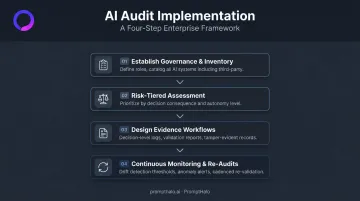
Step 3 — Design Evidence Collection and Documentation Workflows
Determine what constitutes admissible evidence for your regulators before an examination—not after one starts. That typically includes:
- Decision logs at the action level (not just system logs)
- Model version history and change documentation
- Validation reports and drift alert records
- Human review confirmation where required
Logs must be automated, tamper-evident, and organized for rapid retrieval. PromptHalo's audit logs are append-only by design—once written, they cannot be modified or removed—creating a replayable evidence trail for compliance export and post-incident investigation.
Step 4 — Establish Continuous Monitoring and Cadenced Re-Audits
Regulators now expect AI oversight to be continuous, not point-in-time. Set explicit thresholds and document them in your governance policy:
- Drift detection triggers that initiate review
- Anomaly alert thresholds and escalation paths
- Mandatory re-validation events (model updates, data source changes, significant performance shifts)
- Documented review cadence aligned to model risk tier
Frequently Asked Questions
How can artificial intelligence systems be audited?
AI audits follow a structured process covering data quality, model behavior, explainability, and deployment governance. Organizations use frameworks like NIST AI RMF or COBIT alongside automated monitoring tools that generate continuous, tamper-evident compliance evidence across the model lifecycle.
What is AI regulatory compliance?
AI regulatory compliance means meeting the legally enforceable requirements and sector-specific guidelines governing how AI systems are built, validated, monitored, and documented—such as SR 26-2 in banking, HIPAA in healthcare, and FedRAMP in government. Requirements vary by sector but consistently demand documentation, human oversight, and auditable evidence.
What are the key AI audit requirements for financial services organizations?
Financial institutions must demonstrate independent model validation, ongoing performance monitoring, and thorough documentation under SR 26-2. Models influencing credit, fraud, and AML decisions face the deepest scrutiny. Because SR 26-2 explicitly excludes generative and agentic AI, banks need separate governance frameworks for those systems.
What should an AI audit trail include?
A defensible audit trail must capture the inputs, context, enforcement decision, and outcome of each AI action at the decision level — aggregate system logs alone are insufficient. Records must be tamper-evident, timestamped, and replayable so regulators can reconstruct exactly what happened during any decision.
How is auditing agentic AI systems different from auditing traditional AI models?
Agentic AI must be audited at the action level—each tool call, API interaction, retrieval operation, and agent-to-agent handoff is a potential compliance event. Traditional AI audits focus on model inputs and outputs, missing the autonomous workflow layer entirely where scope creep, retrieval poisoning, and unauthorized API access occur.