Introduction
AI agents have moved well past the assisted-tool phase. They now plan multi-step tasks, call external APIs, approve transactions, and chain actions across workflows — often without a human reviewing each decision. That shift reframes the security question. The question is no longer what the model said — it's what the agent is doing right now, and whether it should be allowed to continue.
Traditional security stacks weren't built for this. Firewalls, DLP, SIEM, and code scanners were designed for deterministic systems — they have no visibility into prompt injection embedded in retrieved documents, memory poisoning between sessions, or an agent quietly escalating privileges through over-scoped tokens. As deployments scale, that gap widens fast.
McKinsey's 2025 State of AI survey found 23% of organizations are already scaling agentic AI systems, with another 39% actively experimenting. Meanwhile, 80% of organizations have encountered risky agent behaviors — including unauthorized access and improper data exposure. The infrastructure to govern those behaviors hasn't kept pace.
That's the gap this article addresses. Below are five platforms purpose-built for agentic AI security, evaluated on runtime enforcement depth, behavioral analysis methodology, and compliance audit capability.
Key Takeaways
- Enforce security inline, at the moment of execution — posture scans alone leave the agentic attack surface unprotected
- Prompt injection and multi-agent handoff abuse are invisible to rule-based and signature-based detection
- ML-based behavioral analysis dramatically outperforms rule-based approaches on both catch rate and false positive rate
- Regulated environments now require tamper-evident, decision-level audit logs mapped to OWASP LLM Top 10, NIST AI RMF, and the EU AI Act
- Select platforms based on the agent archetypes in your environment, not brand recognition or SecOps feature breadth
What Is Agentic AI Runtime Security and Why It Matters
Posture vs. Runtime: A Critical Distinction
AI Security Posture Management (AI-SPM) scans configuration, permissions, and model settings before deployment. It's a snapshot. Runtime security is a continuous film: enforcing policy on every agent action, tool call, and handoff as they happen.
The gap matters because an agent with a perfect posture score can still be hijacked mid-session via indirect prompt injection. A retrieved document, an email attachment, a web page the agent pulls — any of these can carry hidden instructions that redirect agent behavior. Posture scanning alone won't catch it; runtime enforcement does.
The Agentic Attack Surface
Runtime monitoring must cover a broader surface than most security teams initially expect:
- Direct prompt injection — attacker-crafted input in the user's prompt that manipulates agent behavior
- Indirect prompt injection — malicious instructions embedded in documents, emails, or web content the agent retrieves (OWASP LLM01:2025)
- RAG retrieval poisoning — NIST AI 600-1 flags how indirect injection through retrieved data can enable remote code execution and proprietary data theft
- Unauthorized tool and API calls — OWASP LLM06:2025 (Excessive Agency) covers over-scoped permissions enabling damaging actions
- Data exfiltration through legitimate channels — EchoLeak demonstrated zero-click data exfiltration from Microsoft 365 Copilot through a prompt injection chain
- Multi-agent handoff abuse — trust assumptions between agents can be exploited when one agent passes context or authority to another
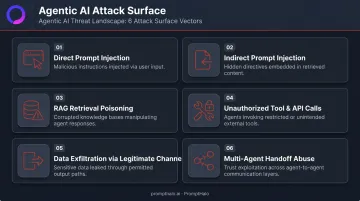
Each of these produces behavior that looks normal in standard logs. Distinguishing legitimate agent action from a hijacked one requires behavioral analysis with a runtime enforcement layer — and that distinction has to happen before the action executes, not after.
Top 5 Agentic AI Security Platforms for Runtime Monitoring and Behavioral Analysis
Platforms were selected based on runtime enforcement depth, behavioral analysis methodology, agentic attack surface coverage, compliance audit capability, and deployment model — not brand recognition or breadth of general security features.
PromptHalo
PromptHalo is a purpose-built runtime security and trust platform for agentic AI, designed specifically for the autonomous tool call, RAG retrieval, and multi-agent handoff attack surface that legacy security stacks cannot see. It combines continuous red-team attack discovery with a real-time enforcement engine in a closed-loop defense: every attack discovered trains the enforcement layer through a shared Threat Library, so protection compounds without waiting for a new release cycle.
What sets it apart:
- ML-based detection achieving over 95% catch rate and under 5% false positives, versus roughly 35% catch and 15–20% false positives for rule-based approaches
- Inline enforcement in under 100ms on every inference, tool call, and agent-to-agent handoff — decisions are allow, restrict, challenge, deny, or monitor, made before actions execute
- Agent security passports issued per request, with policy, budget, and authority decay built in — agent authority doesn't persist indefinitely; budgets across time, steps, and risk force re-authorization when thresholds are exceeded
- Model- and vendor-agnostic deployment in under a day with no model retraining and no code rewrite, via API gateway, agent mode, or inline middleware
- Tamper-evident, append-only audit logs capturing decision reason, acting agent identity, session context, and timestamp — structured for regulatory export
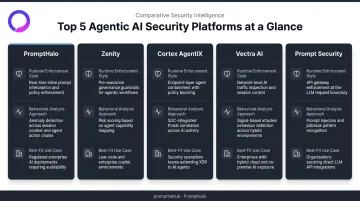
| Capability Area | Detail |
|---|---|
| Key Runtime Capabilities | Prompt injection and jailbreak blocking, RAG retrieval poisoning detection, out-of-scope tool and API call enforcement, multi-agent handoff trust verification, real-time data leakage prevention |
| Behavioral Analysis Approach | ML-based intent and behavioral analysis with a shared Threat Library between red-team discovery and runtime enforcement; closed-loop system where every discovered attack compounds future protection |
| Best For | Enterprises and fintech organizations deploying agentic AI who need real-time, inline protection with compliance-grade audit trails and no disruption to existing model infrastructure |
Zenity
Zenity covers the full agent lifecycle from discovery through runtime threat response, giving security teams unified visibility across SaaS-managed, cloud-deployed, and endpoint-based agents from a single console. Gartner named Zenity "Company to Beat" in AI Agent Governance (April 2026) and "Cool Vendor" in Agentic AI TRiSM (Trust, Risk, and Security Management) (September 2025).
What sets it apart:
- Correlation Agent (introduced December 2025) analyzes complete execution paths — tool calls, memory access patterns, data usage sequences, and control flow — surfacing malicious intent that API-level logging alone would miss
- Dynamic graph analysis stitches build-time configuration with live runtime behavior, catching deviations that only appear when both views are combined
- RBAC, human-in-the-loop approvals, tool allowlisting, and AI Security Posture Management combine with inline prevention for governance at scale
| Capability Area | Detail |
|---|---|
| Key Runtime Capabilities | Intent-aware behavioral correlation, tool allowlisting, shadow AI discovery, inline prevention at execution time, RBAC and human-in-the-loop approvals |
| Behavioral Analysis Approach | Correlation Agent stitches build-time configuration with live runtime execution paths to detect malicious intent that individual API calls would not surface |
| Best For | Enterprise security teams managing large, complex agent ecosystems across multiple SaaS platforms and cloud environments requiring governance at scale |
Palo Alto Networks Cortex AgentiX
Announced October 2025, Cortex AgentiX is Palo Alto Networks' enterprise-grade agentic AI security offering delivered through the Cortex platform. It is available embedded in Cortex XSIAM and Cortex Cloud, and is positioned as the next generation of Cortex XSOAR. Named customers include the Ministry of Justice, the NHL, and Coveo.
What sets it apart:
- Persona-based system agents that plan and execute across integrated tools while staying inside enterprise guardrails and approval gates
- Over 1,000 integrations plus native MCP support, RBAC, least-privilege controls, and human-in-the-loop approvals built into the agent execution layer
- Behavioral analysis embedded within the broader Cortex telemetry and correlation engine, making it strongest for organizations already operating within the Palo Alto platform stack
| Capability Area | Detail |
|---|---|
| Key Runtime Capabilities | Execution-time policy enforcement, tool and MCP allowlists, RBAC and human-in-the-loop approvals, full agent action audit trail, prompt injection inspection |
| Behavioral Analysis Approach | Agentic SOC workflow automation with governance controls; behavioral analysis embedded within the broader Cortex telemetry and correlation engine |
| Best For | Enterprises seeking platform-native agentic SOC workflows with deep integration across the full Cortex ecosystem (XSIAM, XDR, Cloud) |
Vectra AI
Vectra AI is a behavioral detection platform built for environments where non-human identities and AI agents drive business operations across hybrid on-premises, multi-cloud, and SaaS infrastructure.
Its strength is detecting AI-powered adversaries who weaponize legitimate, authorized agents for reconnaissance or lateral movement — behaviors that API-level logging cannot distinguish from normal operations.
What sets it apart:
- AI Stitching technology correlates attack behaviors across network, identity, and cloud domains in real time, constructing complete attack narratives from fragmented signals
- Covers service principals, cloud principals, and machine credentials across Active Directory, Entra ID, Microsoft 365, Azure, and AWS — recognized by GigaOm for full-spectrum human and non-human identity coverage
- Pre-built behavior-based threat hunts and automatic agent identity tracking; documented outcomes include ED&F Man Holdings reducing alerts from 200 per week to 4–5 per month
| Capability Area | Detail |
|---|---|
| Key Runtime Capabilities | Behavioral AI detection, AI Stitching for cross-domain attack narrative construction, automatic agent identity tracking, behavior-based threat hunts, attack prioritization by progression speed |
| Behavioral Analysis Approach | Cross-domain signal correlation stitching network, identity, and cloud telemetry into complete attack narratives; detects agent abuse even when legitimate authorized tools are used |
| Best For | Organizations defending against AI-powered adversaries across hybrid infrastructure who need behavioral detection beyond API-level logging |
Prompt Security
Prompt Security functions as a runtime enforcement and MCP gateway layer sitting between AI applications and the tools, models, and data sources they connect to. It's built for organizations managing AI tool sprawl across mixed LLM and self-hosted model deployments who need control without rearchitecting their stack.
What sets it apart:
- MCP gateway security with dynamic risk scoring across more than 13,000 available MCP server integrations — every request and response is inspected in real time at the gateway layer
- Prompt injection detection at execution time, sensitive data redaction at the egress layer, and shadow AI discovery
- Searchable compliance audit logs covering agent-to-tool interactions — useful for incident investigation when traffic doesn't route through a single control plane
| Capability Area | Detail |
|---|---|
| Key Runtime Capabilities | Prompt injection detection at execution time, MCP gateway risk scoring, sensitive data redaction at egress, shadow AI discovery, searchable compliance audit logs |
| Behavioral Analysis Approach | Dynamic risk scoring at the MCP gateway layer, evaluating agent-to-tool interactions for injection patterns and unauthorized data access in real time |
| Best For | Organizations needing MCP-level control and prompt injection defense across heterogeneous AI environments including mixed LLM and self-hosted model deployments |
How We Chose These Platforms
Evaluation Criteria
Platforms were assessed specifically on runtime monitoring and behavioral analysis capabilities — not general-purpose SecOps features. The most common buyer mistake is selecting platforms based on discovery breadth and posture scores while overlooking whether enforcement actually happens before actions execute or only after.
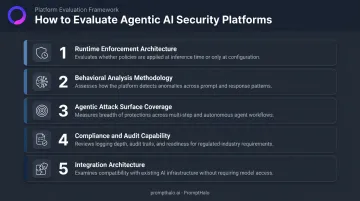
The five criteria used:
- Runtime enforcement architecture — does enforcement happen inline and pre-execution, or is it limited to post-hoc logging?
- Behavioral analysis methodology — ML-based intent analysis versus rule-based pattern matching, measured by detection accuracy and false positive rate
- Agentic attack surface coverage — prompt injection, RAG poisoning, tool misuse, multi-agent handoffs, MCP gateway security
- Compliance and audit capability — tamper-evident logs, decision-level granularity, regulatory framework mapping (OWASP LLM Top 10, NIST AI RMF, EU AI Act)
- Integration architecture — compatibility with existing SIEM, SOAR, XDR, and identity providers without requiring model retraining or code rewrites
Important Caveats
These criteria reflect what matters at runtime — but a few things fall outside this evaluation's scope. Before committing to any platform:
- Pricing and internal performance benchmarks were not assessed
- Coverage depth varies by agent archetype; homegrown, SaaS-managed, and endpoint-based agents each present different detection surfaces
- Run a structured POC against your specific agent types before finalizing any selection
Conclusion
The security question for agentic AI has permanently shifted. Configuration governance and access controls matter, but they don't address what an agent is actually doing at the moment of execution. Choosing a platform based on discovery breadth or posture scores alone leaves the most dangerous part of the attack surface — runtime behavior — unprotected.
Prioritize runtime enforcement depth, behavioral analysis methodology, and compliance audit capability over brand name or general-purpose security feature count. Evaluate platforms against the specific agent types and regulated workflows your organization runs.
Those criteria point to a narrow field of genuinely purpose-built tools. For enterprises deploying agentic AI in fintech, payments, or other regulated environments, PromptHalo's closed-loop approach — red-teaming your AI to surface exploitable attack paths, then enforcing trust on every agent action at runtime — was built for exactly this problem, not retrofitted to it.
Request a demo or assessment to see how it maps to your specific agent architecture and compliance requirements.
Frequently Asked Questions
What is the difference between agentic AI security and traditional GenAI security?
Traditional GenAI security focuses on what the model outputs — catching jailbreaks, harmful responses, and prompt abuse at the inference layer. Agentic AI security addresses what the agent does: tool calls, API access, multi-step workflow execution, and data retrieval decisions where a single compromised action can cascade across systems at machine speed.
What is behavioral analysis in the context of AI agent runtime security?
Behavioral analysis establishes a baseline of normal agent operation — tool sequences, memory access patterns, execution timing, decision paths — and flags meaningful deviations. Unexpected tool invocations, memory reuse from unrelated sessions, or execution sequences that bypass expected controls can all be surfaced before they escalate into a breach.
How does runtime monitoring protect against prompt injection attacks?
Runtime monitoring intercepts content at the point of execution before the agent acts on it — covering both direct injection in the user prompt and indirect injection where malicious instructions are embedded in documents, emails, or web pages the agent retrieves. Detection runs before the response is delivered, not after.
What should security teams look for when evaluating agentic AI security platforms?
Start with enforcement architecture — pre-execution blocking versus post-hoc detection — then evaluate whether detection is ML-based or rule-based. From there, confirm coverage for your agent types (homegrown, SaaS-managed, endpoint-based), audit log tamper-evidence, and SIEM/SOAR integration depth.
How do agentic AI security platforms integrate with existing SOC infrastructure?
Full-featured platforms offer bidirectional integration with SIEM, SOAR, XDR, and identity providers — agent telemetry flows into existing dashboards, and enforcement actions can be triggered from existing playbooks. The intent is to extend your current SOC workflows, not build a separate operations track next to them.
What compliance frameworks do agentic AI security platforms typically support?
Leading platforms map audit trails to OWASP LLM Top 10, NIST AI RMF, and the EU AI Act. Financial services and healthcare teams should specifically verify that logs are tamper-evident, captured at the decision level, and exportable for regulatory reporting and post-incident review.