Introduction
When AI systems were mostly experimental, a missed anomaly meant a degraded user experience. Now that they're running financial transactions, customer workflows, and autonomous agent decisions, the same gap means compliance exposure, security incidents, and real business losses.
Traditional monitoring tools weren't built for this. Static rules only alert after a limit is crossed — by which point the damage may already be done. AI-powered observability platforms work differently: they use ML to learn what "normal" looks like for each service, model, and data pipeline, then flag deviations automatically, without requiring manual threshold configuration.
The urgency is real. According to Technavio, the AI in observability market is projected to grow by $2.92 billion between 2025 and 2029 at a 22.5% CAGR — driven by enterprises that can no longer afford blind spots in production AI.
That growth reflects a real shift in what enterprises need. This article covers the top platforms for 2026, what separates genuine AI-native observability from rebranded APM, and what teams deploying agentic AI need to evaluate beyond standard performance monitoring.
TL;DR
- AI observability platforms use ML baselines to detect behavioral anomalies across infrastructure, models, pipelines, and agentic systems — not just threshold breaches.
- The best 2026 platforms combine real-time anomaly detection, automated root cause analysis, and end-to-end tracing.
- Key selection criteria: detection accuracy, integration depth, LLM/agent coverage, and compliance audit readiness.
- Top platforms: Dynatrace, Datadog, New Relic, Arize AI, and WhyLabs — reviewed by use case and team fit below.
- Agentic AI deployments require security-layer coverage — prompt injection, tool abuse, and retrieval poisoning — that performance observability tools aren't built to catch.
What Is AI-Powered Observability and Why It Matters in 2026
AI-powered observability is the practice of using machine learning to continuously monitor systems, models, and data pipelines, automatically establishing behavioral baselines and flagging deviations without manual threshold configuration. Traditional rule-based monitoring reacts after something breaks. AI observability catches the signal before it escalates.
Why 2026 Is Different
The shift isn't incremental. Three data points make the scale concrete:
- McKinsey's March 2025 State of AI survey found 78% of organizations now use AI in at least one business function
- A PwC survey of 300 senior executives found 79% are already adopting AI agents in their companies
- Deloitte reports only 20% of companies have a mature governance model for autonomous agents
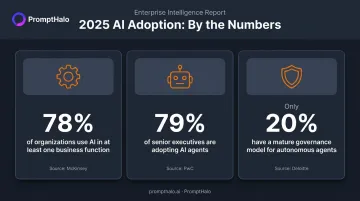
That scale creates an entirely new anomaly surface. Agentic AI systems make autonomous decisions — tool calls, API interactions, multi-agent handoffs — that extend well beyond infrastructure latency or model drift into behavioral and security territory.
Most enterprises are running agentic systems with real observability gaps. The governance hasn't kept pace with the deployment.
The platforms reviewed below were evaluated specifically against these evolving use cases — not just their performance on traditional APM workloads.
Top AI-Powered Observability Platforms for Anomaly Detection in 2026
Platforms were evaluated across six criteria:
- Detection accuracy and dynamic baselining
- Integration breadth and deployment simplicity
- Root cause analysis depth
- LLM and agentic AI workload support
- Compliance readiness and audit capabilities
Dynatrace
Dynatrace is an enterprise-grade software intelligence platform built around the Davis AI engine, which auto-discovers topology and baselines every metric across cloud-native, hybrid, and containerized environments — no manual threshold configuration required.
What sets it apart is deterministic root cause analysis. Davis traces anomalies through the full causal topology to the responsible service, infrastructure component, or dependency — not just the symptom. For large SRE and DevOps teams managing microservices at scale, that precision cuts alert fatigue in half. Forrester named Dynatrace a Leader in AIOps Platforms, Q2 2025, with the highest Current Offering score in that evaluation.
| Attribute | Details |
|---|---|
| Key Features | Autonomous anomaly detection with dynamic baselining; OneAgent auto-instrumentation; SmartScape topology mapping; OpenTelemetry support; Davis AI root cause correlation |
| Best For | Large enterprises with complex, cloud-native infrastructure requiring hands-off, continuous anomaly detection and automated incident prioritization |
| Pricing Model | Usage-based, billed hourly; Full-Stack Monitoring at $0.01 per memory-GiB-hour (~$0.08/hr per 8 GiB host, $58/month per 8 GiB host); no per-agent fees |
Datadog
Datadog is a unified observability platform covering infrastructure, APM, logs, real user monitoring, and LLM workloads. Anomaly detection runs through the Watchdog AI engine, which maps service dependencies continuously and correlates anomalies into composite incidents — automating root cause analysis across the full stack.
The dedicated Agent Observability product extends this to LLM and agentic AI workloads, tracking:
- Token usage, costs, and latency
- Prompt-response chains and hallucination risk
- PII controls and policy violations
Tool, workflow, and retrieval spans are included free; LLM provider calls are billed as LLM spans.
Forrester also named Datadog a Leader in AIOps Platforms, Q2 2025.
| Attribute | Details |
|---|---|
| Key Features | Watchdog AI anomaly detection and RCA; Agent Observability for LLM/agentic workloads; hallucination and PII detection; 500+ integrations; unified metrics, logs, and traces |
| Best For | DevOps and ML teams seeking a consolidated platform covering both infrastructure anomaly detection and LLM/generative AI monitoring |
| Pricing Model | Usage-based; Agent Observability Free tier: 40,000 LLM spans/month; Pro: $160/month for 100,000 LLM spans (annual); additional usage at $3.50 per 10,000 LLM spans |
New Relic
New Relic is a cloud observability platform with a strong Applied Intelligence layer that applies ML to detect anomalies across full-stack telemetry — from infrastructure and APM to custom business metrics and generative AI workloads.
Its Lookout feature provides a heatmap-style deviation view where circle size and color indicate the magnitude and direction of metric changes — useful for scanning estate-wide anomalies at a glance. Recent integrations with Azure OpenAI enable teams to track prompt-response chains, latency, cost-per-call, and model switching behavior in production.
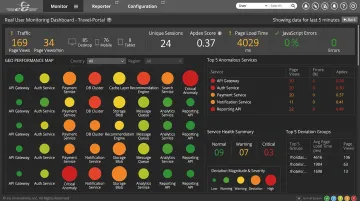
New Relic's pricing transparency is a genuine differentiator: 100 GB/month of free data ingest, with paid tiers charging per GB rather than per host.
| Attribute | Details |
|---|---|
| Key Features | Applied Intelligence anomaly detection; Lookout deviation heatmap; issue correlation and root cause suggestion; GenAI workload tracing; Azure OpenAI dashboard; 780+ integrations |
| Best For | IT operations and SRE teams wanting AI-assisted anomaly detection across existing telemetry, including teams beginning to monitor LLM-powered features in production |
| Pricing Model | Free tier: 100 GB data ingest/month; paid tiers at $0.40/GB (Original) or $0.60/GB (Data Plus); user-type pricing for Core and Full Platform users; no host-based fees |
Arize AI
Arize AI is a purpose-built ML and LLM observability platform focused on model performance monitoring, drift detection, and agentic AI tracing. It's designed for teams who need production-grade visibility into how models and AI pipelines actually behave at scale.
Unlike general-purpose APM tools, Arize provides slice-wise performance breakdowns to isolate failure modes by cohort or dimension — critical for diagnosing why a model degrades for a specific user segment or input type. Its Phoenix edition is free and open-source for self-hosted environments, covering both pre-production evaluation and continuous production monitoring in a single tool.
| Attribute | Details |
|---|---|
| Key Features | Real-time drift detection; LLM evaluation and distributed tracing for multi-agent workflows; interactive performance heatmaps; slice-wise breakdown by cohort; open-source Phoenix edition |
| Best For | ML engineering and AI product teams deploying LLMs or multi-agent systems who need model-specific observability — drift, evaluation quality, and behavioral monitoring in production |
| Pricing Model | Phoenix: free and open-source (self-hosted); AX Free: 25,000 trace spans/month, 1 GB, 15-day retention; AX Pro: $50/month (50,000 spans, 10 GB); Enterprise: custom-quoted |
WhyLabs
WhyLabs has discontinued commercial operations — worth noting upfront before evaluating it. While active, it was a privacy-focused AI observability platform notable for capturing 100% of inferences without sampling, avoiding the outlier-blindness that affects sampled monitoring approaches. Its LLM guardrails covered toxicity, prompt injections, PII leakage, malicious activity, and hallucinations.
Important caveat: WhyLabs' official documentation now states the company is discontinuing commercial operations and has open-sourced its complete platform. The core whylogs library remains active, infrastructure-agnostic, and usable across AWS, GCP, Azure, or local servers. Teams considering WhyLabs should evaluate it as an open-source component rather than a supported commercial SaaS product, and verify support and deployment terms directly before committing.
| Attribute | Details |
|---|---|
| Key Features | 100% inference capture; LLM guardrails (injection, PII leakage, toxicity, hallucination detection); cohort and bias analysis; open-source whylogs library |
| Best For | Teams with engineering capacity to self-host and configure open-source ML observability tooling — particularly where the whylogs profiling library fits an existing data pipeline |
| Pricing Model | Platform open-sourced; verify current commercial support and pricing directly with any fork or successor |
Key Features to Look For in AI Observability Platforms
ML-Based Dynamic Baselining vs. Rule-Based Thresholds
The fundamental differentiator in 2026 is whether a platform learns your environment's normal behavior automatically or requires manual threshold configuration. ML-based systems adapt to seasonality, traffic shifts, and model drift — producing far fewer false positives.
An ACM survey on AIOps methods found ML-based approaches achieving detection rates above 91% with false-alarm rates under 17%, versus rule-based methods at 38–40% false-alarm rates. The noise compounds fast: PagerDuty estimates security operations centers receive an average of 4,484 daily alerts from rule-based systems that flag everything.
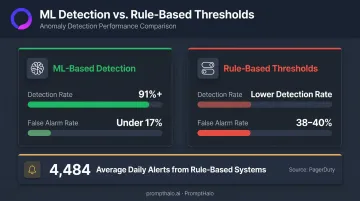
PromptHalo, for example, applies ML-based detection achieving over 95% catch rate at under 5% false positives for AI-specific behavioral anomalies — versus roughly 35% catch rate and 15–20% false positives for rule-based approaches. That benchmark reflects what teams should demand from any AI observability or security enforcement layer.
Automated Root Cause Analysis
Detecting an anomaly means little without rapid root cause tracing. Look for platforms that correlate signals across:
Look for tools that correlate signals across:
- Services and infrastructure dependencies
- Data pipelines and model layers
- Agent tool calls and retrieval steps
- Deployment events and configuration changes
The result: mean time to resolution drops from hours to minutes.
LLM and Agentic AI Tracing
In 2026, teams deploying LLMs and multi-agent systems need trace-level visibility into each inference, tool call, retrieval step, and agent-to-agent handoff — not just infrastructure metrics. Without it, anomalies in AI behavior (a model silently degrading in relevance, an agent making out-of-scope tool calls) are invisible.
OpenTelemetry's March 2025 agent observability guidance now enables AI agent frameworks to report standardized metrics, traces, and logs — making it practical to integrate and compare observability solutions across vendors without custom instrumentation.
Security-Layer Anomaly Detection for Agentic AI
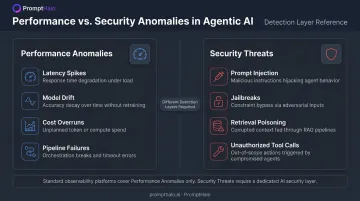
Performance anomalies and security anomalies require fundamentally different detection approaches — and most observability platforms only handle the first category.
Performance issues include latency spikes, model drift, and cost overruns. Security threats include prompt injection, jailbreaks, retrieval poisoning, and unauthorized tool calls. Standard observability tooling has no visibility into the latter.
Enterprises deploying autonomous AI agents should evaluate whether their stack covers the security attack surface separately. Purpose-built AI security platforms like PromptHalo extend beyond what observability tools are designed to do — operating inline on every inference, tool call, and agent handoff, enforcing decisions in under 100ms before actions execute.
Compliance and Audit Readiness
Regulated industries need more than operational dashboards. Evaluate whether the platform can generate:
- Tamper-evident, decision-level logs — not just aggregate metrics
- Framework-mapped audit trails aligned to OWASP LLM Top 10, NIST AI RMF, or EU AI Act Article 12 (which requires automatic event logging for high-risk AI systems)
- Replayable records that support regulatory investigations and post-incident analysis
How We Chose the Best AI Observability Platforms
Platforms were assessed on ML-based detection quality, deployment simplicity, LLM/agentic AI coverage depth, compliance and audit support, and proven fit for regulated or high-stakes enterprise environments.
One pitfall shaped this weighting heavily: teams that choose platforms based on feature volume rather than detection accuracy. The result is alert fatigue and gaps in AI-specific anomaly coverage, both of which compound quickly as AI deployments scale.
AI-native capabilities carried the most weight in our scoring. As workloads shift from standalone models to multi-step agentic pipelines, general-purpose APM tools increasingly leave visibility gaps. Platforms with specific investment in LLM tracing, evaluation, and guardrails scored higher. This is the dominant observability challenge heading into 2026.
Additional factors weighted:
- Pricing transparency — usage-based models score better than opaque enterprise-only pricing
- OpenTelemetry support — essential for avoiding vendor lock-in and maintaining portability
- Deployment flexibility — cloud, VPC, and self-hosted options matter for data governance requirements
- No model access required — solutions that work without touching model weights or requiring retraining fit more enterprise environments
Conclusion
Selecting an AI observability platform in 2026 is a risk management decision, not just a DevOps one. As AI systems make more autonomous decisions with real business consequences, observability gaps translate directly into compliance exposure, operational failures, and undetected adversarial attacks.
Evaluate platforms not only on performance monitoring capabilities, but on their ability to detect behavioral anomalies, support compliance reporting, and scale alongside expanding AI deployments. Pilot tools in your actual environment — synthetic benchmarks don't reflect production edge cases.
Observability tells you what happened. For enterprises deploying agentic AI, that's often not enough — you need enforcement before the action executes. PromptHalo fills that gap with runtime security purpose-built for the agentic attack surface:
- Blocks prompt injection, jailbreaks, retrieval poisoning, and unauthorized tool calls in under 100ms
- Deploys in under a day with no model retraining and no code rewrite
- Generates tamper-evident, decision-level audit logs mapped to OWASP LLM Top 10, NIST AI RMF, and the EU AI Act
Frequently Asked Questions
What are the best AI observability tools?
Dynatrace and Datadog lead for full-stack enterprise observability with AI-powered anomaly detection; Arize AI and WhyLabs (now open-source) are stronger for ML and LLM-specific monitoring; New Relic suits teams wanting AI-assisted insights across existing telemetry. The best choice depends on whether your primary need is infrastructure anomaly detection, model performance monitoring, or agentic AI security coverage.
What is the best tool for anomaly detection?
Dynatrace leads for autonomous infrastructure anomaly detection in complex cloud environments; Datadog's Watchdog is strongest for unified APM and LLM anomaly detection; Arize AI is better suited for ML model and agentic AI behavioral monitoring. Match the tool to what you're monitoring — infrastructure, data pipelines, ML models, or agentic AI behavior.
What is the difference between AI observability and traditional monitoring?
Traditional monitoring relies on static, manually configured thresholds and alerts after a threshold is crossed. AI observability uses ML to learn normal behavioral patterns dynamically, detect subtle anomalies before they escalate, perform automated root cause analysis, and cover emerging surfaces like LLM drift and agentic AI misbehavior that static rules cannot anticipate.
How does AI-powered anomaly detection reduce false positives?
ML-based detection learns what "normal" looks like per metric, service, or model — suppressing expected fluctuations rather than triggering on every threshold breach. This reduces alert fatigue significantly compared to rule-based approaches, which generate false positive rates of 15–20%.
What should enterprises look for in an AI observability platform for agentic AI?
Four criteria matter most: LLM and multi-agent trace-level visibility (not just infrastructure metrics); behavioral anomaly detection covering tool abuse and policy violations beyond performance; compliance-ready audit logging mapped to AI governance frameworks; and the ability to deploy without accessing or retraining proprietary models.