Introduction
Autonomous AI agents are moving fast in fintech and healthcare. They're approving loans, flagging suspicious transactions, summarizing patient records, and routing prior authorizations, often completing dozens of downstream actions before a human reviews anything.
That autonomy is the point — and the exposure.
Traditional security tools were built for deterministic software that executes fixed instructions. They have no way to evaluate whether an agent's reasoning was manipulated, whether a retrieved document was poisoned, or whether a tool call exceeded the agent's actual authorization. Gartner predicts over 40% of agentic AI projects will be canceled by end-2027 due to costs, unclear value, or inadequate risk controls — a warning that governance on paper doesn't equal protection in production.
This article explains where the real exposure lives, why existing security stacks miss it, and what runtime enforcement actually requires in environments governed by HIPAA, SOX, GLBA, and the EU AI Act.
Key Takeaways
- Firewalls and DLP tools can't detect agentic attack surfaces: prompt injection, jailbreaks, retrieval poisoning, or out-of-scope tool calls
- CSA research found 53% of organizations have experienced AI agents exceeding their intended permissions
- Compliance frameworks define what must be protected; they don't enforce it at runtime
- Fintech and healthcare agents face direct financial liability and HIPAA breach obligations when compromised
- Regulators increasingly expect decision-level audit trails, not just access logs
Why Agentic AI Introduces a New Attack Surface in Regulated Environments
Traditional software takes an input and returns an output. An AI agent takes an input and then acts — querying a RAG pipeline, calling an external API, passing context to another agent, and triggering downstream workflows. Each of those steps is a potential attack surface that prior security generations never had to consider.
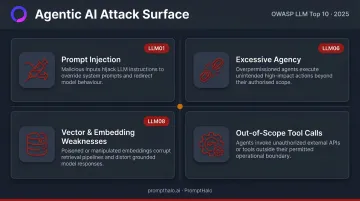
The Four Agentic Attack Vectors
OWASP LLM Top 10 (2025) defines the primary failure modes by name:
- Prompt injection (LLM01) — malicious instructions embedded in user input or retrieved documents that redirect the agent's behavior
- Excessive agency (LLM06) — agents granted more autonomy, functionality, or permissions than a task requires
- Vector and embedding weaknesses (LLM08) — corrupted RAG data stores that cause the agent to act on false or manipulated context
- Out-of-scope tool and API calls — the agent being manipulated into executing actions it was never authorized to perform, using credentials that look legitimate
The Autonomy Amplification Problem
A human analyst who receives a suspicious instruction can pause and verify. An autonomous agent executing a multi-step workflow may complete dozens of downstream actions before any human sees the output. One exploited prompt can cascade into a compliance incident, an unauthorized transaction, a data breach, or all three — all under valid credentials, all before any alert fires.
That compounding effect is what regulated environments are least equipped to contain.
The Authority Gap
Agents are typically granted permissions based on what they might need, not what they need right now. CSA reports that 53% of organizations have experienced AI agents exceeding their intended permissions, with 43% reporting more than 10 active agent identities running in production.
In environments governed by HIPAA's minimum-necessary standard or financial regulators' least-privilege requirements, that gap isn't a configuration issue. It's a control failure — one that auditors will find before the attack does.
What Compliance Frameworks Require vs. What They Don't Enforce
What the Frameworks Actually Say
| Framework | Core AI-Relevant Requirements |
|---|---|
| HIPAA (45 CFR 164.312) | Access controls, audit controls, integrity controls, authentication for ePHI; minimum-necessary standard for PHI access |
| GLBA (16 CFR Part 314) | Written security program, risk assessment, access controls, monitoring, service-provider oversight |
| SOX 302/404 | Executive certification of internal controls; management assessment of financial reporting controls |
| EU AI Act (Articles 9, 12, 13) | Continuous risk management, automatic event logging, transparency requirements for high-risk AI |
| DORA (effective Jan 2025) | ICT risk management, third-party ICT risk controls including AI vendors |
Each framework specifies outcomes — auditability, explainability, data minimization, documented controls — not the technical mechanisms for achieving them. That gap is where most AI deployments are exposed.
The Enforcement Gap
A policy document stating "agents must not access out-of-scope data" is not a technical control. It describes intent. Regulators have already started treating that distinction as enforceable — and organizations that rely on governance documentation without underlying technical controls are finding that out under examination.
The EU AI Act's risk-based classification places most fintech and healthcare agents squarely in the high-risk category under Annex III. That triggers requirements for continuous monitoring and logging at the action level — not just the model level. The CFPB has already stated that creditors using complex algorithms must provide specific adverse-action reasons regardless of model complexity. The SEC charged two investment advisers in 2024 for misleading AI claims, with civil penalties totaling $400,000 — a signal that AI governance representations are now examinable.
Meeting these obligations requires technical controls that generate evidence, not just policies that describe intent.
Why Your Existing Security Stack Can't See Agentic Attacks
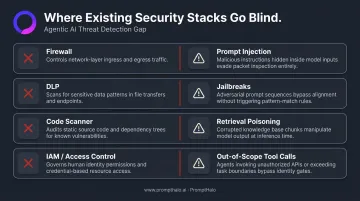
Firewalls inspect network traffic. DLP tools scan file content. Code scanners analyze static code. None of these tools were designed to evaluate the semantic content of an agent's reasoning, validate whether a tool call falls within authorized scope, or detect whether a retrieved RAG document has been tampered with.
Specific Blind Spots
- Prompt injection arrives as natural language text that passes every content filter — it looks like a normal user query until the agent's behavior changes
- Jailbreaks appear as ordinary conversation until the agent starts producing anomalous outputs
- Retrieval poisoning happens inside the data pipeline, entirely invisible to perimeter security
- Out-of-scope tool calls look like legitimate API requests because the credentials are real — only the authorization context is wrong
The False Positive Problem
Security teams in fintech and healthcare already operate under significant alert volume. Rule-based detection approaches generate high false positive rates by design — they flag anything that matches a pattern, regardless of actual intent. In practice, these systems get tuned down or ignored. Real attacks go undetected. Analyst time gets burned on noise.
ML-based detection changes this calculus. PromptHalo's detection engine achieves a catch rate above 95% at under 5% false positives, combining Threat Library signatures with classifier-based risk scoring to reduce reliance on brittle rules. That's what makes operational deployment practical — precise enough to catch real threats, quiet enough that analysts actually trust the alerts.
Industry-Specific AI Agent Threats: Fintech and Healthcare
Fintech: Where Agent Autonomy Meets Financial Risk
The highest-risk agentic workflows in financial services involve real-money decisions:
- Transaction approval and payment routing agents
- AML/KYC verification and case management agents (McKinsey notes these are already being automated in bank financial-crime compliance)
- Credit decisioning agents — subject to CFPB's requirement for explainable adverse-action reasons
- Trade reconciliation and financial reporting agents flagged by PCAOB for GenAI audit risks
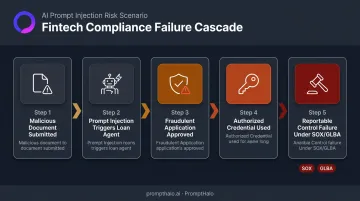
A concrete scenario: A prompt injection embedded in a customer-submitted document causes a loan-processing agent to approve a fraudulent application. The action log shows an authorized credential making the decision. The credential is legitimate — the authorization context was compromised.
Under SOX, GLBA, and PCI DSS, this isn't just a security incident. It's a reportable control failure, because the internal controls documentation shows a decision that should never have been authorized.
DORA (effective January 2025) adds another layer for EU-facing institutions: demonstrated operational resilience and third-party ICT risk controls. A compromised agent that bypasses these requirements doesn't generate a security ticket — it generates a regulatory event.
Closing that gap requires enforcement at the action level. PromptHalo's per-action budget and scope enforcement intercepts payment API calls and tool invocations before they execute, blocking out-of-scope actions in real time — with authority decay forcing re-authorization as an agent's session progresses.
Healthcare: Where PHI Access Creates Existential Compliance Risk
The highest-risk healthcare workflows all touch protected health information:
- Clinical decision support and documentation agents
- Patient intake and record-summarization agents
- Prior authorization agents
- Care coordination agents across multi-provider workflows
A concrete scenario: A retrieval poisoning attack corrupts a clinical agent's RAG knowledge base with incorrect dosing guidelines, or a jailbreak causes a patient-records agent to surface PHI from records outside the requesting clinician's authorized scope.
Under HIPAA, the cause doesn't matter. Any unauthorized PHI disclosure — whether from a human or an agent — triggers breach notification obligations: notice to HHS within 60 days for breaches affecting 500 or more individuals, with civil penalties structured by culpability tier.
HIPAA's minimum-necessary standard (45 CFR 164.502(b) and 164.514(d)) effectively requires fine-grained authorization at the agent action level. An agent granted broad database access when it only needs intake form fields for one patient isn't just over-permissioned — it's a HIPAA control failure. That's the gap PromptHalo's Data Leakage Prevention service is built to close — inspecting responses in real time and enforcing data-access policy across multi-step and multi-session interactions where PHI can otherwise leak gradually.
What Runtime AI Agent Protection Actually Looks Like
Governance documentation describes what should happen. Runtime enforcement controls what does happen — at the inference level, before actions execute.
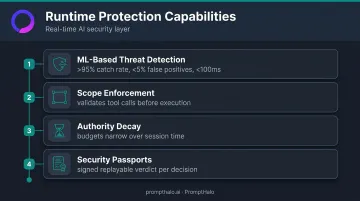
The Core Technical Capabilities
Effective AI agent protection requires:
- ML-based threat detection — identifying prompt injection and jailbreak attempts at over 95% catch rate with under 5% false positives, with every decision made per-action in under 100ms
- Scope enforcement — validating whether a proposed tool call or API action falls within the agent's authorized parameters before it executes
- Authority decay — an agent's permissions narrow over time within a session; budgets across time, steps, and risk decay as the agent operates, forcing re-authorization when thresholds are exceeded
- Security passports — signed documents that travel with each agent request, containing policy, budget, and authority decay parameters, with a signed replayable verdict returned for every decision
The Closed-Loop Defense Model
PromptHalo's platform operates in two integrated phases.
Litmus, the red teaming component, continuously attacks an organization's agents, RAG layers, and tool chains the way an actual adversary would — covering prompt injection, jailbreak, poisoning, and data-leakage probes across multi-step, multi-agent workflows. Discoveries are encoded into a shared Threat Library, so a newly found attack pattern becomes a runtime defense without waiting for a release cycle.
Septa, the runtime enforcement component, sits inline on every inference, tool call, and agent-to-agent handoff — allowing, restricting, challenging, denying, or monitoring each action in under 100ms, backed by an evidence-grade audit trail.
The Model-Agnostic Advantage
Fintech and healthcare organizations rarely run a single AI model or vendor. PromptHalo integrates across any AI application from any provider — via API gateway, agent mode, or inline middleware — without requiring access to the underlying model, model retraining, or a code rewrite. Deployment takes under a day.
For organizations running multi-vendor AI stacks under regulatory scrutiny, that deployment profile is what makes adoption realistic — not aspirational.
Audit Trails That Actually Satisfy Regulators
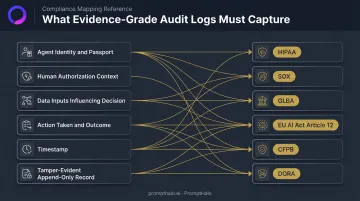
Most existing logging infrastructure captures access-level data: who accessed what system, when. Regulators are increasingly expecting more — specifically, decision-level documentation that shows what reasoning led to which action, with what data, under what authorization.
What Evidence-Grade Audit Trails Must Contain
| Field | Regulatory Relevance |
|---|---|
| Agent identity and passport | HIPAA audit controls, EU AI Act Article 12 |
| Human authorization context | SOX internal controls, GLBA oversight requirements |
| Specific data inputs that influenced the decision | HIPAA minimum-necessary, EU AI Act transparency |
| Action taken and outcome | CFPB adverse-action explainability, DORA resilience |
| Timestamp | All frameworks |
| Tamper-evident, append-only record | EU AI Act Article 12, HIPAA integrity controls |
PromptHalo's Compliance Ready Audit Logs capture every decision along with its reason, the acting agent or passport identity, session and tenant context, and timestamp. The log is append-only and tamper-evident: once an event is written, it cannot be modified or removed. That immutability matters when a regulator asks you to produce records under examination — the log you export is the log that was written at the time of the decision, nothing more and nothing less.
What Regulators Actually Ask During an Examination
When regulators examine an AI-assisted decision or an incident occurs, the question is always the same: what did the agent do, why, and under whose authorization? Organizations with decision-level audit trails mapped to OWASP LLM Top 10, NIST AI RMF, and EU AI Act requirements can reconstruct that picture in minutes. Those relying on generic access logs often cannot demonstrate compliance at all — leaving examiners to draw their own conclusions about what the agent actually did.
Frequently Asked Questions
What are AI safety tools for regulated industries?
AI safety tools fall into two categories: governance platforms that document and manage compliance policy, and runtime security tools that enforce controls on every agent action in real time. Regulated industries need both — but most currently have only the former, leaving the actual enforcement gap unaddressed.
Are any AI agents HIPAA compliant?
HIPAA compliance applies to the entire system surrounding an agent, not the agent in isolation. Agents can operate in HIPAA-compliant ways when the right controls are in place: access controls, audit logging, data minimization, and runtime enforcement of the minimum-necessary standard.
What is the difference between AI governance and AI agent runtime security?
AI governance defines policies and accountability structures for how agents should behave. AI agent runtime security enforces those policies on every action before it executes. Governance without runtime enforcement leaves regulated organizations exposed at exactly the point where attacks actually happen.
What is prompt injection and why is it a risk in fintech and healthcare?
Prompt injection embeds malicious instructions into an agent's input — through user queries, uploaded documents, or retrieved data — causing it to take unintended actions. In fintech, that can mean unauthorized transactions. In healthcare, it can mean unauthorized PHI access. Both carry direct regulatory consequences regardless of intent.
What regulations apply specifically to AI agents in financial services?
The primary frameworks are SOX, GLBA, and PCI DSS, with EU-facing institutions also subject to the EU AI Act and DORA. All impose audit, explainability, and oversight requirements that must be satisfied at the action level, not just the model level.