Most enterprises have no reliable answer.
Traditional system logs track server events and user access. They were never designed to capture the decision-by-decision reasoning of an autonomous AI agent operating across tools, retrieval systems, and other agents. That gap is the problem an AI audit trail is built to close.
This article explains what an AI audit trail actually is, why it has become both operationally and regulatorily non-negotiable, and how to extract real value from one.
TL;DR
- An AI audit trail is a chronological, tamper-evident record of every decision, action, and output an AI system produces — covering what happened, why, what inputs triggered it, and who authorized the action.
- It differs from system logs: logs record technical events; audit trails record governance-relevant decisions at the agent, tool-call, and inference level.
- They're essential for compliance readiness, forensic visibility into agentic behavior, and faster incident response — four capabilities that no SIEM or system log delivers on its own.
- Without one, enterprises can't investigate AI-driven incidents, satisfy regulators, or attribute decisions to specific agents or actions.
- Every new agent deployed without an audit trail adds unattributable decisions and uncontained regulatory exposure.
What Is an AI Audit Trail?
An AI audit trail is a structured, time-ordered record of every significant AI action: the prompt received, the reasoning applied, the output produced, and every tool call in between. It captures these events in a form that can be reviewed, replayed, and verified after the fact.
The key distinction is where it operates. A standard system log tracks infrastructure events — server restarts, API response times, user logins. An AI audit trail works at the decision layer, capturing each inference, each tool invocation and its parameters, each retrieval step in a RAG system, and each agent-to-agent handoff as a discrete, replayable record.
What a Decision-Level Audit Trail Actually Captures
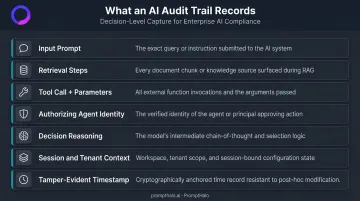
For every action, a proper AI audit trail records:
- The input prompt or instruction received by the agent
- The retrieval steps taken and sources consulted (in RAG systems)
- The tool call made, including parameters and outputs
- The agent or identity that authorized the action
- The reasoning or policy that drove the decision
- The session and tenant context
- A tamper-evident timestamp
The audit trail itself is not the goal. It is the evidence layer that makes AI systems explainable when something goes wrong — and defensible when a regulator asks why it happened.
PromptHalo generates exactly this kind of record: an append-only, tamper-evident log for every inference, tool call, and agent-to-agent handoff, produced inline at the point of action without model retraining or code rewrites.
Key Advantages of an AI Audit Trail
Security teams, compliance leaders, and risk officers are already accountable for these outcomes. As AI deployments shift from single models to multi-step agentic systems making autonomous decisions, each advantage below becomes harder to ignore.
Advantage 1: Compliance-Ready Accountability Mapped to Regulatory Frameworks
Regulators are no longer asking whether enterprises use AI — they're asking whether enterprises can prove how their AI made decisions.
Three major frameworks already have explicit logging and documentation requirements:
- EU AI Act (Articles 12, 13, 26): High-risk systems must automatically record events over their lifetime, retain logs for at least six months, and give deployers the information needed to interpret them.
- NIST AI RMF: Audit requirements span the GOVERN, MEASURE, and MANAGE functions — covering documented roles, production monitoring, incident tracking, and post-deployment response.
- Federal Reserve SR 26-2: Requires model documentation, comprehensive model inventories, outcomes analysis, and ongoing performance monitoring for financial services firms.
The compliance gap is already visible. EY's 2025 AI Governance survey found that only 10% of organizations were fully prepared to audit AI systems, and only 28% were fully compliant with the EU AI Act despite 80% being aware of it.
A decision-level audit trail closes this gap automatically. Every inference, tool call, and agent action is logged with the context needed to map it to a control framework — rather than assembled retroactively from disconnected sources. PromptHalo generates evidence-grade, tamper-evident audit logs at the decision level, mapped to OWASP LLM Top 10, NIST AI RMF, and the EU AI Act.
Without this, legal and compliance teams manually reconstruct AI decision histories during audits — a time-intensive, error-prone process. Non-compliance with EU AI Act operator obligations carries penalties of up to €15 million or 3% of global annual turnover.
KPIs this improves: Regulatory audit preparation time, compliance gaps identified during review, penalty exposure, audit remediation cost.
Most relevant for: Financial services, healthcare, insurance, and any enterprise where AI touches customer-facing or financial decisions.
Advantage 2: Forensic Visibility into Agentic AI Behavior
Agentic AI introduces a new class of opacity. A single user interaction can trigger dozens of autonomous tool calls, retrieval steps, and sub-agent delegations — all executing at machine speed, with no human checkpoint in between. Without a decision-level audit trail, that entire chain is invisible.
Gartner projects that 40% of enterprise applications will include task-specific AI agents by end of 2026, up from less than 5% in 2025. As that deployment curve steepens, so does the attack surface. IBM's 2025 security report found that 13% of organizations experienced breaches of AI models or applications — and 97% of those breached organizations lacked proper AI access controls.
A replayable, decision-level audit trail makes the full agent reasoning chain visible after the fact:
- Which retrieval source did the agent consult, and was it compromised?
- Which tool call was made with which parameters, and was that within authorized scope?
- Which sub-agent received a delegated instruction, and was the handoff authorized?
- At what point did behavior deviate from expected patterns?
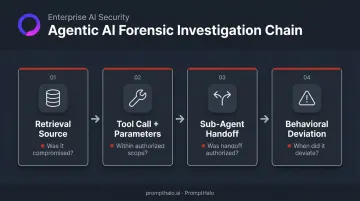
When an agent produces a harmful output or executes an unauthorized action, forensic investigation without this trail requires guesswork. With it, security teams can trace anomalous behavior to its origin — whether a poisoned retrieval source, an injected prompt (OWASP LLM01:2025), or an over-privileged tool call.
PromptHalo sits inline on every inference, tool call, and agent-to-agent handoff, capturing each with its authorization context, agent identity, and decision reasoning. The result is a complete, replayable chain of custody for every agent action.
KPIs this improves: Mean time to detect (MTTD), mean time to investigate (MTTI), agent actions reviewed per incident, false positive rates in anomaly detection.
Most relevant for: Multi-step agentic workflows, RAG deployments, multi-agent architectures, and AI executing real-world actions like API calls or data writes.
Advantage 3: Faster, Evidence-Backed Incident Response and Risk Containment
IBM's 2024 Cost of a Data Breach report put the average breach cost at $4.88 million, with an identification and containment lifecycle averaging 258 days. When an AI-driven incident occurs — a data leak, an unauthorized tool execution, a successful prompt injection — the speed of response depends entirely on the evidence already in hand.
Organizations using security AI and automation detected and contained incidents 98 days faster and reduced breach costs by $1.88 million compared to those that did not.
Regulatory notification deadlines make speed non-negotiable:
| Regulation | Reporting Deadline |
|---|---|
| GDPR Article 33 | 72 hours after awareness |
| SEC Form 8-K Item 1.05 | 4 business days after materiality determination |
| EU AI Act Article 73 | 15 days (2 days for critical infrastructure) |
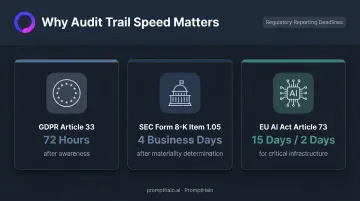
Reactive incident response without pre-built evidence means piecing together partial records from multiple disconnected systems that were never designed to capture agent reasoning. A tamper-evident, replayable audit trail compresses that cycle. Security teams can replay the exact sequence of agent decisions that led to an incident, scope the blast radius, identify the attack vector, and produce documentation for regulatory reporting — without reconstructing anything from scratch.
PromptHalo's audit logs are append-only and tamper-evident, meaning once an event is recorded, it cannot be altered. Every decision includes the reason, acting agent identity, session context, and timestamp — giving incident responders a complete, trustworthy evidence chain from the moment an investigation begins.
KPIs this improves: Incident response time, time to containment, regulatory reporting turnaround, post-incident remediation cost.
Most relevant for: Regulated environments with notification deadlines, enterprises running AI in customer-facing or financial workflows, and any organization where agents have access to sensitive data.
What Happens When an AI Audit Trail Is Missing
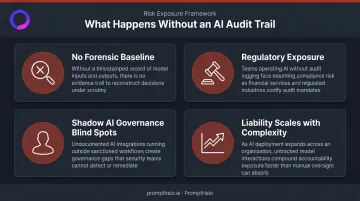
Missing decision-level audit coverage creates a structural blind spot — one that grows harder to close as you add agents, integrate new tools, and take on fresh regulatory obligations.
The consequences are concrete:
- No forensic baseline. Without pre-built decision-level records, security teams reconstruct incidents from infrastructure logs never designed to capture agent reasoning. The resulting picture is partial and legally indefensible.
- Regulatory exposure. Regulators and auditors increasingly expect evidence of how AI systems made consequential decisions. An enterprise that cannot produce this record faces audit failure and growing liability — particularly under the EU AI Act and sector-specific financial services regulations.
- Governance blind spots from shadow AI. IBM found that 20% of organizations reported a breach due to shadow AI, and 63% of breached organizations lacked or were still developing AI governance policies.
- Liability that grows with complexity. In a single-model deployment, missing audit coverage is a manageable risk. In multi-agent systems where agents autonomously call tools and hand off tasks to sub-agents, every untracked action is a potential attack surface. The exposure scales directly with the autonomy of the system.
How to Get the Most Value from Your AI Audit Trail
An AI audit trail generates value only when it is built at the right layer — decision-level, not just system-level — and applied consistently across every agent action from day one. Retroactive implementation is expensive, incomplete, and often inadmissible as evidence.
Build at the Decision Layer from the Start
Audit logs should capture:
- Every inference input and output
- Tool calls and their parameters
- Retrieval steps in RAG systems
- Agent-to-agent handoffs with authorization context
- Tamper-evident timestamps and agent identity
PromptHalo generates decision-level, replayable audit trails at the point of every inference and tool call, with no model retraining and no code rewrite required.
Make Logs Dual-Purpose
Audit logs are most valuable when they serve two functions simultaneously:
- Security forensics — replayable records for incident investigation and root-cause analysis
- Regulatory evidence — compliance-mapped documentation ready for auditor review
Keeping these in separate systems, or treating forensic and compliance logs as distinct outputs, creates gaps that leave you exposed during both incident investigations and regulatory reviews.
Active Review, Not Passive Storage
Storage is not governance. The audit trail becomes an active governance mechanism only through:
- Scheduled reviews of agent behavior patterns against historical baselines
- Anomaly flagging when agent actions deviate from expected scope or authorization levels
- Regular mapping of audit evidence to applicable compliance controls
Tools like PromptHalo's behavioral drift detection support this by monitoring how agent outputs shift across sessions, surfacing deviations before they become compliance or reliability failures.
Conclusion
An AI audit trail is the evidence layer that makes agentic AI governable in practice. It enables regulatory compliance, accelerates incident response, and provides the forensic visibility needed to understand and control autonomous AI behavior across tool calls, retrievals, and multi-agent handoffs.
Its value compounds over time. The earlier it is implemented, the richer the behavioral baseline it builds — and the more defensible the compliance record becomes when regulators, auditors, or customers demand proof.
Enterprises that scale AI safely treat the audit trail as infrastructure — the same way they treat logging, access control, and network monitoring. That means continuous capture, not pre-audit scrambling. Teams that build this habit early can respond to incidents with confidence, satisfy regulatory inquiries without reconstruction, and deploy AI agents knowing there is accountability behind every decision.
Frequently Asked Questions
What is an AI audit trail?
An AI audit trail is a chronological, tamper-evident record of every decision, input, output, and action an AI system produces. Unlike system logs that track infrastructure events, it operates at the decision layer — capturing why the agent acted, what it retrieved, what it called, and who authorized it.
What is the audit trail requirement under the EU AI Act?
The EU AI Act (Articles 12, 13, and 26) requires high-risk AI systems to automatically record events over their lifetime, retain logs for at least six months, and enable deployers to collect and interpret those records. Non-compliance with high-risk operator obligations carries penalties of up to €15 million or 3% of global annual turnover.
What is an automated audit trail?
An automated audit trail is generated in real time by the AI system itself at every decision point — without manual logging — ensuring complete, consistent, tamper-resistant coverage across every agent action and inference. PromptHalo, for example, generates these logs inline at the point of each action in under 100ms.
What are the four types of audit trails?
The four types relevant to enterprise AI are: system-level logs, data lineage trails, model decision trails, and action/tool-call trails. Agentic AI deployments require all four to maintain complete governance coverage.
How is an AI audit trail different from a system log?
System logs capture technical events — who accessed what, when a process restarted. An AI audit trail captures governance-relevant decisions: why the agent took an action, what it retrieved, what tool it called, and what the output was. The difference is between knowing a system was used and being able to explain what it decided.
What should an enterprise AI audit trail include?
At minimum: inference inputs and outputs, tool calls with parameters, RAG retrieval steps, agent-to-agent handoffs with authorization context, tamper-evident timestamps, and agent identity. All records should be stored in an append-only format mapped to your relevant compliance frameworks.