Introduction
Regulatory complexity isn't slowing down. Thomson Reuters Regulatory Intelligence tracked 61,228 regulatory events in 2022 alone—roughly 234 daily alerts across 190 countries. Yet many compliance teams are still trying to keep pace using tools built for a different era: spreadsheets, periodic audits, and manual control reviews.
The result is a structural gap. Organizations know regulations exist. They don't always know whether their current controls actually satisfy them—and they often find out only when an auditor or regulator tells them they don't.
AI-based compliance gap detection changes that equation. Instead of point-in-time assessments that go stale the moment they're completed, AI continuously compares live system behavior and control evidence against regulatory requirements, surfacing gaps before they become findings.
What follows covers the technical stages involved, the concrete benefits, and one challenge most compliance tools still aren't built for: detecting gaps in AI systems themselves—where the control being assessed is also an AI.
Key Takeaways
- Traditional gap analysis is periodic and manual; AI-based detection is continuous and automated
- AI ingests regulatory text, collects live evidence, scores coverage, and prioritizes gaps by risk without human bottlenecks
- Cross-framework mapping lets a single control satisfy multiple regulatory requirements simultaneously
- Standard compliance tools cannot evaluate AI agent behavior; that requires purpose-built, inline inspection
- AI handles detection and prioritization; human judgment remains essential for interpretation and sign-off
What Is Compliance Gap Detection, and Why Does It Need AI?
Compliance gap detection is the process of comparing an organization's controls, policies, and operational practices against applicable regulatory requirements to find where they fall short. Those gaps can exist across frameworks like NIST AI RMF, OWASP LLM Top 10, the EU AI Act, SOC 2, HIPAA, or GDPR.
The Problem with Manual Methods
Traditional gap detection has three structural weaknesses:
- Point-in-time: A gap assessment conducted in January reflects January's state. By March, systems have changed, regulations have updated, and the analysis is already stale.
- Resource-intensive: Thomson Reuters found that 62% of compliance professionals spend 1 to 7 hours weekly just tracking and analyzing regulatory developments—before any actual gap analysis begins.
- Inconsistent: Human reviewers interpret regulatory language differently. One analyst flags a control as partially met; another passes it. The result is variability that undermines defensibility.
When 234 regulatory alerts arrive daily, manual methods don't scale. The gaps accumulate undetected until an audit forces the reckoning.
What AI Changes
AI-powered gap detection doesn't replace the quarterly review with a faster quarterly review. It eliminates the cycle entirely. The system continuously compares live evidence against current regulatory requirements, flagging gaps as they emerge rather than weeks after the fact.
In practice, that means the system is doing three things in parallel at any given moment:
- Mapping newly published regulatory updates to your existing controls
- Detecting drift when a previously compliant control degrades or changes
- Flagging evidence gaps before they become audit findings
That continuous loop is what the next section breaks down—how AI actually runs this process end to end.
How AI-Based Compliance Gap Detection Works
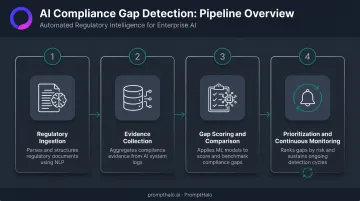
AI compliance gap detection is a multi-stage process. It combines data ingestion, natural language understanding, pattern recognition, and automated scoring to move from raw regulatory text to actionable findings.
Regulatory Requirement Ingestion and Structuring
The process starts with regulatory source material: legislation, standards documents, technical guidance. AI systems use natural language processing (NLP) to extract individual obligations from that dense text and structure them as machine-readable requirements.
Research published in IEEE Transactions on Software Engineering evaluated this approach across 30 real Data Processing Agreements containing over 7,000 statements. The NLP-based system achieved 89.1% precision and 82.4% recall in detecting GDPR compliance violations—a meaningful improvement over baseline rule-matching approaches.
This replaces what was previously a manual task: reading regulatory documents and translating them into control checklists, one framework at a time.
Evidence and Control Data Collection
With requirements structured, the AI pulls evidence from connected systems—policy documents, audit logs, access controls, system configurations, and operational workflows. This happens continuously, not on a scheduled pull.
Continuous collection matters for two concrete reasons:
- Eliminates the evidence-gathering burden that consumes weeks of compliance team time before an assessment even begins
- Ensures analysis reflects current state rather than a documentation snapshot from months ago
Gap Scoring and Comparison
The AI then compares collected evidence against structured requirements using ML models trained to assess control coverage. Each requirement receives a verdict—met, partially met, or not met—along with the specific evidence (or absence of evidence) driving that conclusion.
ML-based scoring outperforms rule-based keyword matching for multi-condition requirements, where a control might satisfy part of a mandate but not all of it. Rules struggle with nuance; ML models trained on compliance patterns handle it more reliably.
Prioritization, Remediation Guidance, and Continuous Monitoring
Not every gap carries equal weight. The AI ranks findings by risk impact—likelihood of enforcement action, severity of exposure, or breadth of affected controls—so compliance teams direct remediation effort where it matters most.
Beyond identification, capable platforms go further:
- Flag missing documentation or control owners
- Suggest specific edits to existing policies
- Monitor whether gaps close as evidence updates
- Create a feedback loop rather than a static report
The system stays active after findings are generated—tracking remediation progress in real time and updating risk scores as evidence changes. That continuous loop is what makes AI gap detection a live compliance posture, not a point-in-time audit.
Key Benefits of AI-Based Compliance Gap Detection
Accuracy and Consistent Scoring
Manual compliance reviews are subject to analyst variability. Two reviewers reading the same regulatory requirement may reach different conclusions, especially for complex, multi-condition requirements.
AI eliminates that variability by applying the same scoring logic consistently across thousands of requirements. The result is more defensible assessments—not because the AI is infallible, but because its reasoning is traceable and consistent.
Continuous Visibility vs. Periodic Audits
Annual or quarterly gap assessments create windows of blind exposure. A control that drifts out of compliance in February won't be caught until the next scheduled review. AI closes that window by maintaining a live compliance posture.
New regulatory requirements, internal system changes, and configuration drift all trigger reassessment automatically—rather than waiting for a calendar date.
Cross-Framework Gap Mapping
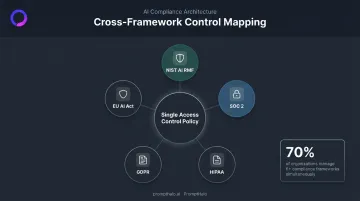
Managing multiple frameworks simultaneously is one of the heaviest operational burdens in enterprise compliance. Coalfire's 2023 Securealities Report found that nearly 70% of respondents manage at least six different frameworks, with many managing more.
AI can identify when a single control satisfies requirements across multiple frameworks—for example, when an access control policy maps to both NIST AI RMF and SOC 2 simultaneously. That cross-mapping capability means one evidence-gathering exercise covers obligations that once required six separate review cycles.
Faster Remediation Through Actionable Outputs
Traditional gap analysis produces a list of findings. AI-based gap detection produces findings with context: what's missing, why it's a gap, and what action would close it. The typical output includes:
- The specific requirement that isn't met
- The evidence gap driving the finding
- A recommended remediation action with priority ranking
Audit-Ready Documentation
AI-driven gap detection generates structured records of what was assessed, when, against which requirements, and what actions were taken. Teams can present those records directly to auditors or regulators—no additional preparation needed.
This matters especially in financial services and healthcare, where evidence standards are high and auditors expect traceable, timestamped documentation—not retrospective summaries assembled under deadline pressure.
A Special Challenge: Detecting Compliance Gaps in AI Systems Themselves
Here's a gap that most compliance discussions skip entirely.
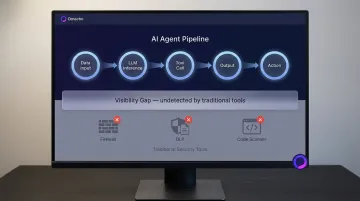
Traditional gap detection tools were built to assess human-run processes, static policies, and infrastructure controls. They were never designed to evaluate the behavior of AI systems—autonomous agents, LLMs, and multi-model pipelines—that now make consequential decisions in real time.
The result is a category of compliance exposure that existing tools simply weren't built to catch: gaps in how AI systems behave, not just in the policies that govern them.
What AI-System Compliance Gaps Look Like
- An LLM that surfaces protected customer data in its responses, violating data residency or privacy requirements
- A RAG pipeline whose retrieved outputs carry content that breaches data handling rules
- An autonomous agent making tool calls that exceed its permitted scope under the EU AI Act's high-risk system requirements (Articles 9–15)
- Behavioral drift across sessions, where outputs gradually shift from expected behavior in ways that quietly undermine governance commitments
These gaps are invisible to traditional DLP tools, firewalls, and static code scanners. None of those tools inspect what an AI agent actually decided to do—they inspect infrastructure, not inference.
What Detecting These Gaps Requires
Catching compliance failures at the agent level requires inline inspection of every inference, tool call, and agent-to-agent handoff—scored against frameworks like OWASP LLM Top 10, NIST AI RMF, and the EU AI Act. PromptHalo's Runtime Security solution does exactly this, making per-action decisions in under 100ms without touching the underlying models.
Every decision generates a compliance-ready, decision-level audit log: the decision and its reasoning, the acting agent identity, session and tenant context, and a tamper-evident timestamp. That log is append-only and cannot be modified or removed, creating a replayable evidence trail for regulatory reporting and post-incident investigation. Because PromptHalo inspects AI behavior at the application layer, it deploys across any AI application from any vendor—in under a day, with no model retraining and no code rewrite.
Why This Matters for Regulated Industries
When AI agents execute compliance workflows, process transactions, or handle customer interactions in fintech and payments environments, a compliance gap at the agent level isn't a governance footnote—it's direct regulatory exposure.
Regulators are closing in from multiple directions:
- The EU AI Act classifies AI systems used for creditworthiness evaluation and risk assessment as high-risk, requiring strict logging, oversight, and documentation
- The CFPB has made clear that creditors cannot hide behind algorithmic complexity when explaining adverse actions
- Organizations that cannot demonstrate control over their AI agents' decisions face compounding exposure as regulatory scrutiny of AI-powered financial services intensifies
Challenges and Limitations of AI-Based Compliance Gap Detection
Data Quality Is the Ceiling
AI gap detection is only as accurate as the evidence it can access. Siloed systems, incomplete documentation, and policies that exist only in informal channels will produce incomplete assessments. Before deploying AI gap detection, organizations need connected, structured data environments—otherwise the tool produces an incomplete picture without flagging what it missed.
The Explainability Requirement
Regulators and auditors increasingly want to understand not just what gaps were found, but how the AI reached that conclusion. Black-box models that cannot surface their reasoning create their own compliance risk. Any gap detection tool under evaluation should be able to produce traceable, human-readable explanations for each finding—not just a score.
CFPB Circular 2022-03 makes this concrete for financial services: creditors must be able to identify specific reasons for adverse decisions even when complex algorithms are involved. The same logic applies to AI compliance tools operating in regulated environments.
Human Judgment Remains Irreplaceable
AI handles detection and prioritization well. What it cannot do is replace the human layer that every compliance program still requires:
- Interpret ambiguous regulatory language in context
- Apply business judgment to findings that sit in gray areas
- Review, validate, and sign off on AI-generated findings before remediation begins
- Carry final accountability for compliance strategy
AI compresses the time it takes to reach that human decision point. The decision itself still belongs to your compliance team.
Frequently Asked Questions
What is AI-based compliance gap detection?
It uses machine learning and natural language processing to continuously compare an organization's controls, policies, and system behaviors against regulatory requirements—automatically identifying shortfalls without relying on manual periodic reviews.
How is AI compliance gap detection different from traditional gap analysis?
Traditional gap analysis is manual, periodic, and resource-intensive. AI-based detection is continuous, automated, and applies consistent scoring logic across thousands of requirements simultaneously—without waiting for a scheduled review cycle.
What compliance frameworks can AI gap detection tools map to?
Modern tools can map to frameworks including NIST AI RMF, OWASP LLM Top 10, EU AI Act, NIST CSF, SOC 2, HIPAA, GDPR, and ISO 27001. The strongest tools cross-map a single control to multiple frameworks at once, reducing duplicate evidence collection.
Can AI detect compliance gaps in AI systems themselves, such as LLMs or autonomous agents?
Standard GRC tools cannot—they were built for static policies and infrastructure. Purpose-built platforms like PromptHalo inspect agent decisions, tool calls, and data flows against AI-specific frameworks, producing tamper-evident audit trails at the decision level.
What are the main limitations of AI-based compliance gap detection?
Three primary constraints apply:
- Data quality and connectivity — gaps in system integration limit detection coverage
- Explainability — outputs must be auditor-ready, not just machine-readable
- Human judgment — ambiguous regulatory requirements still require human interpretation
How often should compliance gap detection be run?
With AI-based tools, detection should be continuous. Regulations change, internal systems evolve, and new gaps can emerge at any time—making real-time monitoring far more effective than quarterly or annual snapshots.