Introduction
Enterprise AI deployments have outpaced the governance frameworks meant to oversee them. Organizations are running AI agents that query databases, call external APIs, and make autonomous decisions — often across multiple vendor boundaries within a single request. Yet most governance tooling was designed for something far simpler: static systems with predictable, rule-based behavior.
That mismatch creates three structural blind spots. First, unknown data assets and undeclared AI systems that never appear in any inventory. Second, agent behavior that produces no meaningful audit signal beyond "the API responded." Third, compliance logs that record what happened but cannot explain why — leaving regulators and security teams with technically complete but semantically empty records.
Closing those blind spots requires capabilities legacy frameworks weren't built to deliver: AI-powered discovery to surface what manual processes miss, behavioral observability to capture how agents actually make decisions, and contextual intelligence to turn compliance signals into something regulators can actually use.
Key Takeaways
- 82% of enterprises have unknown AI agents in their environments, per Cloud Security Alliance
- Traditional governance tools cannot capture the probabilistic, multi-hop behavior of agentic AI systems
- AI-powered discovery replaces passive cataloging with continuous, autonomous identification of undeclared assets
- Observability must cover reasoning chains, tool calls, and context window state — beyond uptime metrics
- Governance gaps in agentic AI create exploitable attack surfaces, not just compliance exposure
Why Traditional Data Governance Can't Keep Up With AI
The Foundational Mismatch
Legacy governance frameworks — SOC 2 controls, HIPAA safeguards, GDPR-era data catalogs — share a common design assumption: systems are known, data flows are stable, and periodic audits produce accurate risk snapshots. Agentic AI violates all of that.
A single agent request can traverse an embedding model, a vector database, a foundation model API, and a third-party logging platform before producing one response. The data flows are multi-hop, probabilistic, and often ephemeral. Scheduled audits and static policy documents cannot capture what happens inside that request chain — and more importantly, they cannot detect when something goes wrong.
The Shadow AI Problem
The same dynamic that created Shadow IT is now playing out with AI: engineering teams adopt tools faster than governance can review them. According to Cloud Security Alliance, 82% of enterprises have unknown AI agents operating in their environments. ISACA's research reinforces the trend from a policy perspective: while 90% of employees now use AI tools, only 38% of organizations have formal, comprehensive AI policies in place.
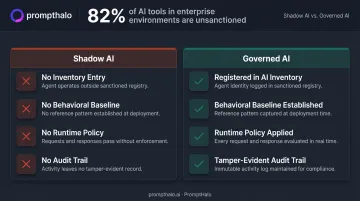
Shadow AI — LLM integrations, RAG pipelines, and model-backed product features deployed without governance review — enters production with none of the controls that managed systems carry:
- No entry in any AI inventory
- No behavioral baseline established before deployment
- No policy controls applied at runtime
- No audit trail if something goes wrong
The Regulatory Consequence
Frameworks including the EU AI Act, ISO 42001, and NIST AI RMF now require continuous, demonstrable evidence of AI governance — not point-in-time attestation. An AI inventory that is perpetually incomplete cannot satisfy those requirements. It creates audit exposure that grows with every untracked deployment.
AI-Powered Data Discovery: Surfacing What Manual Processes Miss
From Passive Catalog to Active Discovery Engine
Traditional data catalogs depend on human tagging, developer self-declaration, and scheduled scans. In practice, this means any AI system deployed between audit cycles simply doesn't exist from a governance perspective — until something breaks.
AI-powered discovery flips that model. Instead of waiting for humans to register assets, ML-driven discovery agents interrogate live telemetry streams, infrastructure metadata, API endpoint activity, and observability records to detect undocumented systems as they appear.
Trace records and LLM run logs (data already generated by production AI infrastructure) become governance signals rather than purely operational ones.
Closing the RAG Retrieval Gap
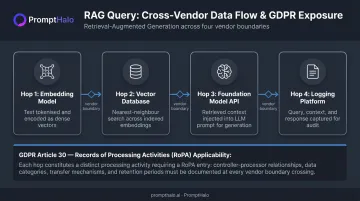
RAG-based systems create a specific discovery challenge. A single user query might traverse:
- An embedding model to convert the query into vectors
- A vector database to retrieve relevant documents
- A foundation model to generate the response
- A logging or observability platform to record the interaction
Each of these hops crosses a potential vendor boundary. Each represents a data processing step that may involve personal data and therefore falls under GDPR Article 30's Records of Processing Activities (RoPA) requirements. Manual discovery processes will miss most of these intermediate flows. AI-powered discovery must map multi-hop data flows across vendor boundaries to produce RoPA entries that are accurate.
Why Continuous Discovery Is the Goal
Even when that initial mapping is accurate, it has a short shelf life. AI systems are updated, models are unpinned, retrieval indexes are swapped, and new agent features are shipped — often without any formal change notification reaching the governance function. One-time mapping exercises start decaying the moment they're completed.
The architecture that matters is an always-on discovery layer that:
- Registers new AI systems as they appear in observability telemetry
- Flags when model versions change or configurations are updated
- Detects when data flows cross new vendor boundaries
- Updates the AI inventory without waiting for the next scheduled audit
Without that continuous layer, governance teams are always auditing a system that no longer exists — and the gap between the documented state and the live environment is exactly where compliance exposure accumulates.
AI Observability: Beyond Monitoring to Behavioral Intelligence
Monitoring vs. Observability — Why the Distinction Matters
Traditional application performance monitoring answers a narrow question: is the system running? It captures CPU utilization, API response times, error rates, and uptime. For deterministic software, that is often enough.
For AI agents, it is not. An agent can be fully operational — returning responses with low latency and no HTTP errors — while making decisions that violate policy, leak sensitive data, or produce outputs derived from poisoned retrieval context. The governance question is not whether the system is running. It is whether it should have done what it just did.
Gartner forecasts that 40% of organizations deploying AI will adopt dedicated AI observability tools by 2028 — a signal that the industry recognizes the gap between infrastructure monitoring and what AI governance actually requires.
What AI Agent Observability Must Capture
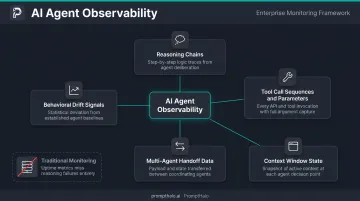
Effective observability for agentic AI goes well beyond server metrics. It requires capturing:
- Reasoning chains — how the agent approached a task, not just the final output
- Tool call sequences and parameters — what the agent invoked, with what inputs, in what order
- Context window state — what information the agent had access to at the moment of each decision
- Multi-agent handoff data — what context was passed between agents and whether scope was preserved
- Behavioral drift signals — whether output patterns have shifted from an established baseline over time
PromptHalo's runtime security layer sits inline on every inference, tool call, and agent-to-agent handoff, capturing decision-level audit data: the action taken, the reason for it, the acting agent's identity, session context, and a precise timestamp. Logs are append-only and tamper-evident (once written, they cannot be modified), creating a replayable evidence trail for compliance and post-incident investigation.
Behavioral Drift as a Governance Risk
Behavioral drift is a governance risk most monitoring stacks were never designed to catch. Research published in the Harvard Data Science Review documented GPT-4's accuracy on a specific task falling from 84% in March 2023 to 51.1% by June 2023 — a dramatic shift triggered by model updates that generated no system-level alert.
When model weights, prompt templates, or retrieval indexes change, agents can begin behaving differently without any infrastructure alert firing. That gap is precisely where observability must extend beyond uptime. PromptHalo's behavioral drift detection tracks output patterns across sessions, drawing on per-tenant session state to identify when behavior diverges from expected baselines and surfacing drift before it compounds into a compliance incident.
Regulatory Requirements for Observability
Observability is not optional for organizations subject to major AI frameworks:
| Framework | Requirement |
|---|---|
| EU AI Act, Article 14 | High-risk AI systems must support effective human oversight during operation |
| EU AI Act, Article 26 | Deployers must retain automatically generated logs for at least six months |
| NIST AI RMF, MEASURE 2.4 | AI system functionality and behavior must be monitored in production |
| NIST AI RMF, MANAGE 4.1 | Post-deployment monitoring plans must be documented |
| ISO/IEC 42001 | Requires establishing, implementing, and continually improving an AI management system |
Each framework above calls for ongoing behavioral evidence — logs, monitoring records, and documented controls — that a point-in-time audit cannot provide. Organizations without continuous observability infrastructure face a structural compliance gap, not just a technical one.
Context as the Missing Governance Layer
Knowing what data an agent accessed is discovery. Knowing what the agent did with it is observability. But governance also requires knowing why — what retrieval logic selected a particular document, what prompt template shaped the query, and whether the context the agent received was accurate and untampered.
Without that third layer, compliance logs are technically present but semantically incomplete.
The Retrieval Poisoning Problem
In RAG-based systems, the retrieved context directly determines model output. OWASP's LLM Top 10 explicitly documents this risk: an attacker who can modify documents in a repository used by a RAG application can alter what the model retrieves — and therefore what it outputs — without touching the AI system itself.
A traditional audit log will record that retrieval occurred and that the agent produced a response. It will not record that the retrieved content was manipulated, or that the compliant-looking output was derived from a poisoned source.
Context-aware governance must verify not just that retrieval happened, but that what was retrieved was trustworthy.
That verification requires detection at the retrieval layer itself. PromptHalo addresses this through embedding-based detection scored against a shared threat library, recognizing manipulation patterns in retrieved content and blocking adversarial retrieval before it influences model behavior.
Proportionate Governance Through Context
Context also enables something practically important: proportionate controls. Not every agent action carries the same risk. An agent summarizing internal documentation poses different governance requirements than one processing a financial transaction or accessing healthcare records.
Context — the risk tier of the agent, the sensitivity of the data accessed, the business intent behind the request — allows governance frameworks to:
- Apply stricter controls to high-stakes decisions automatically
- Route lower-risk operations with lighter oversight
- Trigger re-authorization when cumulative risk exceeds defined thresholds
This proportionate, context-aware approach is the foundation of ISO 42001's risk-differentiated model for AI management systems. Without it, teams are forced to choose between blanket maximum scrutiny — which breaks at scale — or permissive defaults that create unacceptable exposure in regulated environments.
When Governance Gaps Become Security Vulnerabilities
An unregistered AI system with no observability, no context tracking, and no policy enforcement is not just a compliance gap. It is an exploitable attack surface. Attackers do not need to breach infrastructure to compromise an agentic AI deployment: they can manipulate the agent's decision loop directly through its inputs.
Specific Threat Vectors That Exploit Governance Blind Spots
- Prompt injection: Crafted inputs that override policy guardrails and redirect agent behavior
- Indirect RAG injection: Malicious instructions embedded in documents retrieved from a vector database, executing when the agent processes them
- Out-of-scope tool calls: Crafted inputs that trigger unauthorized API or tool invocations the agent was never intended to make
- Multi-agent handoff exploitation: Manipulated context passed between agents that escalates privileges or extracts data across trust boundaries
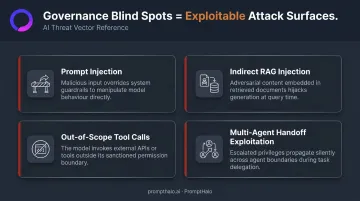
Each of these vectors exploits the same blind spot: an enforcement layer that can't reason about context. PromptHalo's ML-based detection addresses this directly, operating above a 95% catch rate at under 5% false positives — compared to roughly 35% catch rates and 15-20% false positives for rule-based systems. The AI Red Teaming solution probes for these attack paths across multi-step, multi-agent workflows before deployment, encoding discovered patterns into a shared threat library that the runtime enforcement layer uses continuously.
The Business Stakes in Regulated Industries
For financial services and healthcare organizations, the absence of governance infrastructure is not an abstract risk. The CFPB has made clear that creditors using algorithmic models cannot cite model opacity as a reason for failing to provide specific adverse-action explanations. FDA's 2024 postmarket monitoring guidance for AI-enabled medical devices emphasizes continuous output monitoring to ensure safety. Class action litigation against AI-driven insurance claim denials has survived early dismissal motions in federal court.
In each of these contexts, the inability to replay an agent's decision — to show what context it had, what it retrieved, and why it acted as it did — is not just a compliance gap. Without decision-level audit trails, there is no evidence base, no replayable record, and no ground to stand on when regulators or plaintiffs demand an explanation.
Building an AI-Native Governance Framework: Key Principles
Continuous Posture Over Periodic Audit
AI-native governance must be always-on. That means moving away from the periodic audit model across three dimensions:
- Scheduled scans → telemetry-driven discovery
- Point-in-time assessments → ongoing behavioral monitoring
- Manually assembled documentation → evidence synthesized from verified control states
The audit-under-pressure model — collecting evidence when regulators ask for it — does not work when the systems being audited change continuously and generate risk continuously.
Governance Without Model Access
Effective AI governance should not require access to proprietary model weights, training data, or source code. PromptHalo's architecture reflects this principle directly: the platform monitors input and output streams inline, without touching the underlying model. It deploys across any AI application from any vendor in under a day, with no model retraining required. Governance relies on observable behavior — not internal model state.
The Minimum Governance Stack for Agentic AI
Organizations deploying agentic AI need four functional layers working together:
- Continuous discovery — automated identification of AI systems via observability telemetry, updated as new systems appear or existing ones change
- Behavioral observability — decision traces, tool call logs, context window state, and drift detection across sessions
- Policy enforcement — real-time controls applied per action, not just at deployment; allow, restrict, challenge, deny, or monitor decisions made inline in under 100ms
- Compliance evidence — tamper-evident, decision-level audit logs mapped to applicable regulatory frameworks, replayable for post-incident investigation and regulatory reporting
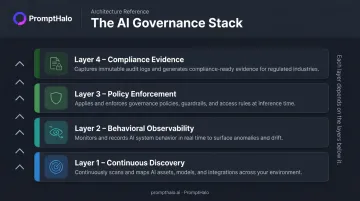
Each layer depends on the others. An inventory with no behavioral signal offers false confidence. Insights without enforcement leave risk unaddressed. And controls without evidence leave you unable to prove compliance when it matters.
Frequently Asked Questions
What is AI governance and observability?
AI governance covers the policies, roles, and accountability structures that determine how AI systems operate within an organization. AI observability is what makes governance enforceable — capturing decision traces, tool calls, and behavioral signals to verify that agents are actually acting within approved boundaries.
What are the common frameworks and key principles of data and AI governance?
The primary frameworks are the EU AI Act, ISO 42001, NIST AI RMF, and GDPR. Across all of them, core principles include data integrity, security, traceability, human oversight, and proportionate risk management — with an increasing emphasis on continuous evidence rather than periodic attestation.
How does AI improve data discovery in governance frameworks?
ML-powered discovery agents automate classification and scan live observability telemetry to identify unknown assets and undeclared AI systems in real time. This replaces slow, manual cataloging with autonomous, continuous inventory management that updates when systems change rather than when audits are scheduled.
What is shadow AI and why is it a governance risk?
Shadow AI refers to AI systems — LLM integrations, RAG pipelines, agent features — deployed by engineering teams without formal security or governance review. These systems carry no observability, no policy controls, and no audit trail, leaving organizations exposed to prompt injection, retrieval poisoning, and data exfiltration with no way to detect or respond.
How is AI observability different from traditional application monitoring?
Traditional monitoring tracks infrastructure health: uptime, error rates, latency. AI observability captures reasoning chains, tool call sequences, context window state, and behavioral drift across sessions — the signals needed to understand why an agent made a specific decision, not just whether the system is running.
What regulatory frameworks require AI observability and data governance?
The EU AI Act (Articles 14 and 26) mandates human oversight and at least six months of log retention for high-risk systems. ISO 42001 requires AI inventories, risk assessments, and continuous improvement processes. NIST AI RMF's MEASURE and MANAGE functions add production monitoring, documented controls, and post-deployment incident handling.