Introduction
Gartner projects that by 2030, more than 40% of enterprises will experience security or compliance incidents tied to unauthorized shadow AI — and that timeline is already accelerating. A 2025 Gartner survey of 302 cybersecurity leaders found 69% of organizations either suspect or have confirmed that employees use prohibited public generative AI tools.
Employees in regulated industries (finance, insurance, healthcare, payments) are adopting AI faster than compliance teams can vet it. They're not acting maliciously — approved alternatives simply lag behind demand, so they reach for whatever works. That gap creates compliance exposure traditional IT controls were never built to catch.
By the end, you'll know how to identify your exposure, which compliance frameworks are most at risk, and what a defensible response actually looks like — before regulators ask the same questions.
Key Takeaways
- Shadow AI creates direct legal liability under GDPR, HIPAA, DORA, and NIST AI RMF — not just operational friction
- Regulated industries face a compounding risk: sensitive data (PII, PHI, financial records) plus zero audit trails from ungoverned AI tools
- Agentic AI has moved beyond chatbots — autonomous agents executing multi-step decisions introduce compliance exposures that traditional security tools weren't built to address
- Detection alone is insufficient — regulated organizations need both governance policy and runtime enforcement
- Audit readiness requires tamper-evident, decision-level logs mapped to recognized frameworks — policy documents alone won't satisfy regulators
What Is Shadow AI in a Regulated Industry Context?
Shadow AI is the use of AI tools, models, or automated workflows within an organization without formal IT, security, or compliance oversight. It's distinct from traditional shadow IT because AI doesn't just store or transmit data — it actively processes, generates, and in agentic cases acts on sensitive information autonomously.
How It Shows Up in Regulated Environments
The risk isn't abstract. It looks like:
- An underwriter pasting policy data into a public LLM to draft a summary
- A loan officer using an unvetted chatbot to generate customer disclosures
- A compliance analyst uploading transaction records to an AI summarization tool
- A developer spinning up an autonomous agent to automate a back-office workflow — without security review
Each bypasses data handling controls required by regulation — and most leave no immediate audit trail to show it happened.
Why It's Harder to Detect Than Shadow IT
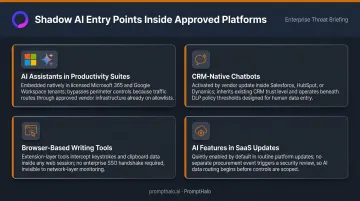
Traditional shadow IT lived on separate networks or unrecognized applications, visible to DLP tools and network monitoring. Shadow AI hides inside already-approved platforms. Common entry points include:
- AI assistants embedded in productivity suites (Microsoft Copilot, Google Gemini)
- CRM-native chatbots rolled out without compliance review
- Browser-based writing tools employees opt into individually
- AI features bundled into SaaS updates with no change-management process
None of these trigger network alerts or appear as unauthorized software. They process sensitive data inside tools your organization already trusts — which is exactly what makes them invisible to standard security controls.
Why Regulated Industries Face Elevated Shadow AI Compliance Risks
Regulated industries don't just face more compliance rules — they handle data where the consequences of any uncontrolled exposure are far more severe.
The Data Sensitivity Multiplier
PHI, PII, financial account data, transaction histories — these aren't just sensitive by organizational policy. They're protected by statute. When an employee uploads a customer file to an unvetted AI tool, the regulatory clock starts immediately, regardless of whether anything bad happens downstream.
Active AI use across finance functions more than doubled from 30% in 2024 to 75% in 2026 according to KPMG, at a pace governance frameworks haven't matched. That gap between adoption and oversight is where shadow AI lives.
The Auditability Problem
Regulators in financial services and healthcare don't just require data protection — they require proof of it. Shadow AI generates none of the documentation regulators expect:
- No model documentation or validation records
- No explainability records for decisions
- No audit trail showing what data was processed or why
- No evidence that outputs were reviewed before affecting customers
An organization can do everything right operationally and still fail an examination because it cannot demonstrate what happened.
The Biased Output Risk
In regulated contexts, AI-generated outputs that inform credit decisions, claims adjudication, or customer communications carry legal weight. CFPB Circular 2022-03 makes clear that ECOA adverse-action notice requirements apply when credit decisions involve complex algorithms, and "the technology is too complicated" is not a valid defense.
A joint statement from the CFPB, DOJ, EEOC, and FTC confirmed the same principle: automated systems are not an excuse for discriminatory outcomes.
Ungoverned AI tools producing biased outputs create regulatory liability under ECOA, the Fair Housing Act, and related statutes, even if the organization didn't know the tool was being used.
The Third-Party Data Transfer Risk
When employees use external AI tools, customer data flows into third-party infrastructure, potentially crossing jurisdictions with different data residency requirements. That flow alone can trigger cross-border data transfer violations under GDPR, independent of any breach or misuse.
The Regulatory Frameworks Shadow AI Threatens
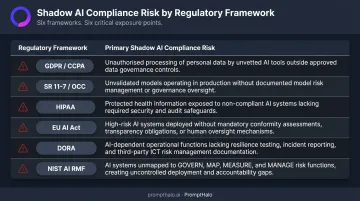
Shadow AI rarely produces a single compliance failure. In regulated industries, one ungoverned tool can trigger violations across GDPR, HIPAA, model risk rules, and the EU AI Act at the same time.
GDPR and US Privacy Equivalents
Shadow AI creates data processing activities that are undocumented, unconsented, and absent from the organization's records of processing activities. GDPR Articles 5 and 30 require accountability, transparency, and documented records of processing. Shadow AI undermines all three. CCPA and state-level equivalents carry similar obligations.
Model Risk Management (SR 11-7 / OCC Guidance)
Federal Reserve SR 11-7 and OCC Bulletin 2011-12 require documentation, validation, and ongoing monitoring for any model used in credit or risk decisions. An employee using an unvetted AI tool to inform a credit recommendation fails all three criteria before the first output is generated.
The Cyber Risk Institute's Financial Services AI Risk Management Framework, aligned with NIST AI RMF and covering 230 control objectives, reflects how seriously examiners now treat this gap.
HIPAA
Any shadow AI tool that processes protected health information without a Business Associate Agreement creates an automatic HIPAA violation. HHS enforces BAA requirements even in low-stakes contexts: in 2017, a covered entity paid $31,000 to settle a violation involving a records-storage vendor with no BAA in place.
That precedent applies directly to AI tools handling PHI.
EU AI Act and DORA
The EU AI Act classifies specific AI uses (credit scoring, life and health insurance risk assessment, employment decisions) as high-risk, requiring conformity assessments, human oversight, and technical documentation. Shadow AI deployments in these categories are inherently non-compliant from day one.
DORA adds ICT risk management obligations for EU-connected financial entities. Ungoverned AI tools operating as unvetted ICT services violate DORA's requirement for a "sound, comprehensive, and well-documented ICT risk management framework."
NIST AI RMF
Regulators and auditors now expect alignment with NIST AI RMF's four core functions: Govern, Map, Measure, and Manage. Shadow AI fails every one. There's no governance documentation, no system inventory, no validation, and no production monitoring.
Bank examiners, state insurance commissioners, and privacy regulators are already using NIST AI RMF alignment as an audit benchmark. Organizations without a documented AI inventory have no credible answer when they ask.
Framework Risk Summary
| Framework | Core Shadow AI Risk |
|---|---|
| GDPR / CCPA | Undocumented processing; missing records of processing activities |
| SR 11-7 / OCC | No model validation, documentation, or monitoring |
| HIPAA | PHI processed without a Business Associate Agreement |
| EU AI Act | High-risk AI use with no conformity assessment or human oversight |
| DORA | Unvetted ICT tools outside the required risk management framework |
| NIST AI RMF | No governance, inventory, validation, or monitoring documentation |
The Agentic AI Blind Spot: When Shadow AI Acts Autonomously
Shadow AI used to mean a chatbot. It increasingly means something far more dangerous.
What Agentic Shadow AI Looks Like
Employees and developers are now deploying autonomous AI agents that make sequential decisions, call external APIs, retrieve documents via RAG pipelines, and hand tasks off to other agents — all without governance oversight.
Unlike a single prompt-response interaction, an ungoverned agent can chain actions across an entire workflow: pulling customer records, initiating a payment, generating a compliance report — each step potentially violating a separate regulatory requirement.
The Attack Surface
Agentic AI introduces attack vectors that traditional security stacks were never designed to see:
- Prompt injection: Adversarial inputs hijack agent behavior to exfiltrate data or execute unauthorized transactions. Research published in 2025 evaluated eight prompt injection defenses and found adaptive attacks bypassed all of them at success rates consistently above 50%.
- Retrieval poisoning: Attackers inject corrupted content into RAG knowledge bases, poisoning the information an agent acts on before it ever reaches the model.
- Out-of-scope tool calls: Agents attempt to access systems or data stores beyond their intended authority — invisible to firewalls and DLP tools.
OWASP lists prompt injection (LLM01) as the top risk in its LLM Top 10, and its Agentic AI Threats and Mitigations guide explicitly covers the threat model for autonomous systems operating at scale.
The Audit Trail Void
When an autonomous agent makes a series of decisions, regulated organizations need to replay exactly what happened, why, and what data was used. Ungoverned agentic systems produce none of this. Post-breach forensics become nearly impossible. Regulatory incident reporting has no evidentiary foundation.
That's the gap PromptHalo is built to close. The platform generates decision-level, replayable audit logs covering every agent action, including:
- Each inference, tool call, and agent-to-agent handoff
- The reason for each action, the acting agent identity, and session context
- Timestamps on every event, stored in an append-only, tamper-evident log
The result is a forensic-grade evidence trail mapped to OWASP LLM Top 10 and NIST AI RMF — one that examiners can review against a known standard.
How to Detect, Govern, and Enforce Shadow AI Policies
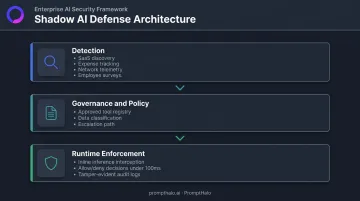
A defensible response requires three layers working together: detection, governance, and runtime enforcement.
Detection First
Before you can govern shadow AI, you need to find it. A practical inventory approach combines:
- SaaS discovery tools to surface unrecognized applications
- Expense tracking to catch AI subscriptions employees are purchasing individually
- Network telemetry for unusual API call patterns
- Employee surveys — direct, low-friction, and often the fastest way to surface embedded AI features in approved platforms
The goal is distinguishing standalone shadow AI tools, AI features embedded in approved platforms, and agentic deployments running in development or production. Each requires a different response.
Governance and Policy Foundations
A functional AI governance policy in a regulated industry needs:
- An approved AI tool registry updated as new tools are reviewed
- Data classification rules specifying which data categories can be processed by AI — and which cannot
- Required security and compliance review before any AI tool or feature is activated
- A clear escalation path for employees who want to use AI tools not on the approved list
That last element is often the deciding factor. If the approved channel is slow or opaque, employees route around it. A transparent, reasonably fast approval process reduces underground AI adoption more reliably than blanket restrictions.
Policy alone, though, is insufficient. Governance documentation tells employees what they should do. It cannot stop an agent from leaking data, executing a prohibited tool call, or producing a non-compliant output at inference time. That's where runtime enforcement becomes necessary.
Runtime enforcement tools like PromptHalo's Policy Enforcement Engine address this gap directly. Protection operates inline on every inference, tool call, and agent-to-agent handoff, making allow, restrict, challenge, deny, or monitor decisions in under 100ms. Governance policies are encoded at the system level and backed by tamper-evident audit logs, so compliance requirements are enforced at the point of action rather than surfaced in a post-incident review.
Training and Culture
Employee education is a prerequisite for governance effectiveness. Teams in regulated industries need to understand not just that shadow AI is prohibited, but what specifically happens when customer data enters an unvetted LLM — and how to request approved alternatives without friction. When employees understand the actual risk — not just the policy — they become a more reliable first line of detection than any tool.
Frequently Asked Questions
What are the risks of shadow AI?
The core risks include:
- Data exposure to unauthorized parties
- Regulatory violations with no audit trail to prove otherwise
- Biased or unvalidated AI outputs affecting high-stakes decisions
- Financial penalties from non-compliance
These risks compound in regulated industries where oversight requirements are strictest and sensitive data categories are most prevalent.
How does shadow AI differ from traditional shadow IT in regulated environments?
Shadow IT typically involves unauthorized software that stores or transmits data. Shadow AI goes further: it actively processes, generates, and in agentic cases autonomously acts on sensitive data. Network monitoring and DLP tools designed for shadow IT were never built to detect these behaviors.
Which regulatory frameworks are most threatened by shadow AI in financial services?
The primary frameworks include:
- SR 11-7 and OCC model risk management guidance
- GDPR and CCPA
- DORA for EU-connected financial entities
- EU AI Act high-risk AI provisions
- NIST AI RMF, increasingly cited by bank examiners and state regulators
Can a regulated organization be penalized for shadow AI even if no data breach occurs?
Yes. GDPR, HIPAA, and model risk guidance all require documented controls, validated models, and audit trails as affirmative obligations. The absence of these records is itself a violation — regardless of whether any data was actually exfiltrated or misused.
What is the difference between shadow AI governance and shadow AI runtime enforcement?
Governance sets policies and approved tool lists. Runtime enforcement operates at inference time — intercepting and evaluating every AI action before it executes to ensure it stays within sanctioned boundaries and generates a compliant audit record. Policy without runtime enforcement leaves the gap open.
How should compliance teams demonstrate AI audit readiness to regulators?
Audit readiness requires tamper-evident, decision-level logs showing what AI did, what data it touched, and why each action was permitted or blocked. Those logs should map to recognized frameworks like NIST AI RMF or OWASP LLM Top 10 so examiners can review evidence against a known standard.