Introduction
Enterprise AI deployment has reached a hard ceiling. According to McKinsey's 2025 global AI survey, 88% of organizations regularly use AI in at least one business function—yet nearly two-thirds haven't begun scaling it across the full enterprise. The constraint isn't the technology. It's trust.
And trust has a data problem.
Gartner found that 63% of organizations either lack or are unsure they have the right data management practices for AI—and predicts that through 2026, organizations will abandon 60% of AI projects unsupported by AI-ready data.
That gap has consequences at the top. Deloitte reports 69% of boards now have AI on their agenda, up from 55% in 2024. What was once a back-office data quality concern has become a board-level accountability question.
Data governance is not a compliance checkbox. It's the structural foundation on which trustworthy, explainable, and auditable AI is built. For agentic AI specifically, that foundation must extend well beyond the data pipeline—all the way to the moment of inference.
Key Takeaways
- 63% of organizations lack adequate data management for AI — governance failures are the leading cause of stalled AI programs
- Static governance policies can't close the accountability gaps created by continuously-acting agentic AI
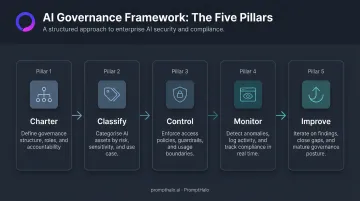
- Effective AI data governance runs on five pillars: Charter, Classify, Control, Monitor, and Improve
- EU AI Act enforcement from August 2026 makes event logging and data lineage non-negotiable
- Data governance alone cannot protect inference-time threats—runtime security is the complementary layer that closes the last mile
What Data Governance Actually Means for AI in 2026
Beyond the Traditional Definition
Data governance for AI means the policies, controls, technologies, and workflows that ensure AI systems are built on high-quality, secure, traceable, and ethically sourced data. The definition sounds familiar. The scope is not.
Traditional governance was designed for structured data in databases and data warehouses, reviewed by humans before use in BI reports. AI-era governance must cover fundamentally different ground—different data types, different risk surfaces, and different timescales.
The Expanded Scope
MIT Technology Review reports that unstructured data can represent up to 90% of organizational data—and all of it needs to be prepared and contextualized before it can power enterprise AI. The governance scope in 2026 includes:
- Unstructured text, images, and documents
- Real-time operational data streams
- Synthetic training data
- Third-party and licensed training sources
- RAG retrieval pipelines and knowledge bases
- Model outputs and inference logs
Traditional vs. AI-Era Governance
| Dimension | Traditional Governance | AI-Era Governance |
|---|---|---|
| Primary focus | Structured data, databases | All data types, including unstructured and synthetic |
| Goal | Accuracy for reporting | AI-readiness, bias mitigation, traceability |
| Scope | Data at rest | Data in motion, at inference, across agents |
| Review cycle | Periodic audits | Continuous, real-time monitoring |
| Accountability | Data owners, DBA teams | Cross-functional: data science, legal, compliance, security |
| Regulatory driver | GDPR, SOX | EU AI Act, NIST AI RMF, ISO/IEC 42001 |
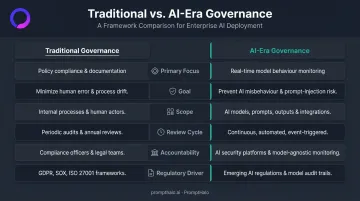
That table gap in regulatory drivers reflects a real shift in expectations. The NIST AI RMF organizes AI risk management into Govern, Map, Measure, and Manage functions, with governance as the cross-cutting layer that informs all three others. ISO/IEC 42001:2023 goes further: it specifies requirements for an AI management system treated as a living program, not a one-time implementation.
Why Traditional Data Governance Falls Short for Agentic AI
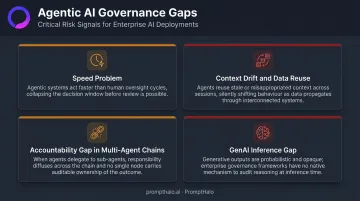
The Speed Problem
Traditional governance was built to manage data at rest—collected, stored, reviewed, then used. Agentic AI compresses that timeline to near zero. Agents consume live operational data continuously, acting on it in real time.
A flawed input doesn't sit waiting for review. It influences the next decision, and the one after that, across automated workflows that move faster than any human oversight cycle was designed to catch.
The Cloud Security Alliance notes that autonomous AI agents create a governance gap that existing AI risk frameworks don't adequately address—particularly when agents can execute code, call APIs, orchestrate workflows, or initiate transactions.
Context Drift and Data Reuse
A CRM record governed under one set of rules doesn't stay in the CRM. In agentic architectures, that same record might flow through a customer service agent, a pricing recommendation system, and a fraud detection workflow—in contexts never anticipated when the governance rules were written.
IAPP has warned that without explicit governance design, AI agents can process data for purposes beyond those originally communicated to data subjects. At scale, this makes two core privacy principles practically unenforceable:
- Purpose limitation — agents act on data in contexts the original rules never anticipated
- Data minimization — no mechanism exists to restrict what context gets passed downstream
The Accountability Gap in Multi-Agent Chains
Picture a multi-agent payment workflow: one agent calls an external pricing API, a second triggers a transaction, and a third logs the outcome for compliance. Traditional governance has no mechanism to assign accountability across those individual handoffs. There's no audit trail for the context passed between agents, no scope check on the tool call, and no record of why a particular action was authorized.
PromptHalo addresses this directly through agent security passports—signed credentials that travel with each agent request and carry policy, budget, and authority decay parameters. Authority is scoped per action and enforced externally, so an agent cannot grant itself more access than it was issued.
The GenAI-Specific Gap
Even when an organization's internal data is well-governed, large language models trained on massive external datasets can hallucinate, generate harmful content, or violate intellectual property boundaries. NIST AI 600-1 identifies these generative AI risks—including harmful bias, IP infringement, data privacy violations, and misinformation—as distinct from upstream data pipeline risks.
The governance gap here lives in model inference behavior, not the data catalog. Cataloging your data assets doesn't control what a model does with external training at runtime.
For the agentic era, governance maturity requires continuous enforcement across the entire AI lifecycle—from data sourcing through model inference, tool execution, and audit reporting. Static policies reviewed quarterly won't hold.
The Five Pillars of a Data and AI Governance Framework
Charter and Accountability
Governance without ownership is policy theater. A meaningful charter defines cross-functional responsibilities spanning data science, legal, compliance, and security—and for AI specifically, it must address AI-native risks including hallucinations, bias, prompt injection, and unauthorized agent behavior. Every team that touches AI data must be accountable for its integrity, with escalation paths defined before an incident occurs.
Classify and Catalog
You cannot govern what you cannot see. Automated data classification and metadata tagging are essential for identifying PII, sensitive financial data, regulated third-party inputs, and potentially harmful training sources before they enter AI pipelines. Gartner's finding that 63% of organizations lack adequate AI data management practices points directly to this gap—organizations often lack the metadata needed to even assess AI readiness, let alone enforce governance policies on top of it.
Manual classification at AI data volumes isn't viable. Automated discovery tools are now the baseline for any AI governance program worth running.
Control and Access
AI-specific access controls go beyond storage-layer permissions. They include:
- Role-based access to training pipelines and inference logs
- Prompt filtering and input sanitization at the inference layer
- Data minimization enforced at the point of response, not just at rest
- Secure handling of retrieval contexts in RAG systems
IBM's July 2025 report found that 13% of organizations had experienced breaches of AI models or applications—and 97% of those breached organizations lacked proper AI access controls. Most AI data leaks trace back to access governance failures, not external attacks.
PromptHalo's platform enforces these controls inline at the inference layer—inspecting responses in real time, blocking out-of-scope tool calls before execution, and applying the same data-access policy across multi-step agent interactions where data can otherwise leak gradually.
Monitor and Trace
Enforcing access controls is only half the equation. Real-time monitoring is now a regulatory requirement. The EU AI Act's Article 12 requires high-risk AI systems to technically enable automatic event logging over the system lifetime. Article 26 requires deployers to retain automatically generated logs for at least six months. Article 72 mandates post-market monitoring by providers.
NIST AI RMF mirrors this under the Manage function, requiring post-deployment monitoring and documentation of measured AI risks.
Monitoring must cover:
- Data flow integrity across pipelines
- Model output consistency and behavioral drift
- Bias indicators across demographic dimensions
- Anomalies that suggest prompt injection or retrieval poisoning
Iterate and Improve
ISO/IEC 42001 is explicit: an AI management system must be continually improved, not established once and left static. Governance programs that treat policy as a one-time setup step will fail the moment the threat landscape shifts or a new regulation takes effect. In 2026, both happen constantly.
Continuous improvement requires:
- Scheduled governance audits against current regulatory requirements
- Incident-driven policy updates when gaps surface in production
- Regulatory horizon-scanning to catch rule changes before they're enforced
- Model performance reviews feeding findings back into governance design
The Data Governance Challenges Enterprises Cannot Ignore in 2026
Bias and Fairness Gaps
Training data that reflects historical patterns based on race, gender, geography, or socioeconomic status doesn't merely replicate bias—AI models amplify it at scale. PwC's 2025 Responsible AI survey found that only 69% of organizations at the strategic AI stage had evaluation and testing capabilities for bias. That leaves a significant share deploying AI with no active detection mechanism in place.
Siloed Data and Lineage Blindspots
Fragmented enterprise data across CRM systems, IoT platforms, cloud storage, and unstructured repositories makes consistent governance nearly impossible. Without data lineage, there's no way to trace how a data point evolved from its source to an AI output—or to demonstrate to regulators that the path was clean.
EU AI Act Annex IV requires technical documentation on training data, architecture, and methodologies because lineage gaps are where regulatory exposure concentrates.
Rapidly Evolving Regulatory Requirements
The compliance landscape in 2026 requires organizations to navigate multiple overlapping frameworks at once:
- EU AI Act — In force since August 1, 2024; general application from August 2, 2026
- GDPR — With active AI-related enforcement (Clearview AI fined €30.5 million; OpenAI fined €15 million by the Italian Garante in December 2024)
- NIST AI RMF 1.0 — Published January 2023, with AI 600-1 Generative AI Profile released July 2024
- ISO/IEC 42001:2023 — The first AI management system standard
- US Executive Order 14179 — Signed January 2025, reshaping domestic AI policy priorities
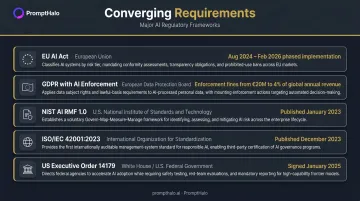
At this pace, periodic manual policy reviews don't hold up. Automated compliance dashboards have moved from nice-to-have to operational necessity.
Explainability and Transparency Deficits
Black-box models—transformer-based LLMs in particular—cannot explain why a specific decision was made. That opacity creates direct regulatory exposure.
GDPR Article 22 gives data subjects the right not to be subject to purely automated decisions with significant effects; Article 15(1)(h) requires meaningful information about the logic involved. The EU AI Act's Article 13 requires high-risk AI systems to be interpretable enough for deployers to assess outputs appropriately.
Addressing this means building three capabilities in from the start:
- Explainable AI techniques embedded at the model level, not retrofitted after deployment
- Model documentation — model cards and data statements that make the system's behavior auditable
- Human-in-the-loop review for high-impact decisions, particularly in regulated use cases
These aren't enhancements. They're the baseline for any AI system that has to answer to regulators or affected individuals.
Where Data Governance Ends and Runtime AI Security Begins
Data governance handles the upstream: classification, access controls, lineage tracking, pipeline integrity. But even perfectly governed, well-classified training data can be corrupted or weaponized at inference time.
The attack vectors that operate outside the data pipeline include:
- Prompt injection — Adversarial inputs that alter model behavior before the model can detect them; OWASP identifies this as a top LLM application risk
- RAG retrieval poisoning — Injecting manipulated content into knowledge bases that the model retrieves at inference time; research on PoisonedRAG demonstrates that a small number of poisoned texts can reliably manipulate outputs
- Unauthorized tool calls — Agents invoking APIs or executing commands beyond their intended scope (OWASP LLM06: Excessive Agency)
- Agent-to-agent context manipulation — Threats that span multi-agent handoffs, where context passed between agents carries embedded instructions or manipulated state
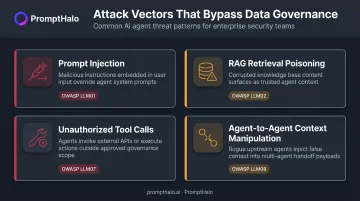
None of these occur in the data pipeline. Traditional governance controls never reach them.
Closing this gap requires a runtime enforcement layer: a control plane that evaluates every inference, tool call, and agent handoff in real time, deciding whether to allow, restrict, challenge, or deny each action before it executes. PromptHalo's runtime security platform sits inline on every agent action across any AI application, making per-action enforcement decisions in under 100ms, without touching the underlying model.
That enforcement layer also produces a replayable evidence trail. Each PromptHalo decision log captures:
- The action taken (allow, restrict, challenge, or deny)
- The acting agent's identity and session context
- The reason for the decision and its timestamp
- An append-only, tamper-evident record structured for regulatory examination
Organizations that treat data governance and runtime AI security as complementary layers — rather than alternatives — gain end-to-end accountability from data sourcing through live agent decisions. That coverage is what regulators and enterprise customers now require as a baseline, not a differentiator.
AI Automation Trends Shaping Enterprise Data Governance in 2026
AI-Augmented Governance Automation
ML models are now doing the work that governance teams can't staff fast enough: automated sensitive data discovery, metadata enrichment, anomaly detection, and policy flagging at scale. Forrester described sensitive data discovery and classification as foundational for privacy, security, and AI governance in 2026—and tools that automate this classification are increasingly what separates organizations with viable governance programs from those operating without visibility into what data their AI systems are touching or exposing.
Human oversight remains essential for high-stakes policy decisions, but the discovery and monitoring functions are being automated by necessity.
Governance-as-Code and Federated Models
Governance policies are shifting from Word documents in shared drives to version-controlled YAML and JSON artifacts integrated into CI/CD pipelines. This "governance-as-code" approach logs policy decisions, blocked actions, and warnings directly in the technology stack, making governance auditable by design rather than reconstructed after the fact.
McKinsey's analysis of next-generation data architecture points to a parallel shift: governed data products, where domain teams own governance for their data within a centrally defined framework. This distributes accountability without abandoning standards — and eliminates the central data team bottleneck that has slowed governance programs for years.
Real-Time Regulatory Compliance Reporting
The enforcement teeth of the EU AI Act, combined with GDPR's active penalty regime, are pushing organizations toward continuous compliance rather than periodic audits. Three capabilities are now table stakes for regulated enterprises:
- Automated consent management that responds to data subject requests without manual intervention
- Dynamic compliance dashboards tracking data usage across jurisdictions in real time
- Data subject rights workflows that execute with the speed regulators now expect
Organizations that treat these as optional enhancements are exposed. Those that embed them into their governance stack are positioned to scale AI without scaling regulatory risk.
Frequently Asked Questions
What are the five pillars of a data and AI governance framework for enterprise systems?
The five pillars are:
- Charter: defining accountability and cross-functional ownership
- Classify: automated data discovery and metadata tagging
- Control: AI-specific access management and inference-layer guardrails
- Monitor: real-time tracing, behavioral drift detection, and audit logging
- Improve: continuous iteration as threats, model behavior, and regulations evolve
What are the top AI automation trends for enterprise data governance in 2026?
Three trends are reshaping enterprise data governance in 2026:
- AI-augmented automation: metadata tagging and anomaly detection that scales governance without proportional staffing increases
- Governance-as-code: federated ownership models where domain teams manage policies within a central framework
- Real-time compliance reporting: driven by EU AI Act enforcement and converging global privacy requirements
Why does data governance for AI fail even when organizations already have governance programs?
Traditional governance was designed for data at rest and human-reviewed decisions. AI systems consume live operational data continuously and act at machine speed—creating accountability and control gaps that static upstream policies were never designed to address. The problem isn't the absence of governance; it's that existing governance doesn't reach the places where AI operates.
How does data governance differ from AI governance?
Data governance manages the quality, lineage, access, and compliance of data assets. AI governance extends accountability to model behavior, agent actions, decision explainability, and runtime enforcement. Data governance is the necessary foundation, but it cannot by itself address what happens at inference time—when the model acts on data rather than just stores it.
What regulations require enterprise data governance for AI systems in 2026?
Key frameworks include:
- EU AI Act: in force August 2024, general application August 2026
- GDPR: with active AI enforcement now in effect
- NIST AI RMF: Generative AI Profile published July 2024
- ISO/IEC 42001:2023 and US Executive Order 14179
Organizations operating across jurisdictions face overlapping requirements for end-to-end data lineage and model accountability documentation.
How can organizations build audit trails that satisfy EU AI Act and NIST AI RMF requirements?
Compliant audit trails must be decision-level rather than system-level logs: tamper-evident and replayable, capturing data provenance, inference actions, tool calls, and agent decisions with timestamps and acting identity. The EU AI Act's Article 26 requires log retention of at least six months for high-risk systems. NIST AI RMF requires post-deployment monitoring documentation under the Manage function.