Introduction
Most enterprises have deployed AI faster than they've built the infrastructure to control it. That gap is a liability.
A single AI assistant in a contained environment is governable with basic controls. Fifty autonomous agents calling APIs, retrieving documents, and handing off tasks across production systems is a different problem entirely.
Fragmented oversight, uncontrolled agent actions, missing audit trails, and a threat surface that expands with every new model or workflow — that's the operational reality for most enterprise AI teams right now.
According to McKinsey's 2024 survey, 72% of organizations were using AI regularly — yet only 18% had an enterprise-wide council with actual authority over responsible AI governance. The organizations sitting in between — deploying AI without the controls to match — carry the most exposure.
This article covers why governance fails at scale, the attack surface that traditional security tools can't see, and what effective enterprise AI governance looks like across identity, actions, data, and compliance.
Key Takeaways
- Enterprise AI governance requires purpose-built controls for agent actions, API calls, and multi-model complexity — not extensions of existing security tools
- Firewalls, DLP, and code scanners can't see the agentic attack surface — autonomous tool calls, RAG retrieval, and agent-to-agent handoffs require a different layer of protection
- Four pillars underpin effective governance: identity and permissions, action-level control, data safety, and auditability
- Governing at the agent-action layer — not just the data layer — is the gap most enterprises miss
- At scale, compliance demands decision-level, replayable audit logs aligned to OWASP LLM Top 10, NIST AI RMF, and the EU AI Act
Why Enterprise AI Governance Breaks Down at Scale
Governance designed for a chatbot doesn't transfer to an environment with dozens of autonomous agents, multiple LLM vendors, and hundreds of daily tool invocations hitting production systems.
The Numbers Confirm the Gap
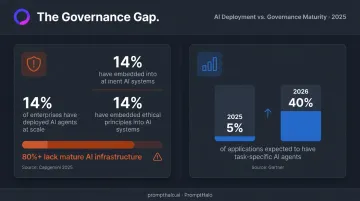
Capgemini's 2025 research puts the disparity in sharp relief:
- 14% of organizations have deployed AI agents at partial or full scale
- Only 14% have fully embedded ethical AI principles into governance and workflows
- Over 80% lack mature AI infrastructure to support what they're deploying
Gartner adds another dimension: fewer than 5% of enterprise applications had task-specific AI agents in 2025, but that figure is projected to reach 40% by 2026. The governance infrastructure isn't growing at the same rate.
Governance Debt Accumulates Quickly
Teams ship AI features fast during pilot phases, establish no enforcement mechanisms, and then find themselves unable to audit or control what agents are doing once those pilots reach production. Call it governance debt — it compounds exactly like technical debt, just with higher stakes.
The organizational dimension makes this worse. Security, compliance, and AI/ML teams typically each own a slice of the AI risk surface, but no single function owns all of it. Those gaps multiply as deployment scales.
Three compounding factors:
- Each new model or vendor adds trust decisions that must be made in real time
- No cross-team control plane exists to handle that growth systematically
- Risk surface expands with every new agentic workflow, faster than teams can track manually
The gap is operational: most enterprises know which models they've deployed. Few can answer what those models are actually doing at runtime.
The Agentic Attack Surface: What Traditional Security Can't See
Firewalls authenticate traffic. DLP tools scan content. Code scanners inspect repositories. None of them can inspect the semantic intent of an agent deciding to call a downstream API mid-inference.
That's the core visibility problem.
What the Agentic Attack Surface Actually Includes
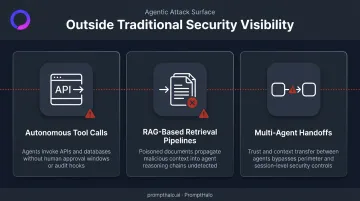
The agentic attack surface covers three distinct interaction types that traditional security was never designed to handle:
- Autonomous tool calls — agents invoking APIs, databases, and external services based on their own reasoning
- RAG-based retrieval pipelines — agents acting on retrieved content without verification of its integrity
- Multi-agent handoffs — trust and permissions transferring between agents, creating escalation opportunities
Prompt Injection at Enterprise Scale
OWASP defines prompt injection as manipulating model responses through crafted inputs to alter behavior or bypass safety measures. Direct injection comes from users. Indirect injection — the more dangerous variant at enterprise scale — arrives through external content: documents, emails, retrieved data.
The distinction matters because indirect injection is invisible at the perimeter. A malicious instruction embedded in a retrieved contract can hijack that agent's behavior mid-workflow — causing it to exfiltrate data, trigger unintended API calls, or abandon its original objectives entirely. No firewall sees this happen.
RAG Retrieval Poisoning
When a RAG pipeline retrieves adversarially crafted content, the agent treats it as trusted context. Research published on PoisonedRAG demonstrated that injecting a small number of malicious texts into a knowledge database causes consistent retrieval and generation errors — making the retrieval layer itself an attack vector.
This differs from standard data integrity concerns. The attack doesn't touch the model — it controls what the model is allowed to see and reason over. Both prompt injection and retrieval poisoning exploit the same blind spot: security tools built for network traffic and static content have no concept of agent reasoning.
Why Rule-Based Detection Can't Keep Pace
Pattern matching fails against context-dependent attacks on agent reasoning. Rule-based approaches catch roughly 35% of AI-native attacks while generating 15–20% false positives — enough noise to overwhelm a security team, and enough gaps to let real incidents through.
PromptHalo's ML-based detection achieves a catch rate above 95% at under 5% false positives. At enterprise scale, that difference isn't academic: it determines whether an agent exfiltrates data before anyone notices.
The Four Pillars of Enterprise AI Governance at Scale
Identity and Access Control for AI Actions
Every agent action must trace back to a real human user with scoped permissions. The agent should inherit permissions from the user on whose behalf it acts — not operate as a super-admin with broad system access.
OWASP's Excessive Agency guidance is explicit: execute actions within the user's security context, restrict permissions to the minimum necessary, and limit the tools and functions agents can access.
What this requires in practice:
- RBAC/ABAC extended to cover agent-specific permissions, not just human logins
- Security passports that carry scoped, contextual authority per request
- Authority decay — permissions that automatically diminish as risk accumulates or context changes
Meeting these requirements in practice means tying policy enforcement to the request itself — not to the session. PromptHalo's security passport mechanism issues signed passports that travel with each agent request, embedding policy, budget, and authority decay into the request payload. Budgets are tracked across time, steps, and accumulated risk. When any envelope is exceeded, the system forces re-authorization rather than allowing authority to persist indefinitely.
Action-Level and Tool-Level Enforcement
Governance must operate at the individual tool call and API invocation level. Session-level or request-level controls are insufficient because agents can chain individually permitted actions into disallowed workflows.
Each action requires a policy evaluation before it executes:
- Is this tool authorized for this agent in this context?
- Are the parameters within scope, or is the agent invoking with unusual inputs?
- Is this a high-risk operation that requires human approval before proceeding?
PromptHalo's runtime enforcement layer sits inline on every inference, tool call, and agent-to-agent handoff — making allow, restrict, challenge, deny, or monitor decisions in under 100ms. Authority is scoped per action and enforced externally, preventing an agent from granting itself more access than it was originally given.
Data, Retrieval, and Input Safety
Standard data governance wasn't built for agentic retrieval. The data layer needs AI-specific controls:
- RAG-retrieved content must be scanned for embedded instructions before the agent acts on it
- Source trust must be scored — not all retrieved content carries equal authority
- Retrieval drift (gradual shifts in what gets retrieved) must be detected before it changes agent behavior
PromptHalo's prompt injection protection specifically addresses retrieval and RAG injection, using embedding-based detection scored against a shared threat library. Attack patterns that Litmus uncovers during red-teaming feed directly into the Septa enforcement engine — so each new exploit strengthens runtime defenses automatically.
Monitoring, Auditability, and Anomaly Detection
Without full behavioral observability, governance is reactive at best. Every tool call, parameter value, and decision outcome must be logged with user attribution, timestamps, and approval status.
Anomaly detection at enterprise scale goes beyond individual sessions. The patterns that matter are cross-agent:
- Unusual tool call sequences across multiple agents
- Repeated permission violation attempts
- Cascading failures in multi-agent workflows
The OWASP AI Agent Security Cheat Sheet recommends logging all agent decisions, tool calls, and outcomes with anomaly detection for unusual behavior — a baseline that most AI observability tools don't yet meet.
Governing API Access and Agent Actions at Runtime
The traditional API gateway authenticates, routes, and rate-limits traffic. For agentic AI, that's the wrong question entirely. The authorization question shifts from "is this user allowed to call this API" to "is this agent, in this context, permitted to take this specific action with these specific parameters, right now."
Runtime Enforcement vs. Perimeter Security
The critical governance layer sits between AI reasoning and system execution — evaluating every inference, tool call, and agent-to-agent handoff before it executes. Perimeter tools enforce identity and access at the boundary; they have no visibility into what an agent does once it's inside.
For this to work in production, policy decisions must happen fast. PromptHalo makes these decisions in under 100ms across any AI application from any vendor, without touching the underlying model. Low-risk operations pass through immediately; high-risk actions trigger deeper inspection or human review. The latency overhead is negligible compared to LLM inference time.
Credential and Secret Isolation
Agents must never have direct access to raw API keys, database tokens, or sensitive credentials. A compromised agent can exfiltrate anything present in its context window — and any credential in that context window is a credential at risk.
Curity's API security guidance outlines the core approach: use scoped, audience-restricted tokens rather than broad credentials. In practice, that means:
- Coarse-grained limits enforced via OAuth scopes
- Fine-grained authorization applied through token claims
- Audience restrictions that prevent credential reuse across unintended services
Even a compromised agent can't leverage credentials beyond their defined scope.
Managing Complexity: Multi-Model, Multi-Vendor, and Multi-Agent Environments
Enterprises using GPT-4, Claude, Gemini, and open-source models in parallel have no native cross-vendor governance layer. Each provider has different capability boundaries, different failure modes, and different integration surfaces. Gartner predicts that by 2027, organizations will use small, task-specific AI models at least three times more than general-purpose LLMs — meaning the multi-model problem gets harder, not easier.
The Multi-Agent Handoff Problem
When one agent delegates a task to another, trust and permissions must transfer correctly. Research on Prompt Infection demonstrated how malicious prompts can propagate from one agent to another through LLM-to-LLM interaction — effectively using the trust relationship between agents as an attack vector.
The implication: each agent must be treated as a separate identity and policy boundary, not as a trusted internal component. PromptHalo evaluates and enforces trust at every handoff, treating each transfer of control as a discrete security checkpoint. Agent security passports travel through the workflow, with authority decay built in so permissions from early stages don't persist inappropriately through later ones.
Vendor-Agnostic Governance
Effective enterprise governance operates at the application layer, above any individual model. NIST AI RMF and ISO/IEC 42001 are both model- and vendor-neutral frameworks by design. The enforcement and audit layer must follow the same principle: policies, enforcement decisions, and audit logs must be consistent regardless of which LLM or vendor powers a given workflow.
PromptHalo supports this across three deployment paths, all feeding the same inspection and enforcement pipeline:
- API gateway — intercepts requests before they reach the model
- Agent mode — monitors and enforces at the agent orchestration layer
- Inline middleware — embeds directly into existing application infrastructure
Compliance and Audit Readiness at Enterprise Scale
The Regulatory Landscape
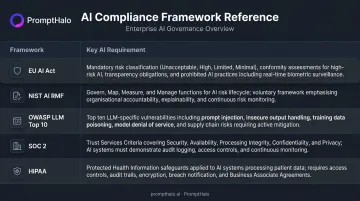
Enterprises face overlapping obligations from multiple frameworks, each with specific logging and control requirements:
| Framework | Key Requirement for AI |
|---|---|
| EU AI Act | Automatic event logging over system lifetime; deployers must retain logs for at least 6 months |
| NIST AI RMF | Govern, Map, Measure, Manage functions; production monitoring for validity and reliability |
| OWASP LLM Top 10 | Covers Prompt Injection, Excessive Agency, Vector & Embedding Weaknesses, and more |
| SOC 2 | Role-based access with least privilege (CC6.3); anomaly monitoring (CC7.2) |
| HIPAA | Access controls and audit records for systems containing ePHI |
"Audit-ready" for AI means something specific: decision-level logs, not session summaries. Each log entry must capture the agent's decision, the authority behind it, the context it acted within, and a precise timestamp — all in a tamper-evident structure that cannot be altered after the fact.
Logging for Monitoring vs. Logging for Compliance
Most AI observability tools log for debugging. Compliance-grade logging requires more:
- Append-only, tamper-evident records that cannot be modified after creation
- User attribution tied to specific human identities, not just agent sessions
- Policy decision mapping — what policy was evaluated and what outcome it produced
- Structured exportability for SIEM ingestion and regulatory reporting
PromptHalo's audit logs capture every decision with its reason, the acting agent or passport identity, the session and tenant context, and a timestamp. The append-only structure creates a replayable evidence trail usable for compliance export and post-incident investigation.
The Financial Services Dimension
The audit requirements above aren't abstract for financial firms — they're already enforceable. FINRA Regulatory Notice 24-09 confirms that existing securities rules — supervision, communications, privacy, recordkeeping — apply directly to generative AI deployments. The SEC's 2024 enforcement action against Delphia and Global Predictions, which resulted in $400,000 in civil penalties for misleading AI claims, shows regulators are prepared to act on how firms deploy and describe their AI systems.
For fintech and financial services firms, governance isn't a backend compliance checkbox. It directly shapes client trust, regulatory standing, and the firm's ability to keep deploying AI at scale.
Frequently Asked Questions
What is enterprise AI governance and why does it require a different approach than traditional security?
Traditional security protects networks, systems, and data at rest or in transit. AI agents take actions — invoking tools, calling APIs, processing sensitive data based on their own reasoning — creating risks that firewalls, DLP, and access management systems weren't built to address. Governance must operate at the action layer, not just the perimeter.
How does agentic AI change the API security challenge for enterprises?
Autonomous agents make API calls based on their own reasoning, not explicit user commands. Authorization can't be enforced only at the point of user authentication — it must apply at the point of every action, evaluated against the specific context, parameters, and risk level of that individual call.
What are the biggest AI governance risks when scaling from pilot to production?
Four risks surface consistently at this transition point:
- Governance debt from pilots with no enforcement mechanisms carries forward into production
- Auditability breaks down as agent interactions multiply across systems
- The blast radius of agent errors grows significantly larger at scale
- Multi-agent trust gaps emerge that simply didn't exist in contained pilot environments
Can existing security tools like firewalls and DLP govern agentic AI?
No. Traditional tools operate at the network perimeter or content layer. They cannot inspect the semantic intent of agent tool calls, evaluate parameter values for policy compliance, or intercept mid-inference decision chains — the exact point where agentic attacks execute.
Which compliance frameworks apply to enterprise AI deployments in the US?
NIST AI RMF, OWASP LLM Top 10, SOC 2, and HIPAA (for healthcare AI) are the primary frameworks, alongside FINRA and SEC requirements for financial services. The EU AI Act applies to US enterprises with cross-border operations. Most frameworks require demonstrable access controls, decision-level audit trails, and documented risk management processes.
How do you govern AI agents without adding unacceptable latency to production workflows?
Runtime enforcement engines built for AI workloads make policy decisions in under 100ms — negligible relative to LLM inference time. Low-risk operations move through quickly; high-risk actions trigger deeper inspection or route to human review without blocking the entire workflow.