Introduction
Most enterprises don't have one AI problem—they have dozens. Different teams are calling different LLM providers, token costs are climbing faster than anyone budgeted, and sensitive data is flowing into model prompts with no interception point in sight. According to McKinsey's 2024 survey, 65% of organizations are now regularly using generative AI—nearly double the prior year. That adoption spike has created an AI governance gap: distributed, uncontrolled AI traffic with no central policy enforcement.
The AI gateway emerged as the architectural answer. It sits between your applications and your AI providers, creating a single enforcement point for every inference, tool call, and model interaction—before either side sees the other. What follows covers what an AI gateway is, how it differs from a traditional API gateway, what core capabilities it provides, and where its governance scope ends.
Key Takeaways
- An AI gateway centralizes LLM traffic control—routing, cost governance, access control, and compliance logging at the infrastructure layer.
- AI gateways extend traditional API gateways with token budgets, semantic caching, multi-model failover, and agentic tool governance.
- Retrofitting audit architecture at scale compounds regulatory exposure—governance must be built in from the start.
- AI gateways govern traffic but don't block runtime threats—prompt injection, jailbreaks, and RAG poisoning require a dedicated inline enforcement layer.
What Is an AI Gateway?
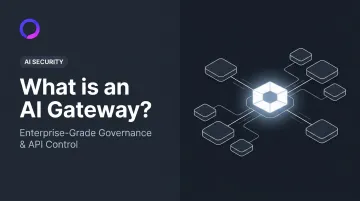
An AI gateway is a managed infrastructure layer that intercepts all traffic between enterprise applications and LLM providers. Every request and response passes through it before either side executes—enforcing policy, routing, authentication, and compliance controls along the way.
The Architectural Position
Instead of applications calling OpenAI, Anthropic, AWS Bedrock, or internal models directly, all traffic routes through the gateway. This gives the organization a single enforcement point for:
- Access control and authentication
- Cost management and token budgeting
- Security policy and data loss prevention
- Audit logging and compliance reporting
Major vendors converge on the same definition. IBM describes an AI gateway as specialized middleware for integrating, deploying, and managing AI tools including LLMs. Cloudflare frames it as visibility and control over AI applications. Kong calls it the control point between applications and AI models.
The common thread is centralization—one enforcement layer for all AI traffic.
What the Gateway Intercepts
An AI gateway operates on every layer of the AI interaction stack:
- User prompts and system messages before they reach the model
- Model responses and streamed tokens before they reach the application
- Tool and API calls triggered by agentic workflows
- RAG retrieval queries from document and knowledge pipelines
That scope carries real stakes. IDC projected enterprise AI investment at $307 billion in 2025, growing to $632 billion by 2028—at that scale, unmonitored AI traffic is a governance liability. The gateway is also model- and vendor-agnostic by design, sitting in front of any AI application from any provider without touching underlying models or requiring code rewrites.
API Gateway vs. AI Gateway: Key Differences
Traditional API gateways were built for deterministic, stateless workloads. A fixed request produces a predictable, structured response. Rate limiting is measured in requests per second. Every assumption that holds for a REST API breaks the moment you introduce an LLM.
Where Traditional API Gateways Fall Short
AI workloads introduce challenges no conventional API gateway was designed to handle:
- The same prompt can produce different responses, so policies that assume static response schemas fail immediately
- Billing is driven by token consumption — prompt size, context length, model choice, and output length — not call count
- Streaming responses require observing partial output events, not just final HTTP payloads
- Context accumulates across conversation turns, so usage and cost grow even when request count stays flat
- Traffic must be routed by semantic meaning rather than endpoint path
What AI Gateways Add
AI gateways extend the API gateway foundation with capabilities purpose-built for these workloads:
| Capability | Traditional API Gateway | AI Gateway |
|---|---|---|
| Rate limiting | Requests per second | Token budgets per user, team, project |
| Caching | Exact URL/body match | Semantic similarity matching |
| Routing | Endpoint path | Model capability, cost, latency, policy |
| Security | Auth, TLS, WAF rules | LLM-aware guardrails, prompt inspection |
| Observability | HTTP status, latency | Token consumption, model used, cost per call |
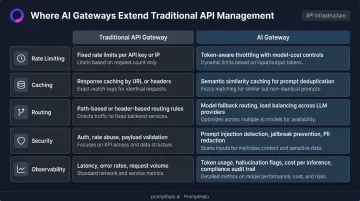
AI gateways extend rather than replace API gateways. The existing API management foundation handles authentication, TLS, and traffic management — the AI layer adds token-aware controls, semantic routing, and LLM-specific guardrails on top. Both layers enforce policy consistently, which matters when a single enterprise environment runs traditional microservices and agentic AI workloads side by side.
Core Capabilities of an Enterprise AI Gateway
Multi-Model Routing and Failover
Intelligent routing lets the gateway select the appropriate model or provider based on cost, latency, capability, or policy. When a primary provider hits rate limits or experiences an outage, the gateway automatically fails over to a backup without interrupting the calling application.
An application hard-coded to a single provider becomes fragile; an application routed through a gateway can shift providers transparently.
Token-Based Cost Governance
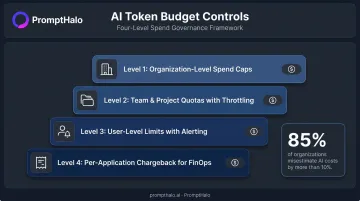
Token-based budgets are fundamentally different from request-count limits, and the difference has real financial consequences. A single misconfigured agent loop can exhaust a quarterly budget in hours. A16z reported average enterprise LLM spend rose from roughly $4.5M to $7M over two years, with another ~65% growth expected. Meanwhile, 85% of organizations misestimate AI costs by more than 10%, and nearly a quarter miss by 50% or more.
Hierarchical budget controls address this directly:
- Organization-level spend caps
- Team and project-level quotas with automated throttling
- User-level limits with alerting before overruns
- Per-application chargeback for FinOps visibility
Semantic caching adds another cost lever. Rather than caching only on exact string matches, semantic caches return stored responses for prompts with similar meaning. Research suggests over 30% of LLM queries are semantically similar in production workloads, which translates directly into fewer redundant inference calls.
Security and Compliance Enforcement
Cyberhaven found that 39.7% of AI interactions expose sensitive data, with employees inputting sensitive information into AI tools on average once every three days. Enterprise AI gateways address this at the infrastructure layer through:
- PII detection and redaction before prompts reach the model
- Content filtering using allow/deny policies for prompt patterns
- Authentication and authorization integrated with existing identity providers (OIDC, LDAP, SSO)
- Encryption for data in transit across all AI traffic
Compliance enforcement works by treating the gateway as the system of record for all AI interactions. Every request and response is logged with AI-specific metadata: token counts, model used, request and response content, latency, and cost. Policies mapped to regulatory frameworks generate audit artifacts automatically. The gateway becomes the single source of truth for AI compliance reporting.
Observability and Audit Logging
Real-time dashboards give operations teams visibility into:
- Token consumption by team, application, or user
- Cost per request and per model
- Latency distributions and error rates by provider
- Usage pattern anomalies that signal runaway agent loops
This visibility transforms AI from a black box into a measurable infrastructure component that operations teams can actually govern and optimize.
Agentic AI and MCP Governance
Single-turn request governance is the easy part. As autonomous agents enter production, gateways must govern multi-step workflows where each step may invoke tools, call APIs, or pass context to other agents.
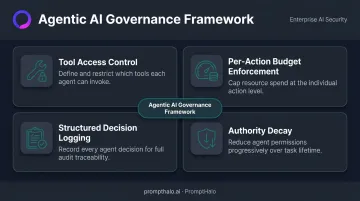
MCP (Model Context Protocol) governance controls tool access for agentic systems. Effective agentic governance typically covers:
- Tool access control: defining which tools an agent can call, under what conditions, and with what scope
- Per-action budget enforcement: preventing agents from accumulating cost or authority beyond their intended operating envelope
- Structured decision logging: capturing every agent action, not just inference calls, for operational and regulatory audit trails
- Authority decay: agent privileges diminish over the course of operation, forcing re-authorization when operating envelopes are exceeded — a pattern PromptHalo implements through security passports and per-action scope enforcement
Why Enterprise AI Governance Cannot Be Deferred
Organizations that bolted governance onto API programs after they'd scaled found the remediation work exponentially harder than building it in from the start. AI governance debt compounds faster—and carries higher stakes.
The compliance posture, data lineage assumptions, access boundaries, and audit trail architecture of an AI system are baked in from first deployment. Retrofitting them after scale is painful, and it creates historical compliance exposure that can never be corrected after the fact.
Regulatory Pressure Is Accelerating
Three frameworks are establishing enforceable standards for AI system auditability:
- EU AI Act (Regulation 2024/1689): High-risk AI systems must implement risk management (Article 9), automatic event logging (Article 12), and human oversight (Article 14)
- NIST AI RMF 1.0: Organizes AI risk management around four core functions—Govern, Map, Measure, and Manage
- OWASP LLM Top 10: Documents specific LLM risk categories including prompt injection, sensitive information disclosure, and excessive agency
Enterprises deferring governance aren't just accumulating technical debt. They're accumulating compliance liability in real time.
The Shadow AI Problem
Microsoft found that 78% of AI users bring their own AI tools to work. When there's no centralized gateway, individual teams make direct, unmediated calls to LLM providers. Proprietary data flows into public models with no interception, no policy enforcement, and no audit trail. By the time shadow AI is discovered, the exposure is already historical and undocumented.

A gateway makes unsanctioned AI usage visible. Once traffic routes through it, the organization has the data needed to enforce policy—and the audit trail to prove it did.
The Security Gap: What Traditional AI Gateways Miss
Most AI gateways excel at traffic management—routing, cost controls, access policies. They were designed to govern the infrastructure layer. But a different class of threat emerges when LLMs become autonomous actors rather than passive endpoints.
The Agentic Attack Surface
Traffic management doesn't defend against:
- Prompt injection embedded in retrieved documents: hidden instructions planted in external content that execute when the model retrieves them into context
- Jailbreaks designed to override system instructions: adversarial inputs that push models outside their intended behavior
- RAG poisoning: injecting malicious content into knowledge databases to corrupt retrieved context (documented in PoisonedRAG research)
- Out-of-scope tool and API calls: agents invoking capabilities beyond their authorized scope, a risk OWASP classifies as Excessive Agency (LLM06)
Gartner predicts 40% of enterprise applications will feature task-specific AI agents by 2026, up from less than 5% in 2025. Yet Deloitte found only 21% of enterprises report mature governance for agentic AI risk. Most organizations are scaling agent deployments faster than their security posture can keep up—and existing gateway controls don't close that distance.
What Inline Runtime Security Enforcement Requires
Defending against these threats requires capabilities that traditional gateways weren't built to provide:
- Per-action threat detection at the inference level, not just at the request boundary
- ML-based classification of adversarial inputs rather than rule-based pattern matching (rule-based approaches typically achieve ~35% catch rate; ML-based systems can exceed 95%)
- Real-time decisions on every agent action—allow, restrict, challenge, or deny—before the action executes
- Tamper-evident audit trails at the decision level, mapped to OWASP LLM Top 10 and NIST AI RMF
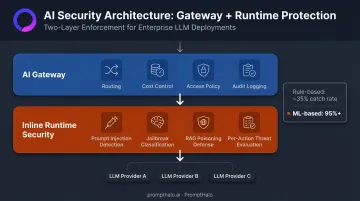
PromptHalo operates as the runtime security enforcement layer alongside an AI gateway—not a replacement for it. It addresses the agentic attack surface that firewalls, DLP tools, and API gateways were never designed to see: every tool call, retrieval action, and agent handoff, evaluated in real time before it executes.
The model is vendor-agnostic, requires no code rewrite, and deploys in under a day. The division of responsibility is clean: the AI gateway governs traffic flow; PromptHalo enforces security at the decision level within that traffic.
Frequently Asked Questions
What is the difference between an API gateway and an AI gateway?
Traditional API gateways manage deterministic, stateless traffic with request-based rate limits. AI gateways extend this foundation with AI-specific capabilities: token-aware cost controls, semantic caching, multi-model routing, and LLM-aware security enforcement for probabilistic, context-dependent workloads that don't fit the REST request/response model.
What is the enterprise AI governance model?
Enterprise AI governance is a policy-driven architecture that enforces access controls, cost limits, compliance logging, and security guardrails across all AI interactions from a centralized control plane. Building it in from the start is critical. Retrofitting governance at scale leaves audit gaps and regulatory exposure that are difficult to close.
What is the best API gateway for enterprise AI?
The best choice depends on existing infrastructure, regulatory requirements, and whether your workloads are primarily single-turn or agentic. Evaluate on governance depth, latency overhead, compliance certification support, and whether the solution is AI-native or an extension of existing API management tooling.
Do I need an AI gateway if I already have an API gateway?
Yes. AI gateways add capabilities traditional API gateways cannot provide—token-based budgets, semantic caching, LLM-aware security, and agentic tool governance. Most enterprise implementations deploy both in concert, with the API gateway handling conventional traffic and the AI gateway adding the AI-specific control layer on top.
How does an AI gateway handle agentic AI systems?
AI gateways govern agentic workloads through MCP governance for tool access control, per-action scope and budget enforcement, and structured logging of agent decisions. Detecting adversarial attacks like prompt injection, jailbreaks, and RAG poisoning requires an additional inline security enforcement layer that operates at the decision level, not just the traffic level.