Introduction
Compliance officers face a real problem: AI is running in production across loan decisioning, fraud detection, and customer service workflows — but the security stack protecting those environments was built for a different world.
Firewalls inspect network packets. DLP tools scan file transfers. SIEM correlates human-initiated events. None of them were designed to intercept a prompt, evaluate an agent's tool call, or catch a RAG retrieval that carries poisoned instructions. That gap between where AI risk lives and where your controls point is exactly what attackers are exploiting.
According to KPMG's 2025 Shadow AI report, 44% of employees have used AI in ways that contravene organizational policies, and only 41% of organizations have a policy guiding GenAI use at all. Meanwhile, IBM's 2025 Cost of a Data Breach research found that 97% of organizations that experienced an AI-impacting attack lacked proper AI access controls.
This guide breaks down what an AI gateway is from a risk and compliance perspective — the threat vectors it covers, how it maps to the frameworks your team is accountable for, and what to evaluate when you're the buyer.
Key Takeaways:
- An AI gateway enforces security at runtime — before AI decisions execute, not after
- Agentic AI creates attack vectors — tool calls, RAG retrievals, agent handoffs — that traditional security tools never see
- EU AI Act, NIST AI RMF, and OWASP LLM Top 10 all require decision-time evidence — not just policy documentation
- Prioritize ML-based detection, tamper-evident audit logs, and agentic coverage when evaluating vendors
What Is an AI Gateway? A Risk and Compliance Team's Definition
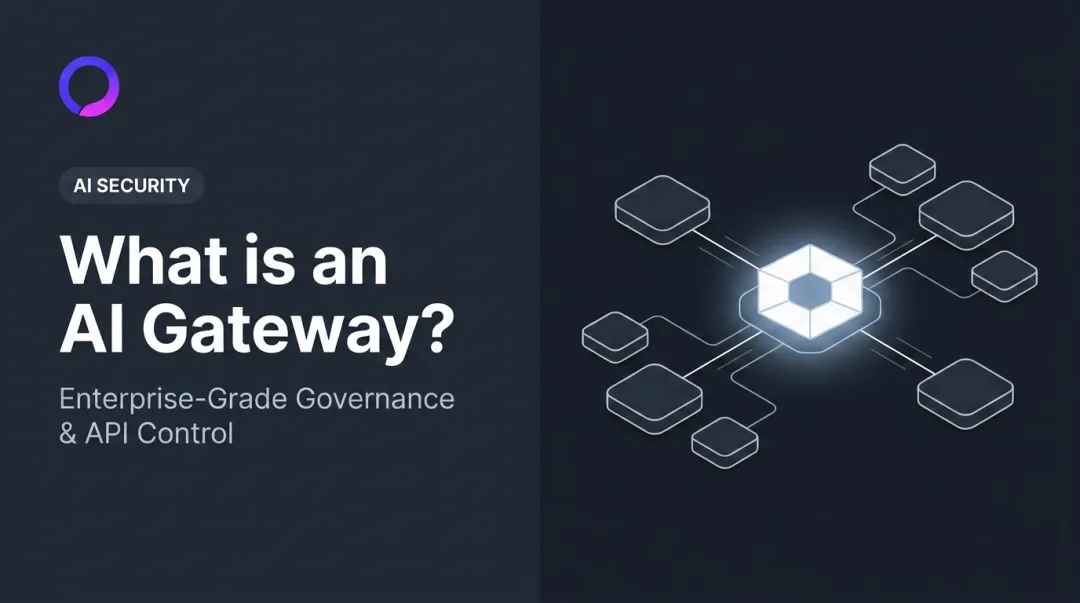
An AI gateway is a runtime control layer that sits between your applications and AI models, intercepting every inference call, tool invocation, and agent-to-agent handoff to enforce security and governance policies before any action executes.
That distinction — before, not after — is what separates an AI gateway from every reactive security control you already have.
How It Differs from a Traditional API Gateway
Traditional API gateways manage request routing and authentication for human-initiated API calls. They understand HTTP — methods, headers, payloads. What they don't understand is AI-native traffic: prompt structure, token flow, RAG retrievals, or what it means for an autonomous agent to call an external API.
An AI gateway operates at the semantic layer of that traffic. It can evaluate whether a prompt contains an injection attempt, whether an agent is requesting a tool call outside its authorized scope, or whether a model response is about to surface data it shouldn't. These aren't problems you can solve with a routing rule or a rate limiter.
One Control Plane for Compliance Teams
For compliance officers managing AI deployments across multiple models and vendors, the centralization argument is straightforward:
- Policies are encoded as configurable rules and applied consistently per action across every AI workflow
- Every inference, tool call, and denial is logged with full context in a single location — no gaps by model or vendor
- Audit readiness holds regardless of whether you're running GPT-4, Claude, Gemini, or an open-source model
PromptHalo deploys across multiple integration paths — API gateway, agent mode, and inline middleware — all feeding into the same inspection and enforcement pipeline. The practical effect for compliance teams: consistent policy enforcement and uniform audit trails across a heterogeneous AI environment, without touching the underlying models.
The AI Risk Landscape Compliance Teams Can't Ignore
Traditional security tools were designed for a world where humans made requests and systems responded. Agentic AI works differently. Agents call external APIs, retrieve from vector databases, delegate tasks to other agents, and take real-world actions — often without a human in the loop. Each step is a potential compliance exposure point that firewalls and DLP tools were never designed to see.
The Specific Threat Vectors
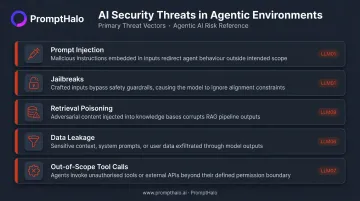
Compliance teams need to account for five primary risks in agentic AI environments:
- Prompt injection: malicious instructions embedded in inputs that hijack agent behavior, including indirect injection through retrieved content. OWASP LLM01:2025 defines this as user prompts altering LLM behavior in unintended ways.
- Jailbreaks: adversarial inputs designed to bypass safety guardrails. Research using the JAILJUDGE benchmark found string-matching detection achieved 18.8% accuracy versus 85.1% for ML-based detection on out-of-distribution attacks.
- Retrieval poisoning: corrupting RAG knowledge bases to manipulate model outputs. OWASP LLM08:2025 classifies vector and embedding weaknesses as exploitable for harmful content injection or sensitive data exposure.
- Data leakage: sensitive data escaping through model outputs or tool calls. Analysis of over 2,000 real-world LLM applications found 90% of successful attacks resulted in sensitive data leakage.
- Out-of-scope tool and API calls: agents executing actions beyond their authorized scope, which OWASP classifies as Excessive Agency (LLM06:2025).
Why Rule-Based Detection Falls Short
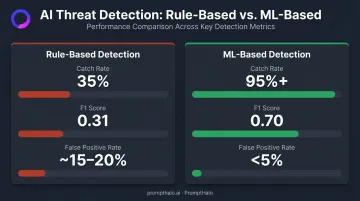
Those five threat vectors share a common problem: legacy security tools can't reliably catch them. Rule-based detection — used by many first-generation AI security products — struggles with the variability of adversarial inputs. Research published on arXiv comparing string-matching against ML-based approaches on jailbreak detection found F1 scores of 0.31 vs. 0.70 on the same dataset. For compliance teams already managing alert fatigue, that gap has direct operational consequences: missed threats on one side, false positives consuming analyst capacity on the other.
The Shadow AI Visibility Problem
Without a gateway, compliance teams have no unified view of what models are being called, what data is flowing through them, or whether any interaction crossed a regulatory line. KPMG found 58% of employees use AI productivity tools daily, with a substantial portion doing so outside sanctioned channels. IBM found shadow AI added $670,000 in average breach cost for organizations that experienced an AI-related attack.
Regulators are increasingly clear on what they expect: evidence that AI systems acted within defined authority at the time of each decision, not just attestations that policies exist on paper.
How an AI Gateway Enforces Compliance at the Infrastructure Layer
Real-Time Threat Detection and Blocking
Every prompt, model response, and tool call passes through the gateway's inspection pipeline. The decision — allow, restrict, challenge, deny, or monitor — happens inline, in under 100ms, so security doesn't become a latency tax on production AI systems.
For agentic workloads specifically, purpose-built gateways handle risks that generic proxies miss entirely:
- Per-action tool call scope enforcement — agents are blocked from invoking APIs or tools beyond their authorized scope before the call executes
- Authority decay — agent permissions decay over time and across steps, preventing gradual permission accumulation. Re-authorization is forced when budget thresholds are exceeded.
- Trust verification at agent handoffs — every agent-to-agent handoff is subject to the same inspection and authorization checks as a direct human request
PromptHalo implements this through agent security passports: signed authorization documents that travel with each request and carry policy, budget, and authority decay built in. For each action, the system issues a signed, replayable verdict. The detection engine combines a shared Threat Library with classifier-based risk scoring, achieving a stated catch rate above 95% at under 5% false positives versus roughly 35% catch rate for rule-based approaches.
Attack patterns discovered through red-teaming feed directly into the runtime defense library — protection compounds as new attack variants emerge, rather than requiring manual rule updates.
Audit Trails and Regulatory Reporting
Decision-level audit logging means something specific: every inference, every tool call, and every denial is logged with the full context — the decision, the reason for it, the acting agent identity, session and tenant context, and a timestamp. The result is a replayable record that answers "why did the AI do that?" for regulators, auditors, or incident investigators.
Standard application logs fall short. They can be altered, lack semantic linkage to AI decisions, and aren't structured for regulatory reporting. Decision-level AI audit logs are:
- Append-only and tamper-evident — once written, the record cannot be modified or deleted
- Decision-level, not activity-level — capturing not just what happened, but why and under whose authority
- Exportable for compliance review — structured for post-incident investigation and regulatory submission
PromptHalo's audit logs are designed precisely this way: immutable, decision-level records tied to the enforcement action taken, suitable for regulatory reporting without reconstruction after the fact.
Sensitive Data Protection and Access Control
At the gateway layer, every input and output is inspected for sensitive content before it reaches an external model provider or surfaces in a response. Data that shouldn't cross the boundary between enterprise systems and third-party AI is blocked or redacted before it does.
Role-based access control in this context goes beyond user permissions. It defines:
- Which agents are permitted to call specific models
- Which tools and APIs each agent can invoke
- Which data categories each agent or application is authorized to process
Policies are enforced at runtime, not managed through post-hoc audits. Authority is scoped per action and enforced externally, so an agent cannot grant itself permissions beyond what was originally authorized.
Regulatory Frameworks an AI Gateway Helps You Meet
EU AI Act
High-risk AI systems under the EU AI Act — including credit scoring and creditworthiness evaluation — must maintain human oversight, transparency, and comprehensive documentation. Specifically:
- Article 12 requires automatic event logging over the system's lifetime
- Article 13 requires transparency sufficient for deployers to interpret outputs, including mechanisms for collecting, storing, and interpreting logs
- Article 14 requires effective human oversight commensurate with the system's autonomy and risk level
- Article 26 requires deployers to keep automatically generated logs under their control for at least six months
An AI gateway enforces these requirements in practice: access controls enforce authorized use, decision-level logs satisfy Articles 12 and 26, and human-in-the-loop enforcement supports Article 14 oversight requirements.
NIST AI Risk Management Framework
The NIST AI RMF's four core functions translate directly into gateway capabilities:
| NIST Function | Gateway Capability |
|---|---|
| Govern | Policy enforcement engine — governance encoded as runtime rules |
| Map | Agentic attack surface coverage — tool calls, RAG, handoffs |
| Measure | Observable detection metrics, catch rates, false positive rates |
| Manage | Centralized audit logs documenting active risk management decisions |
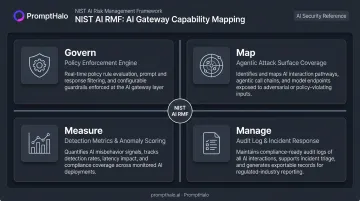
NIST AI 600-1 specifically calls for logging and analysis of generative AI incidents to support information sharing, and recommends regular review of security guardrails — both served by a gateway's enforcement and audit infrastructure.
OWASP LLM Top 10
The OWASP LLM Top 10 categories most relevant to compliance teams map directly to gateway defense layers:
- LLM01 Prompt Injection → intercepted and blocked before execution
- LLM02 Sensitive Information Disclosure → input/output inspection and redaction
- LLM05 Improper Output Handling → output validation before downstream use
- LLM06 Excessive Agency → per-action scope enforcement and authority decay
- LLM08 Vector and Embedding Weaknesses → RAG retrieval inspection and poisoning detection
Each of those categories maps to a logged, queryable decision record. When an incident occurs, investigators pull the specific control category from the audit log rather than reconstructing events from scratch — response time drops significantly.
That is the core compliance advantage. Mapping every logged decision to a named framework control closes the gap regulators now focus on most: the distance between a written policy and demonstrated, documented enforcement.
What to Look for When Evaluating an AI Gateway for Risk and Compliance
Compliance buyers have different priorities than developers. Here's what to weight most heavily:
Detection methodology and accuracy
- Is detection ML-based or rule-based? The performance gap is stark — F1 scores of 0.31 (rule-based) versus 0.70 (ML-based) on the same jailbreak dataset.
- What are the documented catch rate and false positive rate? Rule-based approaches typically run around 35% catch with 15-20% false positives; purpose-built ML solutions should exceed 95% catch at under 5% false positives.
Audit log quality
- Are logs decision-level, tamper-evident, and append-only?
- Are they explicitly mapped to framework controls (OWASP, NIST, EU AI Act), or just collected for post-incident review?
- Ask any vendor to produce a sample log from an actual AI decision event — it should show agent identity, policy applied, outcome, and timestamp.
Agentic attack surface coverage
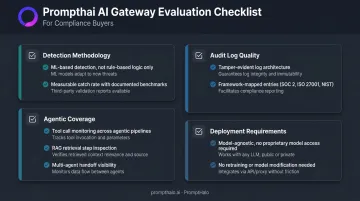
- Does the gateway protect tool calls, RAG retrievals, and multi-agent handoffs — or only LLM input/output?
- Does it implement authority decay and per-action scope enforcement?
- Does it handle trust verification at agent-to-agent boundaries?
Deployment and integration requirements
- Regulated environments can't afford regressions. Look for solutions that deploy without model retraining or code rewrites.
- Model-agnostic coverage matters when you're running multiple AI vendors simultaneously.
- PromptHalo, for example, deploys in under a day with no model modifications, integrating across API gateway, agent mode, and inline middleware paths — practical for teams needing to close compliance gaps on AI already running in production.
The audit readiness test: If a vendor can't produce a sample log showing full decision context, the policy applied, the outcome, and the applicable framework control reference, their solution is monitoring — not compliance infrastructure.
Frequently Asked Questions
Which AI gateway is best for risk and compliance teams?
The best choice for compliance teams is a purpose-built solution with ML-based detection, tamper-evident decision-level logs, and coverage of the agentic attack surface: tool calls, RAG retrievals, and multi-agent handoffs. General-purpose developer tools optimized for throughput and routing won't satisfy regulatory audit requirements.
What compliance frameworks does an AI gateway support?
Purpose-built gateways support EU AI Act (Articles 12, 13, 14, 26), NIST AI RMF, OWASP LLM Top 10, and in some cases GDPR and HIPAA. The differentiator is whether logs are actively mapped to specific framework controls at the time of logging, or simply collected for retrospective review after an incident.
How is an AI gateway different from a DLP tool or traditional firewall for AI security?
DLP tools and firewalls operate on network-level data patterns and weren't designed to inspect prompt structure, tool call authorization, or agent-to-agent handoffs. An AI gateway operates at the semantic layer of AI traffic, where prompt injection, excessive agency, and retrieval poisoning actually occur.
What AI-specific risks does an AI gateway protect against in regulated industries?
The primary threats are prompt injection, jailbreaks, data leakage through model outputs, retrieval poisoning in RAG systems, and unauthorized tool or API calls by autonomous agents. These require detection at the inference and action layer, not the network layer.
Can an AI gateway generate audit logs suitable for regulatory reporting?
A properly built gateway generates decision-level logs that are tamper-evident, replayable, and mapped to specific regulatory framework controls. Application logging, by contrast, can be altered, lacks semantic linkage to AI decisions, and isn't structured for regulatory submission.
How quickly can an AI gateway be deployed without disrupting existing AI systems?
The best solutions are model-agnostic, require no code rewrites or model retraining, and deploy in hours to a day. PromptHalo integrates via API gateway, agent mode, or inline middleware without touching the underlying model, so compliance coverage extends to existing AI deployments without modifying production systems.