This article breaks down what enterprise AI governance tools actually cost, the hidden expenses that routinely inflate total cost of ownership, how to calculate ROI in terms your CFO will accept, and the investment rules of thumb practitioners use to size governance budgets without guesswork.
Key Takeaways
- Enterprise AI governance tool costs range from roughly $30,000/year for mid-market deployments to $500,000+ annually for large regulated enterprises
- Pricing models vary widely — per-user, per-model, flat subscription, and consumption-based structures each scale differently
- Hidden costs — implementation, staffing, and certification — often double the total cost of ownership beyond the license fee
- ROI flows from three sources: avoided regulatory fines, compliance labor savings, and faster AI deployment cycles
- The BCG 10-20-70 rule shows that governance and operations — not models — account for the majority of enterprise AI spend
What Enterprise AI Governance Tools Cost: Pricing Models and Price Ranges
AI governance tool pricing is not standardized. Vendors use fundamentally different structures, making direct vendor comparison difficult at the evaluation stage.
The Four Dominant Pricing Structures
| Pricing Model | Common Use Case | Scaling Behavior |
|---|---|---|
| Per-user / seat | Policy and compliance workflow tools | Costs grow with headcount |
| Per-model / per-asset | Platforms governing large model inventories | Costs grow with AI portfolio size |
| Flat annual subscription | Mid-market platforms with usage caps | Predictable, but cap overages add up |
| Consumption-based / metered | Runtime monitoring and enforcement tools | Costs grow with inference volume |
IBM is one of the few vendors with public price points — watsonx.governance publishes component pricing in the hundreds to low thousands of dollars per unit. Vendors like ValidMind, Credo AI, OneTrust, and Alation use custom enterprise pricing tailored to deployment model and governance scope. That opacity reflects how much pricing varies based on negotiation leverage, organizational size, and the depth of capabilities required.
Approximate Annual Cost Ranges by Organizational Tier
These ranges reflect market observations and should be treated as planning benchmarks, not vendor quotes:
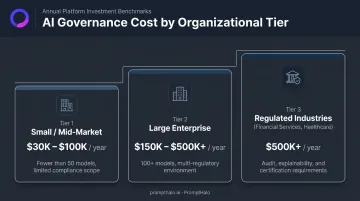
- Small / mid-market (fewer than 50 models, limited compliance scope): $30,000–$100,000/year
- Large enterprise (100+ models, multi-regulatory): $150,000–$500,000+/year
- Regulated industries (financial services, healthcare with audit and explainability requirements): Often at the high end or above, due to mandatory certification, logging, and reporting capabilities
Deployment Model Affects Pricing Significantly
- SaaS/cloud-hosted: Lower upfront cost, but subscription fees escalate as usage grows. Most mid-market buyers start here.
- On-premises: Higher initial license and infrastructure investment, but preferred by organizations with data residency requirements under regulations like GDPR or sector-specific rules.
- Hybrid: Sits between the two in cost, but typically introduces the highest integration complexity — and integration complexity translates directly into professional services spend.
Agentic AI Governance: A Separate Budget Category
Governance tooling for agentic AI — covering autonomous tool calls, RAG retrieval, and multi-agent handoffs — is not yet commoditized. These capabilities are typically priced separately from traditional model risk or bias governance platforms and reflect a nascent but rapidly maturing market.
Platforms purpose-built for this surface operate differently from traditional governance tools — running inline on every inference and agent action rather than auditing after the fact. PromptHalo, for example, enforces trust decisions in under 100ms across tool calls and multi-agent handoffs, a runtime enforcement model that sits outside the scope of most conventional AI governance pricing structures.
The Hidden Costs of Enterprise AI Governance
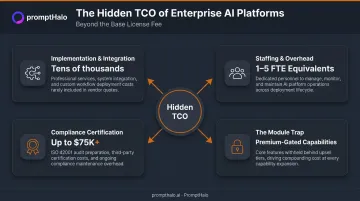
The license fee is rarely the largest line item once a deployment is complete. Four hidden cost categories consistently surprise buyers.
Implementation and Integration
Enterprise governance platforms must connect to existing SIEM, IAM, GRC, and data infrastructure. That integration work is expensive and often underestimated at the evaluation stage.
For adjacent enterprise GRC platforms, implementation fees add tens of thousands of dollars on top of base license costs. Vendors like CoreStream offer tiered services packages starting at $24,500 for essentials configurations. AI governance platforms with deeper technical integration requirements run higher. Budget for implementation as a material TCO line item from the first RFP response — not after contract signature.
Solutions that deploy without model retraining or code rewrites substantially cut this cost category. PromptHalo, for example, is operational in under a day, compared to platforms requiring deep model access or custom connector development.
Staffing and Organizational Overhead
Governance is not a tool you buy and forget. It requires ongoing human capacity:
- 5–10% of technical staff time in small organizations
- 1–2 dedicated FTE equivalents at mid-size companies
- Up to 5% of the AI workforce in large enterprises, focused on governance, risk, and compliance
This cost exists whether headcount is dedicated or absorbed. When existing staff carry the load, the real cost is opportunity cost: engineering cycles pulled from model development and deployment.
Compliance Certification Costs
Achieving certifications like ISO 42001 or demonstrating alignment to NIST AI RMF and the EU AI Act requires investment beyond software licenses. According to Vanta, initial ISO 42001 certification typically ranges from several thousand dollars to $75,000+, excluding ongoing maintenance fees. Add gap assessments, audit preparation, and annual surveillance audits and certification becomes a recurring cost that scales with the size and complexity of your AI deployment.
The Module Trap
Many governance platforms publish competitive base license pricing, then gate critical capabilities behind premium tiers:
- Audit trail generation
- Bias monitoring and fairness reporting
- Regulatory framework mapping (EU AI Act, NIST AI RMF, GDPR)
- Runtime policy enforcement
Credo AI's Policy Packs — which translate laws and internal standards into actionable technical controls — illustrate this modular approach. Alation includes EU AI Act, NIST AI RMF, ISO 42001, and GDPR mappings in its base product. Before signing, require a complete capability matrix showing what's included versus what triggers an upsell.
How to Calculate ROI on AI Governance Tools
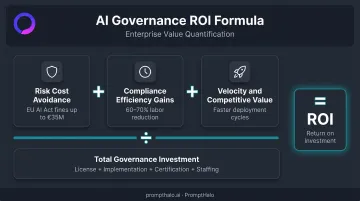
ROI from governance investment breaks into three quantifiable categories.
1. Risk Cost Avoidance
Regulatory exposure is the most compelling input to any ROI model. The EU AI Act permits fines of up to €35 million or 7% of worldwide annual turnover for prohibited AI practices, and up to €15 million or 3% for other violations. GDPR enforcement against AI systems is already active — France and Italy each fined Clearview AI €20 million for facial recognition processing violations.
On the breach cost side, IBM's 2025 Cost of a Data Breach report puts the global average at $4.4 million, with financial services costs running above that average. Even partial fine avoidance or prevention of a single significant incident can deliver positive ROI on governance investment.
2. Compliance Efficiency Gains
Manual compliance work is expensive. PwC estimates that directly attributable regulatory compliance costs run at approximately 2.6% of operating costs per year for financial firms — and that figure typically understates the true end-to-end burden when you account for staffing, tooling, and audit preparation. For context, UK financial services alone spend over £33.9 billion annually on compliance — over 13% of average operating costs — a signal of how quickly these costs compound at scale.
Automated compliance workflows compress this cost. Credo AI reports customer outcomes including 70% faster AI use-case reviews and a 60% reduction in manual AI compliance effort — though these are vendor-reported figures and should be treated as directional benchmarks, not guaranteed results.
3. Velocity and Competitive Value
Governed AI deployment is faster AI deployment. When governance infrastructure already exists — audit trails, risk assessments, policy enforcement — security and legal review cycles shorten for each new model or feature. The time-to-production gains compound over a growing AI portfolio.
The ROI Formula
ROI = (Risk Avoidance Value + Compliance Efficiency Gains + Velocity Value) ÷ Total Governance Investment
Total governance investment must include license fees, implementation costs, certification, and staffing — not just the software line item.
Implementation Speed as a ROI Multiplier
A platform that requires 6–12 months of integration before yielding output inflates the denominator without adding numerator value. Payback periods stretch and first-year returns evaporate before the tool is even producing output. For agentic AI security specifically, implementation friction is often the deciding factor between a governance investment that pays back in 12 months versus one that takes 36.
Tools that deploy in under a day with no model retraining — without touching proprietary models — compress the payback period and improve first-year returns significantly. PromptHalo's runtime enforcement layer is designed for exactly this: rapid deployment that starts generating value from day one.
Enterprise AI Investment Rules of Thumb
The BCG 10-20-70 Rule
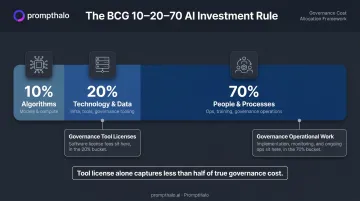
BCG's research on AI transformation establishes a widely cited allocation pattern: 10% of AI investment goes to algorithms, 20% to technology and data, and 70% to people and processes.
Mapped to governance budgets:
- Governance tooling falls in the 20% technology bucket
- Governance-adjacent work — training, process design, compliance culture, policy management — sits in the 70% people and process bucket
Teams that count only the tool license are capturing less than half the real cost of governance. The 70% bucket is where governance programs succeed or fail — and it's the category most commonly missing from early-stage budget conversations.
Sizing Governance Budgets in Practice
Walk through a sample calculation:
- Total enterprise AI development budget: $5 million
- 10-20-70 allocation: $500K algorithms, $1M technology/tooling, $3.5M people and operations
- Governance tool budget (subset of $1M technology): $200K–$400K
- Governance-adjacent operational work (subset of $3.5M): $500K–$1M+
This range gives budget owners a credible anchor — enough to close real regulatory exposure without funding tools that sit unused.
Agentic AI deployments require proportionally more. When autonomous decisions carry downstream consequences, governance and safety investment should claim a larger share of the technology budget than traditional batch ML deployments justify.
Key Considerations When Evaluating Enterprise AI Governance Tools
Coverage Across the Full AI Risk Surface
Most traditional governance tools were built for batch ML models. They don't natively address:
- Autonomous tool calls and out-of-scope API actions
- RAG retrieval poisoning and prompt injection
- Multi-agent handoffs where authority can be escalated across agents
- Real-time inference monitoring at production speed
Enterprises deploying agentic AI need to evaluate whether a tool covers these vectors explicitly or leaves them ungoverned. Runtime enforcement platforms that address the agentic attack surface directly serve as a complementary or alternative layer to policy-and-compliance-oriented governance platforms. PromptHalo, for example, delivers ML-based detection across autonomous tool calls, RAG retrieval, and multi-agent handoffs at over 95% catch rate and under 100ms per decision.
Integration Complexity and TCO
Before signing any enterprise governance contract:
- Require a proof of concept within 90 days
- Audit actual integration requirements against your existing SIEM, IAM, and GRC stack
- Factor professional services into TCO from the first RFP response — not after contract signature
Any solution requiring model retraining, code rewrites, or vendor access to proprietary models carries integration costs and vendor lock-in risks — reject those in the first RFP round. Integration speed directly determines how quickly governance investment starts returning value.
Audit Trail Quality and Regulatory Defensibility
Not all audit trails are equal, and the gap becomes visible the moment regulators ask why a specific action was allowed. The distinction that matters under scrutiny:
- Activity logs capture event sequences — what the system did and when
- Decision-level audit trails record why each action was allowed or denied, mapped to specific regulatory controls, in a tamper-evident format that survives examination
The EU AI Act's Article 12 requires high-risk AI systems to technically enable automatic logging of events over the system's lifetime. That is a specific technical requirement with real implementation implications. Treat audit trail quality as a mandatory evaluation criterion from day one.
Frequently Asked Questions
How much do enterprise AI governance tools cost?
Annual costs range from roughly $30,000 for mid-market deployments to $500,000+ for large regulated enterprises. The primary cost drivers are pricing model (per-user, per-model, flat subscription, or consumption-based), deployment complexity, and required capability coverage — with regulated industries like financial services typically sitting at the high end.
What are the key considerations for enterprise AI governance?
Five dimensions matter most:
- Regulatory coverage and compliance framework alignment
- Integration with existing security and risk infrastructure
- Coverage of the full AI risk surface, including agentic AI
- Audit trail quality and regulatory defensibility
- Total cost of ownership beyond the base license fee
What are common rules of thumb for enterprise AI governance budgets?
BCG's 10-20-70 rule allocates roughly 10% of AI investment to algorithms, 20% to technology and tooling, and 70% to people and processes. Governance tooling sits in the 20% bucket, while governance-adjacent operational work sits in the 70%. Teams that budget only for the tool license consistently underestimate total governance cost.
What is the ROI of investing in AI governance tools?
ROI comes from three sources: regulatory fine and breach cost avoidance (EU AI Act fines up to €35M or 7% of turnover), compliance labor efficiency through automated audit preparation, and AI deployment velocity gains as security review cycles shorten. Payback periods typically range from 12–36 months, depending heavily on implementation speed and regulatory exposure.
What is the difference between AI governance tools and AI runtime security enforcement?
Traditional AI governance tools focus on policy management, model lifecycle oversight, bias monitoring, and compliance documentation. Runtime security enforcement operates inline on every inference, tool call, and agent action — blocking threats before they execute rather than auditing them after the fact. The two categories are complementary, not interchangeable.
How long does it take to implement an enterprise AI governance platform?
Implementation timelines vary significantly. Policy and compliance platforms typically require 3–6 months of integration work. Runtime enforcement tools purpose-built for agentic AI — with no model retraining and no code rewrite required — can deploy in under a day, a gap that shows up directly in first-year ROI calculations.