Introduction
Deploying LLMs in production exposes a gap most teams don't see until an auditor asks for it: traditional logging tells you what API was called, but not what decision was made, who authorized it, or whether sensitive data passed through. Security teams are left reconstructing incidents from fragments.
The scale of the problem is hard to overstate. McKinsey's 2025 global survey found 88% of organizations regularly use AI in at least one business function — yet only 18% have an enterprise-wide governance council with authority over AI decisions.
That gap is where compliance findings accumulate. Without decision-level audit trails, there's no reliable way to answer regulators when something goes wrong.
This guide covers four things:
- Why LLM audit logs are structurally different from conventional API logs
- What a complete LLM audit record must contain
- How those logs power security enforcement and regulatory reporting
- Why agentic AI raises the stakes further — and what new audit surface it creates
Key Takeaways
- LLM risk happens at the input layer (the prompt), not the output — logs built around responses miss most of what matters
- Compliance-grade audit trails need four things: immutability, completeness, tamper-evidence, and exportability
- Standard API logs can't capture session continuity, guardrail trigger events, or token anomalies — those signals require purpose-built LLM logging
- Agentic AI creates tool call, RAG retrieval, and agent handoff events that must appear as distinct, attributed audit entries
- Log metadata and classifications — never raw prompt content or PII values
What Is an LLM Gateway and Why Are Audit Logs Central to It?
An LLM gateway is the centralized control and routing layer sitting between applications and LLM providers. It handles authentication, policy enforcement, routing, and observability across every model call. Kong describes this architecture as a "connectivity and governance layer" for AI-native applications — the primary mechanism through which organizations can attribute, control, and prove what their AI systems did. Governance and auditability aren't features bolted on afterward; they're the reason a gateway exists.
The Governance Failure Mode Without a Gateway
When teams connect directly to provider APIs without a centralized layer, the same problems surface every time:
- No per-team attribution — shared API keys mean usage can't be traced to a specific user, team, or application
- No sensitive data record — there's no way to determine which requests touched regulated or protected content
- No selective revocation — revoking access for one team means rotating credentials for everyone
- No reconstructable audit trail — when an investigator or regulator asks what happened, there's nothing to show them
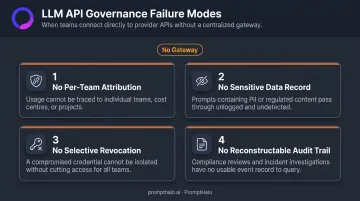
Each of these gaps is an operational blind spot — and each one becomes a compliance finding. IAPP's 2024 governance survey found 65% of organizations without AI governance functions lacked confidence in their privacy compliance, compared to just 12% with governance functions in place.
Basic Logging vs. Decision-Level Audit Trails
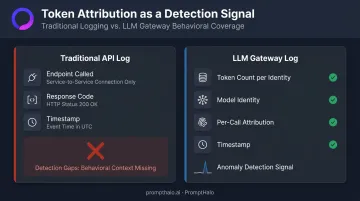
Most teams start with request logging: timestamp, endpoint called, response code, maybe token count. That's useful operationally. It's not what compliance or security investigations require.
The distinction comes down to what each record can answer:
- Request log: what was called, when, and whether it succeeded
- Decision-level audit trail: what the request contained, who made it, which policy applied, what the enforcement outcome was, and which security events fired
An auditor asking "did your system expose customer financial data to an unauthorized model?" cannot be answered by a request log. Only a decision-level record closes that gap.
Why LLM Audit Logs Are Fundamentally Different from Traditional API Logs
Traditional API logging captures authentication events, endpoint calls, file access, and error states. LLM traffic breaks that model at the input layer, the session layer, and the event-type layer simultaneously.
Exposure Happens at the Input, Not the Output
In standard API interactions, the risk surface is usually the response — what data was returned, to whom. In LLM traffic, OWASP LLM01:2025 on Prompt Injection identifies the prompt itself as the primary control surface. Hidden instructions embedded in user input, obfuscated directives, and multimodal injection vectors all operate at the input layer. Logs built around responses miss the attack entirely.
The Session Continuity Problem
LLM tools accumulate context across multi-turn conversations. A user might share benign information in turn one and sensitive context in turn three — together they create an exposure that neither turn would reveal on its own. Logging individual requests without capturing a session or thread identifier loses the cumulative picture that investigations require.
Security Events With No API Log Equivalent
LLM traffic generates event types that simply don't exist in traditional API logs:
- Guardrail trigger events (content policy fired, rule identified)
- PII detection and redaction events
- Prompt injection attempt detections
- Tool call authorization decisions
- Content blocks with the specific reason recorded
None of these appear in request/response logs unless the gateway emits them as first-class audit entries. OWASP LLM10:2025 specifically calls for comprehensive logging and anomaly detection for unusual resource consumption — a signal category that standard API logs don't surface.
Token and Cost Attribution as a Detection Signal
Token consumption per identity is a behavioral indicator, not just a billing detail. Unexplained volume spikes for a specific user or service account are a reliable early signal for data exfiltration attempts or runaway agent behavior. Surfacing that signal requires logs that capture token counts, model identity, per-call attribution, and timestamp together — not just request status codes.
What an LLM Gateway Audit Log Must Capture
A log entry that records "request received, response sent" looks complete. It answers almost nothing an investigator or auditor asks. Here's what each entry must actually contain.
Identity and Access Fields
Every audit entry must attribute the call to a specific actor:
- Calling identity — user, team, virtual key, or non-human service account
- Account type — corporate, personal, or agentic
- Role — what access level the identity held at call time
- Provider and model reached — which LLM provider, which model, which endpoint
Without these fields, usage can't be attributed and access can't be verified — both prerequisites for any enforcement or investigation that follows.
Request Context Fields
Beyond identity, each entry needs context that makes the record useful for investigation:
- Prompt classification — whether the input contained PII, source code, financial data, or other sensitive content categories
- Session or thread identifier — linking multi-turn interactions into a single traceable conversation
- Policy state at call time — which rules were active when the call was made, not just what rules exist today
These three fields are what allow an auditor to reconstruct not just what happened, but under what conditions it was permitted to happen.
Enforcement Decision Record
Every call must capture:
- The gateway action taken — allow, restrict, challenge, deny, or monitor
- The guardrail outcome — which rule triggered, what was blocked or redacted
- The reason for each enforcement decision, not just the outcome
PromptHalo's audit logs capture every decision along with its reason, the acting agent or passport identity, the session and tenant context, and a timestamp — in an append-only, tamper-evident format that creates a replayable evidence trail for post-incident investigation.
Performance Metadata as Detection Fields
Token counts, latency, and cost data serve dual purposes — operational visibility and behavioral detection:
| Field | Operational Use | Detection Use |
|---|---|---|
| Prompt token count | Cost attribution | Exfiltration signal if anomalous |
| Completion token count | Billing | Runaway agent signal |
| Model latency / TTFT | Performance monitoring | Unexpected model behavior |
| Provider name | Routing verification | Unauthorized provider access |
| Per-call cost | Budget management | Volume anomaly detection |
What Should Not Be in an LLM Audit Log
Knowing what to capture is only half the equation. Raw prompt content and the actual PII values a redaction layer detected should not appear in audit logs. NIST SP 800-92 explicitly notes that logs may contain sensitive data and organizations should avoid recording unneeded sensitive information. Storing the values a sanitizer redacted creates a second copy of the data the guardrail was meant to protect.
Log the classification event, the redaction outcome, and the enforcement decision — not the underlying values. Thorough on metadata. Disciplined about content.
Using Audit Logs for Security Enforcement and Threat Detection
Well-structured audit logs aren't just a record of what happened. They're the feedback loop for enforcement and the primary evidence surface for incident detection.
How Logs Turn RBAC Into Provable Enforcement
Saying "we have role-based access control" is not the same as proving it was applied on every call. The audit log is what closes that gap. Each entry must capture the identity resolved at authentication, the policy evaluated against it, and the enforcement outcome. That sequence transforms a policy claim into demonstrable evidence — and surfaces policy bypass attempts when the sequence breaks.
Detection Signals That Emerge From Structured Logs
Several threat patterns only become visible when logs capture the right fields consistently:
- User-to-tool pattern shifts — a user who has never accessed a coding assistant suddenly uploading source files to an external AI endpoint
- Volume anomalies relative to baseline — token consumption per identity spiking above established behavioral norms
- Cross-tool data movement chains — content moving from a protected source to an LLM tool across multiple interaction steps
- First-time model or provider access outside approved configurations
None of these signals emerge from logs that only record request and response events.
Guardrail Events Enable Real Incident Triage
When a prompt injection attempt or jailbreak is recorded at the gateway with a trace ID, timestamp, calling identity, and the specific detection type that fired, security teams can reconstruct the full incident timeline. That matters because provider-side logs may not be queryable, may have different retention periods, or may not exist in a format useful to investigators.
That forensic gap is exactly what purpose-built gateway logging is designed to close. PromptHalo generates decision-level, replayable audit trails at every inference, tool call, and agent-to-agent handoff — structured to support both security team investigation and regulatory reporting.
"Request received, response sent" tells you something happened. "Prompt injection detected, action denied, identity attributed, trace ID issued" tells you what to do next.
Making Audit Logs Compliance-Grade
The Four Required Properties
A compliance-grade audit trail has four properties that distinguish it from basic logging:
- Immutable: entries cannot be edited or deleted after the fact
- Complete: every call records who, what, when, which model, which data category, and which enforcement decisions were made
- Tamper-evident: each entry carries a cryptographic trace ID or equivalent, so any alteration is detectable
- Exportable — streams to a SIEM or external compliance system, not locked inside a vendor dashboard
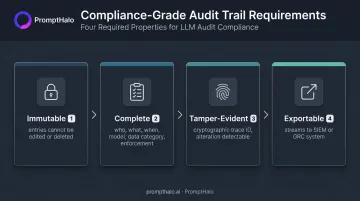
PromptHalo's audit logs are append-only by design, with every enforcement decision captured in a structured format built for compliance export and post-incident replay.
Regulatory Framework Mapping
| Framework | Specific Obligation | Log Relevance |
|---|---|---|
| EU AI Act Art. 12 | High-risk AI must technically allow automatic event logging | Logging architecture requirement |
| EU AI Act Art. 19/26 | Providers and deployers must retain logs for at least 6 months | Retention policy |
| HIPAA 45 CFR 164.312(b) | Audit controls required for systems with ePHI | Required when AI processes health data |
| SOC 2 CC6/CC7 | Logical access controls and security event monitoring | Access attribution and enforcement evidence |
| OWASP LLM Top 10 | LLM01, LLM02, LLM04, LLM06, LLM10 | Specific event types logs must evidence |
| NIST AI RMF | Production monitoring and incident response | Governance and traceability baseline |
PromptHalo's logs are structured and pre-mapped to these frameworks, exportable in formats accepted by common SIEM and GRC tools without manual reformatting.
The Boundary Between Controls and Compliance
That framework mapping clarifies something worth stating directly: a gateway with well-structured audit logs helps satisfy logging, oversight, and traceability obligations, but compliance itself depends on system risk classification, organizational roles, documentation, and conformity assessment. None of that comes from a log alone. The audit trail is necessary operational infrastructure — one that makes certification achievable, not one that substitutes for it.
Agentic AI Expands the Audit Surface
Standard LLM logging captures prompt/response pairs. Agentic AI generates an entirely different audit surface — and McKinsey's 2025 research found 62% of organizations are already experimenting with or scaling AI agents, with 80% encountering risky agent behaviors including improper data exposure and unauthorized system access.
Why Agents Create New Audit Requirements
Autonomous agents make tool calls, read from and write to external systems, retrieve context from vector stores via RAG, and hand off tasks to other agents. Each action carries its own risk profile. Burying these events as side effects inside a chat completion log leaves security teams blind to what the agent actually did — only discovering it after an incident has already occurred.
Specific Audit Entries Required for Agentic Workflows
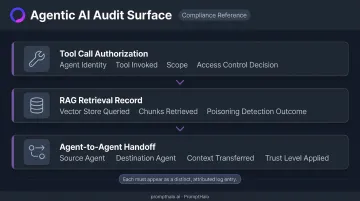
Each of these event types must appear as a distinct, attributed entry:
- Tool call authorization events — which agent invoked which tool, under which scope, what the access control decision was
- RAG retrieval records — which vector store was queried, which chunks were retrieved, whether retrieval poisoning was detected
- Agent-to-agent handoff records — source agent, destination agent, the context or task handed off, and the trust level applied at the handoff boundary
Making Privilege Creep Visible Before It Becomes an Incident
Agentic tools routinely inherit permissions from the configuring user's full access profile rather than operating under a defined, narrow scope. OWASP's AI Agent Security Cheat Sheet requires granting agents the minimum tools necessary and implementing per-tool permission scoping.
PromptHalo enforces this through agent security passports with authority decay built in — budgets across time, steps, and risk decay as an agent operates, forcing re-authorization when a threshold is exceeded. Every per-action scope decision is recorded in the audit trail, giving security teams a clear record of how agent permissions shifted over a session's lifetime before any escalation reaches a critical threshold.
Frequently Asked Questions
What is the difference between an LLM gateway audit log and a standard API gateway log?
Standard API logs capture authentication events, endpoint calls, and response codes. LLM gateway audit logs must capture input-layer events — prompt classification, PII detection, guardrail triggers — along with enforcement decisions at each step, session continuity across multi-turn conversations, and token-level attribution. Standard API logs are structurally blind to the exposure surface where LLM risk actually lives.
What must an LLM audit log capture to be considered compliance-grade?
Compliance-grade logs require four properties:
- Immutability — entries can't be edited after writing
- Completeness — who, what, when, which model, data category, and enforcement decisions
- Tamper-evidence — cryptographic trace ID or equivalent
- Exportability — to a SIEM or external compliance system
Logs record metadata about sensitive data events — never the raw sensitive values themselves.
How do LLM gateway audit logs support regulatory frameworks like the EU AI Act or SOC 2?
The EU AI Act, SOC 2, and NIST AI RMF all require organizations to reconstruct what their AI systems did, on whose data, under which policies. Gateway audit logs make those reconstructions possible — but satisfying the logging obligation is not the same as achieving compliance.
How is auditing agentic AI different from auditing standard LLM chat interactions?
Agentic AI generates event types beyond prompt/response pairs — tool call authorizations, RAG retrieval records, and agent-to-agent handoffs each carry distinct risk and must appear as attributed log entries. Without this, autonomous agent actions are invisible to security teams, and the action chain behind an incident may be unrecoverable by the time it surfaces.
Should raw prompt content be stored in LLM audit logs?
No. Storing raw prompt content — especially after a PII redaction event — recreates the sensitive data exposure the guardrail was meant to prevent. Compliance-grade audit logs record data category classifications, redaction events, and enforcement outcomes. The underlying content should not appear in the log.
How do audit logs help detect prompt injection or data leakage through an LLM gateway?
Decision-level audit logs capture guardrail trigger events — injection attempt detected, content blocked, identity attributed, trace ID issued — in real time, enabling teams to reconstruct incident timelines without relying on provider-side logs. Token consumption anomalies per identity are a distinct exfiltration signal that only surfaces from gateway logs with consistent per-call attribution.