
Key Takeaways
- Manual compliance review can't keep pace with AI content volume or accelerating enforcement
- Effective AI compliance requires content scanning, real-time enforcement, audit trails, and multi-framework regulatory mapping
- Regulators are deploying AI scanning tools themselves — violations are easier to catch than ever
- Agentic AI introduces compliance risks that content review platforms were never built to handle
- Runtime enforcement at the agent decision level is now a compliance requirement in regulated industries
What Is AI-Powered Marketing Compliance?
Marketing teams face a compliance problem that has fundamentally changed in character. The volume of content is higher, regulatory scrutiny is sharper, and the tools required to manage both look nothing like what existed five years ago.
AI-powered marketing compliance uses machine learning, natural language processing, and automation to review, enforce, and monitor marketing content, campaigns, and data workflows against regulatory, brand, and financial standards — replacing periodic manual spot-checks with continuous, scalable oversight.
Rule-Based Automation vs. True AI Compliance
The distinction matters more than most teams realize:
- Basic automation triggers workflow rules when predefined conditions are met — useful, but brittle
- True AI compliance applies adaptive pattern recognition, tracks regulatory changes, detects anomalies, and flags predictive risk based on new content and updated rules
Rule-based systems fail when regulations change; AI compliance systems adapt to them.
Two Operating Modes
Organizations typically deploy AI compliance in one of two configurations:
- Compliance assistant — AI prioritizes and triages issues for human reviewers, reducing workload without removing humans from the decision
- Compliance enforcer — AI blocks non-compliant actions before they execute, with no human intervention required at the point of action
Regulated industries — financial services, healthcare, fintech — need the enforcer model for their highest-risk rule categories. The assistant model alone cannot prevent a violation from going live.
Why Marketing Teams Can't Ignore AI Compliance Anymore
Regulatory Enforcement Is Getting More Aggressive
The enforcement record from the last three years makes the trend unmistakable:
- FTC fined Fashion Nova $4.2M for suppressing customer reviews and GoodRx $1.5M for sharing health data with Facebook and Google for advertising — then launched Operation AI Comply in 2024 targeting deceptive AI marketing claims
- SEC Marketing Rule sweeps produced charges against 9 advisers in 2023 ($850K combined penalties), 5 more in April 2024 ($200K), and 9 again in September 2024 ($1.24M)
- FINRA fined M1 Finance $850,000 for influencer social media posts that were unreviewed and contained exaggerated claims
- ICO (UK) issued over £2.59M (approximately $3.3M USD) in fines for nuisance marketing calls, texts, and emails since April 2023
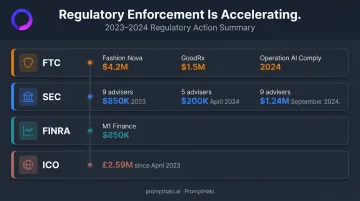
These are not outliers. They represent an enforcement posture that has shifted from reactive to systematic.
Regulators Are Using AI Too
The FCA reviewed more than 480,000 new websites in 2024 and issued over 1,600 alerts. Nearly 20,000 financial promotions were amended or withdrawn in 2024 alone, compared with fewer than 600 in 2021. The UK's Advertising Standards Authority processes more than 100,000 ads per month through its AI-powered Active Ad Monitoring system.
The gap between what regulators can detect and what compliance teams can manually review has closed.
Multi-Channel and Multi-Jurisdictional Complexity
Modern campaigns run across Google Ads, Meta, LinkedIn, TikTok, email, and affiliate channels simultaneously. Each platform has its own policies. Each geography layers on different regulatory requirements:
- GDPR (EU) — consent, opt-out, data minimization
- CCPA (California) — disclosure, opt-out of data sale, Global Privacy Control recognition
- HIPAA (US healthcare) — authorization for marketing use of protected health information
- 19 US states had passed comprehensive privacy laws as of mid-2025, each with variations on opt-out rights for targeted advertising
No manual process tracks all of these simultaneously across active campaigns.
The Cost Beyond Fines
Fines are the number that shows up in press releases. The operational damage runs deeper: canceled campaigns, delayed launches, reputational fallout, and customer churn that compounds long after the penalty is paid.
Research from PwC found that 40% of customers stopped purchasing from a company due to lack of trust — with data handling ranking as a top trust driver. That makes non-compliance a direct revenue exposure, not just a legal one.
Core Capabilities of AI-Powered Marketing Compliance Systems
Pre-Publication Content Scanning
Enterprise-grade systems scan text, images, video, audio, and social posts before publication. They check for:
- Regulatory violations and misleading claims
- Missing required disclosures (FTC endorsement rules, SEC performance presentation requirements)
- Brand guideline deviations
- Platform-specific policy violations
Scanning happens across formats, not just written copy.
Real-Time Enforcement vs. Retrospective Auditing
| Mode | When it acts | Best for |
|---|---|---|
| Retrospective | After violation occurs | Low-risk content, trend analysis |
| Real-time enforcement | Before launch or data export | High-risk rules, regulated industries |
Both matter. Enforcement takes priority for the categories where a violation that goes live creates immediate legal exposure.
Automated Audit Trail Generation
When a regulator requests proof of compliance, teams without automated logging spend weeks reconstructing approval chains from emails and spreadsheets, often with critical gaps. Compliance-grade systems log every rule check, flag, approval, and enforcement action in an immutable, timestamped trail from the moment they deploy.
The EU AI Act (Article 12) explicitly requires automatic logging for high-risk AI systems. SEC and FINRA recordkeeping rules require similar documentation for investment adviser communications. Reconstructing this trail retroactively, after an audit notice lands, typically takes 3-6 weeks and still produces incomplete records.
Multi-Framework Regulatory Mapping
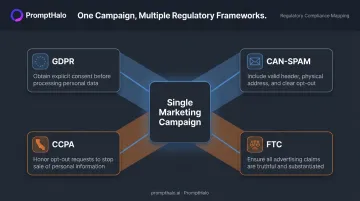
Campaigns do not operate under a single regulation. A fintech email campaign may simultaneously implicate GDPR consent rules, CAN-SPAM header requirements, CCPA opt-out obligations, and FTC truthful advertising standards. AI compliance systems map content to all applicable frameworks at once and automatically flag affected controls when a regulation updates — so teams avoid manually re-reviewing every existing asset after each rule change.
No-Code Workflow Integration
Compliance embedded in the tool the marketing team already uses gets used. Compliance requiring a developer request does not. The practical requirements:
- Rule builders that marketing analysts, brand managers, and compliance officers can configure without writing SQL or custom code
- Native integration into DAM systems, project management tools, and ad platforms — not a separate review portal
Key Regulatory Frameworks Marketing Teams Must Address
Marketing compliance doesn't fit a single rulebook. Depending on your channels, audience, and data practices, obligations stack across privacy law, advertising standards, financial services rules, and now AI-specific governance — each with its own enforcement teeth.
Consumer Data Privacy
- GDPR — gives EU data subjects the right to object to direct marketing at any time; requires data minimization and purpose limitation; maximum fines reach €20M or 4% of global annual revenue
- CCPA — requires disclosure of data sale, opt-out mechanisms, and Global Privacy Control recognition (as the Sephora settlement confirmed)
- HIPAA — requires explicit authorization before using protected health information in marketing; tracking pixel use on health-related pages carries specific risk after HHS guidance updates in 2024
Advertising and Financial Services Rules
Privacy rules govern what data you can use. These frameworks govern what you can say and how you can say it.
- FTC — claims must be truthful, substantiated, and not misleading; endorsements require disclosure of material connections; fake or AI-generated reviews are prohibited under the 2024 Fake Reviews Rule
- CAN-SPAM — commercial email requires accurate headers, opt-out mechanisms honored within 10 business days, and a valid postal address; each violating email can trigger penalties up to $53,088
- FINRA Rule 2210 — retail communications require principal approval before first use; posts must be fair, balanced, and not exaggerated
- SEC Marketing Rule — performance claims require net performance presented with equal prominence to gross performance
Emerging AI Governance Frameworks
Traditional marketing regulations weren't written with AI-specific failure modes in mind — prompt injection, model confabulation, and autonomous agent actions fall outside their scope. These frameworks address that gap directly:
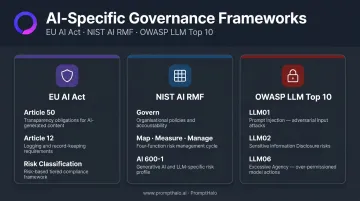
- EU AI Act — risk-based classification with transparency obligations for AI-generated content (Article 50) and automatic logging requirements for high-risk systems (Article 12)
- NIST AI RMF — Govern, Map, Measure, and Manage functions provide a structured risk management approach for AI systems; NIST AI 600-1 specifically addresses generative AI risks including confabulation and data integrity
- OWASP LLM Top 10 — identifies critical security risks in LLM deployments; Prompt Injection (LLM01), Sensitive Information Disclosure (LLM02), and Excessive Agency (LLM06) are directly relevant to marketing AI workflows
Best Practices for Implementing AI Marketing Compliance
1. Audit Your Compliance Gaps First
Before selecting or configuring any tool, map where violations are actually occurring:
- Campaigns launching without required approvals
- Missing consent metadata in targeting workflows
- Budget overruns discovered after the fact
- Incomplete UTM tracking or missing disclosure language
Prioritize by regulatory exposure (highest potential fines first) versus operational friction. That priority list determines which rules to implement first, not the tool vendor's default configuration.
2. Map Every Platform to Its Applicable Rules
For each connected platform — ad networks, CRM, CDP, analytics tools, data warehouses — define which regulations apply to each data type and geography. This mapping surfaces integration gaps where monitoring cannot yet reach, which determines the connector coverage required from any compliance tool.
3. Start in Monitoring Mode
Run compliance rules in detection-only mode for the first several weeks. Flag violations and send alerts without blocking execution. This phase:
- Tunes rules to reduce false positives before enforcement goes live
- Trains marketing teams on new workflows without campaign disruption
- Builds confidence that enforcement decisions are accurate before they carry operational consequences
Hard enforcement should go live for high-risk rule categories only after the monitoring phase validates rule accuracy.
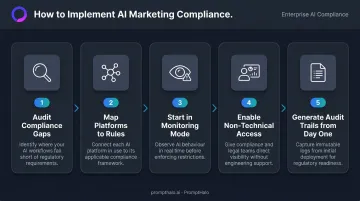
4. Make Compliance Accessible to Non-Technical Teams
If configuring a compliance rule requires a developer, it won't get done fast enough to keep pace with campaign launches. The practical requirements are:
- No-code rule builders that marketing teams can configure directly
- Plain-language violation explanations (not error codes)
- Dashboards that campaign managers and compliance officers can navigate without engineering support
5. Generate Audit Trails from Day One
Do not wait for an audit request to start logging. Immutable, timestamped records of every compliance event should be generated automatically from day one of implementation — even before enforcement rules go live.
Reconstructing compliance history after a regulator asks is slower and less reliable. Gaps created by manual logging are exactly what automated audit trails are designed to prevent.
The Agentic AI Frontier: When Your Marketing AI Needs Its Own Compliance Layer
A New Risk Surface
Enterprises increasingly deploy AI agents that autonomously generate marketing content, manage campaign budgets, interact with customers, and execute decisions across platforms. When an agent is making decisions in milliseconds, traditional pre-publication review tools cannot intervene in time — they are designed to scan finished assets, not intercept live agent actions.
Three Specific Failure Modes
Prompt injection — adversarial inputs manipulate an agent into producing non-compliant claims, disclosing restricted information, or bypassing brand guidelines. This can occur through direct user input or through poisoned content retrieved from external sources (retrieval injection). OWASP LLM01 identifies this as the top risk in LLM deployments; NIST AI 600-1 confirms it as a core generative AI risk.
PII leakage across tool boundaries — in multi-step, multi-agent workflows, customer data can surface in contexts where it should not appear. A marketing agent with access to CRM data can inadvertently expose protected information across session boundaries or tool handoffs — invisible to any content review platform that only checks published output.
Out-of-scope API calls — agents can invoke tools and APIs beyond their intended scope, violating campaign constraints or data handling rules. OWASP LLM06 (Excessive Agency) identifies this directly: when agents have excessive permissions, functionality, or autonomy, the results can range from policy violations to data exposure.
None of these failure modes are visible to content review platforms because they occur during execution, not after content is produced.
Runtime Enforcement as the Answer
Organizations in financial services, fintech, and healthcare deploying AI agents for marketing workflows need enforcement at the moment of each agent decision. PromptHalo's Runtime Security solution sits inline on every inference, tool call, and agent-to-agent handoff, applying one of five per-action decisions (allow, restrict, challenge, deny, or monitor) in under 100 milliseconds.
Each action is backed by an append-only, decision-level audit log that captures each decision, its reason, agent identity, session context, and timestamp. This creates the replayable evidence trail that regulatory reporting and post-incident investigation require.
Beyond logging, PromptHalo provides the runtime controls that content review tools have no visibility into:
- Issues agent security passports and applies risk profiling to each agent identity
- Enforces authority decay so permissions don't persist beyond their intended scope
- Applies per-action budget and scope limits, enforced externally so agents cannot self-escalate access
- Deploys in under a day with no model retraining and no code rewrite required
For regulated industries running agentic marketing workflows, this kind of runtime enforcement is the gap that content review platforms were never designed to fill.
Frequently Asked Questions
Which AI is best for regulatory compliance?
The right tool depends on the compliance need. Content review platforms handle pre-publication asset scanning, GRC tools manage audit and risk, and runtime security platforms like PromptHalo address AI-system-level compliance for agentic workflows. Organizations in regulated industries typically need coverage at both the content level and the AI-system level.
How much does compliance AI cost?
Most enterprise platforms use custom pricing based on team size, connected platforms, and required rule sets. Evaluate total cost of ownership — implementation time, false-positive management overhead, and financial exposure from non-compliance — not just the subscription fee.
What regulations does AI-powered marketing compliance typically cover?
The most common frameworks are GDPR, CCPA, HIPAA, FTC advertising guidelines, CAN-SPAM, TCPA, and SEC/FINRA rules for financial services. Organizations deploying AI systems in marketing must additionally address the EU AI Act, NIST AI RMF, and OWASP LLM Top 10 — which are distinct from and on top of traditional marketing regulations.
How does AI marketing compliance differ from traditional compliance approaches?
Traditional manual review is slow, inconsistent, and breaks under volume pressure as AI-generated content scales. AI-powered compliance runs continuously, scans thousands of assets simultaneously, adapts to regulatory changes, and generates automated evidence capture: the model shifts from periodic audits to real-time enforcement.
What are the risks of using AI agents for marketing without compliance safeguards?
Without safeguards, AI agents can fail in several critical ways:
- Generate claims that violate advertising standards through prompt injection
- Leak customer PII across tool boundaries in multi-agent workflows
- Make out-of-scope decisions that violate campaign constraints
- Produce no auditable record of their actions
These risks occur during execution, not after content is produced — making them invisible to standard content review tools.