Introduction
According to HiddenLayer's 2026 AI Threat Landscape Report, 1 in 8 reported AI breaches were agentic in nature, and 69% of organizations definitively identified an AI security breach in the prior 12 months. This is an active threat, already operating at scale.
What makes agentic breaches different is the operational consequence. A compromised agent doesn't just return a bad response. It holds legitimate credentials, can chain tool calls across systems, retrieve sensitive data, and pass instructions to subagents — all through authorized channels that perimeter defenses were built to trust, not interrogate.
This article covers three things security teams need to get right:
- What makes agentic AI uniquely dangerous at runtime
- What your monitoring stack must capture to detect threats early
- How to enforce protection at every agent decision point
Runtime security for agentic AI is an ongoing operational discipline — and the sections below give you a concrete framework to build it.
Key Takeaways
- Agentic AI's threat surface — tool calls, RAG retrieval, multi-agent handoffs — is invisible to firewalls, DLP, and traditional monitoring
- Effective monitoring demands agent-semantic telemetry: cognitive, action, and coordination events, not infrastructure metrics alone
- Inline, per-action enforcement decides allow, restrict, or deny before an action executes — not after
- ML-based detection catches roughly 95% of threats; rule-only approaches catch closer to 35%
- Tamper-evident, decision-level audit logs satisfy both security and regulatory requirements under OWASP LLM Top 10, NIST AI RMF, and the EU AI Act
Why Agentic AI Runtime Security Requires a New Approach
The Digital Insider Problem
Agentic AI systems operate using legitimate credentials, API keys, and authorized tool access. A compromised or misaligned agent looks indistinguishable from normal operation to any perimeter-based control. The threat doesn't arrive from outside — it's a trusted principal already inside your infrastructure, acting within its authorized scope.
CyberArk's 2025 identity security report makes the scale concrete: machine identities now outnumber human identities 82:1, 42% have privileged or sensitive access, and 68% of organizations lack identity security controls for AI. Each deployed agent is a new non-human principal with its own permissions, persistence, and scope. A single team can provision hundreds of agents — far beyond what manual IAM reviews can handle.
A Cloud Security Alliance survey compounds this: 82% of enterprises have unknown AI agents operating in their environments. That's a sprawling, unmonitored attack surface with no owner.
An Attack Surface That Perimeter Tools Can't See
Standard security tools — firewalls, SAST scanners, DLP — intercept network traffic, scan code, and inspect data movement. None of them observe:
- Goal manipulation: an agent's objectives being altered mid-session
- Memory poisoning: corrupted context influencing downstream decisions
- Prompt injection via retrieved content: malicious instructions embedded in documents or database records the agent reads
- Tool-chain hijacking: redirected tool calls without any prompt or code change
HiddenLayer's Agentic ShadowLogic research demonstrated exactly this — a graph-level attack that hijacks agent tool calls without modifying a single prompt or line of code. Perimeter filters never trigger because nothing suspicious crossed a boundary they were designed to watch.
Rule-Based vs. ML-Based Detection
Static rules struggle against non-deterministic agents. An agent's behavior legitimately varies based on context, goal, and retrieved information — making fixed thresholds both under-inclusive and prone to alert fatigue. The detection approach has to match the problem.
| Approach | Catch Rate | False Positive Rate |
|---|---|---|
| Rule-based | ~35% | 15–20% |
| PromptHalo ML-based | >95% | <5% |
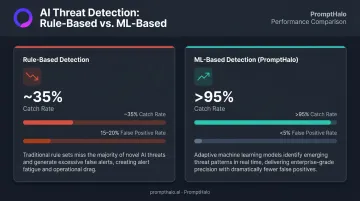
PromptHalo's ML-based detection combines Threat Library signatures with classifier-based risk scoring to hit those numbers. For security teams already dealing with alert overload, a false-positive rate under 5% isn't just a metric — it's the difference between actionable alerts and noise your team learns to ignore.
Pre-Deployment Hardening: Security Before Agents Go Live
Adversarial testing is the first layer of runtime defense. The goal is to discover exploitable attack paths before an attacker does.
What Pre-Deployment Testing Must Cover
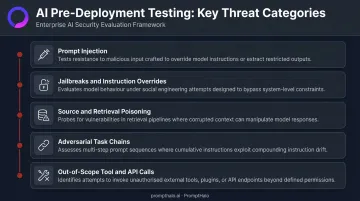
PromptHalo's red teaming solution continuously attacks agents, RAG layers, and tool chains across the full agentic attack surface:
- Prompt injection: direct and retrieval-layer variants
- Jailbreaks and instruction overrides: attempts to push the model outside its intended behavior
- Source and retrieval poisoning: corrupted external content carrying hidden instructions
- Adversarial task chains: multi-step, multi-agent workflows designed to exploit handoff boundaries
- Out-of-scope tool and API calls: probing whether the agent will invoke capabilities beyond its stated scope
Results are delivered as risk-scenario-mapped reports with prioritized fixes. Attack patterns discovered during testing feed directly into the ML detection engine used at runtime — meaning every vulnerability uncovered before launch is actively enforced against at runtime.
The Security Passport Concept
Every agent should launch with a security passport: a signed authorization credential that defines its operating envelope from day one. In PromptHalo's platform, a security passport specifies:
- Permitted tools and API categories
- Per-action budget and scope thresholds
- Authority decay parameters — permissions that erode over time and as risk accumulates
- Re-authorization triggers when predefined limits are exceeded
Least-privilege access is enforced structurally from the start — not granted broadly and narrowed down after problems appear.
With the operating envelope defined, the final check is whether the agent is actually ready to run in production.
Hard Deployment Gates
Do not proceed to production if:
- Adversarial testing reveals unmitigated prompt injection paths
- The agent's tool permissions exceed its stated operational scope
- No tamper-evident, decision-level logging mechanism is in place
These are deployment blockers, not post-launch cleanup items.
Runtime Monitoring: What to Watch at Every Agent Decision Point
What Agent-Semantic Telemetry Must Capture
Infrastructure monitoring captures latency, error rates, and HTTP responses. For agentic systems, that's not enough — governance violations almost always originate in cognitive and coordination behaviors that conventional observability tools never see.
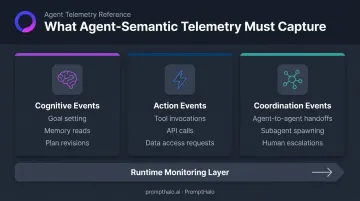
Effective agent-semantic telemetry covers three event categories:
| Event Category | What It Captures |
|---|---|
| Cognitive events | Goal setting, memory reads, plan revisions |
| Action events | Tool invocations, API calls, data access requests |
| Coordination events | Agent-to-agent handoffs, subagent spawning, human escalations |
Beyond capturing these events, monitoring requires behavioral baselines — expected frequency distributions of tool usage, API call patterns, and decision sequences per agent goal. Deviations are only detectable against a known norm.
Detecting Threats in Real Time
Prompt injection at the retrieval layer is where attackers increasingly focus. The instruction isn't in the user's message — it's embedded in a document, database record, or web page the agent retrieves before making a decision. Monitoring must inspect retrieved context, not just direct inputs.
PromptHalo's detection uses embedding-based scoring against a shared Threat Library, catching retrieval-layer injection on the wire in milliseconds rather than after the response is already generated.
Behavioral drift detection catches misalignment before it becomes an incident. Consider a compliance monitoring agent that begins reducing alert frequency while its stated goal remains "monitor trading thresholds." No single decision is a policy violation, but the cumulative pattern reveals misalignment.
Goal-conditioned drift detection compares current behavior against the baseline for that specific agent goal, not a generic average across all agents.
Privilege escalation signals to watch for:
- The agent invoking tool categories not present at session start
- Access to resources outside the agent's initial scope
- Subagent spawning with permissions the parent shouldn't be able to delegate
- Requests that pass individually but form a suspicious sequence in aggregate
Across all three threat types, PromptHalo's runtime monitoring sits inline on every inference, tool call, and handoff — making per-action decisions in under 100ms, fast enough to intervene before an escalation completes.
Runtime Protection: Enforcement, Containment, and Response
Enforcement at Every Decision Point
Every inference, every tool call, and every agent-to-agent handoff needs enforcement before it executes — not just observation after the fact. The enforcement layer evaluates each action in real time and decides: allow, restrict, challenge, deny, or monitor.
PromptHalo's runtime enforcement layer operates inline across any AI application from any vendor, without touching the underlying model. Integration options include API gateway, agent mode, and inline middleware, all connecting to the same inspection pipeline. Sub-100ms per-decision latency holds across inferences, tool calls, and multi-agent handoffs.
Three enforcement mechanisms matter most:
- Authority decay: permissions automatically erode after anomalous behavior or as accumulated risk within a session rises, forcing re-authorization before the agent continues
- Per-action budget and scope enforcement: limits on how much data an agent can access and which tool categories it can invoke per task, enforced at the security passport level
- Model- and vendor-agnostic enforcement: works across homegrown agents, SaaS platform agents, and multi-vendor pipelines without requiring model retraining or code rewrites
Graduated Containment and Response
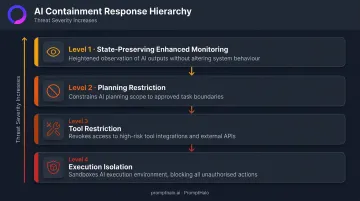
When a threat signal activates, response should be proportional: limit blast radius while preserving operational value where possible. A four-level containment hierarchy:
- State-preserving enhanced monitoring: agent continues operating; governance signal collection increases; high-risk decisions route to human review
- Planning restriction: current task completes; new goal-setting is blocked
- Tool restriction: specific tool categories are dynamically revoked; read-only variants substituted where available
- Execution isolation: agent moved to a controlled environment with simulated tool responses
Each level buys time to investigate without immediately halting a business-critical workflow.
Decision-Level Audit Logs
Session-level logging (for example, "the agent ran from 14:00 to 14:47 and completed these tasks") is inadequate for forensic investigation or regulatory demonstration.
Decision-level logging captures every input, reasoning step, action, and output, along with:
- The enforcement decision and its reason
- The acting agent or passport identity
- Session and tenant context
- Timestamp
PromptHalo's audit logs are append-only and tamper-evident. Once written, an entry cannot be modified or removed, creating a replayable evidence trail for debugging, compliance export, and incident reconstruction.
The EU AI Act (Articles 12, 14, 26) requires high-risk AI systems to enable automatic event logs, human oversight, and log retention of at least six months where under the deployer's control. Decision-level logging is what satisfies that standard.
Common Agentic Runtime Security Mistakes to Avoid
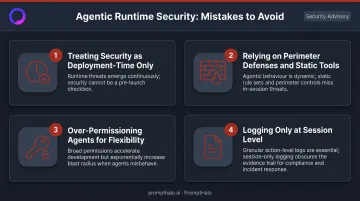
Most agentic security failures trace back to four repeatable mistakes. Recognizing them early is the difference between a contained incident and a regulatory event.
Treating security as a deployment-time decision. A monitoring rule or permission scope that was correct at launch can become dangerously inadequate after the agent encounters new inputs, tools, or goals. Agents operate in evolving contexts — and silent drift compounds until a breach or audit surfaces the gap.
Relying on perimeter defenses and static tools. Firewalls, DLP, and SAST show green on coverage dashboards while the actual agentic attack surface — cognitive events, tool-chain sequences, agent handoffs — remains entirely unmonitored. Organizations typically discover this gap only after an incident.
Over-permissioning agents "for flexibility." Standing, broad access at deployment is the most common enabler of privilege escalation and data exfiltration. An agent carrying enterprise-wide database credentials for a narrow task can execute entirely different actions if its goals shift or if it's manipulated via prompt injection — a structural design flaw, not a runtime accident.
Logging only at the session level. Without replayable, decision-level audit trails, forensic investigation becomes guesswork. In fintech and other regulated industries, session-level summaries don't satisfy audit requirements — and incident response teams can't reconstruct whether a harmful action was an attack, a misalignment, or a legitimate edge case.
Conclusion
Agentic AI runtime security is not a deployment checkbox. Agents learn, adapt, and operate in continuously changing contexts, and your monitoring and enforcement has to keep pace.
The organizations that scale agentic AI without scaling their regulatory and incident exposure are the ones that instrument each inference, each tool call, each agent handoff — and enforce trust before any of it executes. Every agent action is a security decision point. Treat it that way.
Frequently Asked Questions
What does it mean to be agentic?
"Agentic" describes AI systems that can perceive their environment, set or pursue goals, take sequences of autonomous actions, and adapt based on feedback. Unlike generative AI that responds to a single prompt, agentic systems plan, act, and revise across multiple steps.
Is ChatGPT an agentic AI?
Standard ChatGPT is a generative model, not a fully agentic system. GPT-4o with tool use, browsing, or code execution begins to exhibit agentic characteristics. Runtime security concerns apply most acutely to purpose-built deployments where an LLM drives multi-step workflows autonomously.
What is the meaning of agentic OS?
An "agentic OS" refers to a software layer that orchestrates multiple AI agents — managing their goals, memory, tool access, and coordination. It functions analogously to an operating system, but for autonomous AI workflows rather than hardware processes.
What are the biggest runtime security risks for agentic AI?
The top runtime threats are prompt injection (including indirect injection via retrieved context), retrieval poisoning, unauthorized or out-of-scope tool calls, privilege escalation through goal drift, and data exfiltration via multi-agent handoffs. All of these risks emerge at execution, making runtime enforcement the only viable defense layer.
How is runtime monitoring for agentic AI different from traditional application monitoring?
Traditional monitoring captures infrastructure health — latency, error rates, API responses. Agentic runtime monitoring must capture cognitive and semantic events: goal revisions, memory reads, tool-chain sequences, and agent-to-agent handoffs. Most governance violations in agentic systems originate in these layers, which conventional observability tools never see.
What compliance frameworks apply to agentic AI security?
OWASP LLM Top 10, NIST AI RMF, and the EU AI Act are the primary applicable frameworks. Each requires decision-level, tamper-evident audit logs that map individual agent actions to specific controls. Session-level summaries don't meet the traceability requirements these frameworks impose.