Introduction
Most enterprise compliance programs were built for a different era—one where software followed deterministic rules, humans made the consequential decisions, and audit trails captured what a person did, not what a model inferred.
AI changes all three assumptions. Modern AI apps generate outputs probabilistically, call external tools autonomously, and retrieve data dynamically from vector databases. The compliance infrastructure that governs your HR system or CRM was never designed to govern that.
According to IBM's 2025 Cost of a Data Breach report, 63% of organizations lack AI governance policies—and 97% of organizations that experienced an AI-related security incident had inadequate AI access controls. The gap isn't theoretical—it's already producing incidents.
This article covers the regulatory drivers forcing enterprises to act, the five pillars of a sound AI governance architecture, and why agentic AI introduces challenges that traditional logging and DLP tools cannot address.
Key Takeaways:
- Traditional compliance stacks can't capture AI decision chains or produce regulator-readable rationales
- EU AI Act Article 12 mandates automatic event logging with six-month minimum retention for high-risk systems
- Agentic AI needs per-action scope enforcement and authority decay—session-level controls aren't enough
- Sound AI governance enforces policy before actions execute, not only after they're logged
- A practical governance architecture starts with AI discovery, then maps regulations to technical controls
Why Traditional Compliance Tools Fall Short for AI
Firewalls, DLP systems, SIEMs, and code scanners were designed to govern static software and human users. They watch for known-bad signatures, flag policy violations in structured data flows, and log what a person did at a specific endpoint.
AI systems behave differently in three ways that break this model entirely.
First, the decision chain is invisible to traditional tools. A single AI interaction may span multiple inference calls, tool invocations, RAG retrievals from a vector database, and agent-to-agent handoffs. AWS Bedrock invocation logs, Azure AI OpenTelemetry traces, and Google Vertex audit logs each capture model ID, identity, prompt/input, response/output, token usage, retrieval operations, and tool execution — none of which generic SIEM event schemas define.
Your firewall sees a network request. It doesn't see that the model retrieved a confidential document, passed it to a sub-agent, and triggered an API call.
Second, traditional tools log after the fact. By the time a SIEM processes an event, the AI has already generated the output, the tool call has already executed, and the data has already been retrieved. For human users, post-facto logging is often sufficient. For autonomous AI agents executing actions in milliseconds, it isn't.
Third, there's no structured rationale. Regulators increasingly expect to understand why an AI made a specific decision—not just that it did. A log entry reading "model returned output" tells an auditor nothing about which data sources were accessed, which policy checks ran, or what risk score was assigned.
Gartner projects that over 40% of enterprises will face security or compliance incidents linked to shadow AI by 2030—with 69% already suspecting unauthorized GenAI use. Closing that gap requires tooling built specifically for how AI systems actually behave.
The Regulatory Landscape: What Rules Apply to Your AI
No single regulation governs AI comprehensively, so enterprises face a layered compliance obligation across multiple frameworks simultaneously.
Primary Frameworks
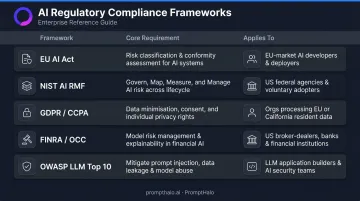
| Framework | Core Requirement | Who It Applies To |
|---|---|---|
| EU AI Act | Automatic event logging, six-month log retention, human oversight for high-risk AI | Providers and deployers of AI systems in or affecting the EU |
| NIST AI RMF | Govern, Map, Measure, Manage risk functions | US federal agencies; increasingly adopted as enterprise standard |
| GDPR / CCPA | Personal data traceability in AI decisions; data minimization for AI logs | Any organization processing EU or California resident data |
| FINRA / OCC | Documented AI decision rationales; model inventories with risk ratings | Financial services firms using AI for client-facing decisions |
| OWASP LLM Top 10 | AI-specific security risk categories including prompt injection (LLM01) and sensitive information disclosure (LLM02) | De facto benchmark for AI security governance |
The EU AI Act Provider vs. Deployer Split
EU AI Act Articles 19 and 26 create a shared but distinct obligation. Providers must engineer automatic event recording into the system from the design phase. Deployers must retain and govern those logs operationally. Both parties face a minimum six-month retention requirement, unless applicable law specifies otherwise.
Key dates and obligations to track:
- August 2, 2026 — High-risk AI system obligations under EU AI Act Annex III take effect; full rollout by August 2027
- January 1, 2027 — CCPA's Automated Decisionmaking Technology (ADMT) regulations require pre-use notice and consumer access rights for covered AI uses
- GDPR Articles 5(1)(c) and (e) — Data minimization principles create a direct tension: audit logs containing personal data must satisfy statutory retention floors while honoring deletion obligations once the purpose expires
ISO/IEC 42001 and the OWASP LLM Top 10 aren't legally mandated in most jurisdictions. That said, regulators increasingly expect audit trails mapped to a recognized framework — treat compliance-to-framework mapping as a baseline expectation, not an optional enhancement.
The Five Core Pillars of AI Governance for Compliance
Pillar 1 — Comprehensive AI Audit Logging
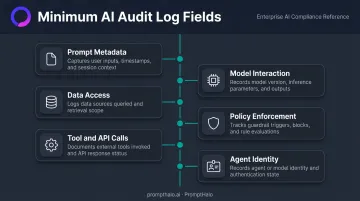
Effective AI audit logs capture the full interaction chain, not just inputs and outputs. The minimum fields that regulators and cloud-native AI telemetry schemas (AWS Bedrock, Azure AI, Google Vertex) identify include:
- Prompt metadata — what was sent to the model, hashed if sensitive
- Model interaction — model ID, version, parameters, token usage, latency
- Data access — which documents or vector DB results were retrieved in a RAG query, including source corpus and retrieval scores
- Policy enforcement — which checks ran, pass/fail outcomes, risk score assigned
- Tool and API calls — what external actions the agent attempted and whether they were allowed or blocked
- Agent identity — which agent or sub-agent initiated the action, session and tenant context
Sensitive data within logs should be hashed, tokenized, or masked—not stored in plaintext. Google Cloud's Sensitive Data Protection supports HMAC-SHA-256 hashing for one-way tokens; AWS Bedrock Guardrails can detect and redact PII before it enters the log pipeline.
This satisfies both completeness (auditors need the record) and GDPR data minimization (the record shouldn't contain unnecessary personal data).
Pillar 2 — Tamper-Evident, Immutable Log Storage
Regulators don't just require logs—they require logs that can't be altered after the fact. SEC Rule 17a-4 requires non-rewriteable, non-erasable storage or an auditable alternative. AWS CloudTrail validates log integrity using SHA-256 hashing and RSA digital signing; S3 Object Lock prevents deletion or overwrite during a defined retention period.
The EU AI Act's "automatic recording" mandate implies the same architectural requirement: logs must be structurally impossible to modify retroactively, not merely access-controlled.
PromptHalo generates decision-level, replayable, append-only audit logs with tamper-evident storage. Every event captures the decision, its reason, the acting agent's identity, session context, and timestamp. Because logs are append-only, each entry becomes a permanent evidence artifact—usable for debugging, compliance export, or post-incident investigation without requiring custom engineering from your team.
Pillar 3 — Real-Time Policy Enforcement
Logging proves what happened. Policy enforcement prevents it from happening. These are distinct functions — and most enterprises that face regulatory scrutiny have built the first without the second.
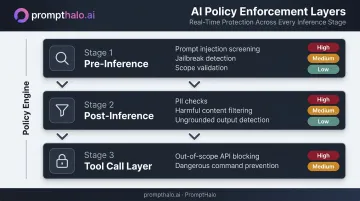
A governance architecture must include inline policy checks that fire before the AI completes an action:
- Pre-inference: Prompt injection screening, jailbreak detection, scope validation
- Post-inference: PII exposure checks, harmful content filtering, ungrounded output detection
- Tool call layer: Out-of-scope API call blocking, dangerous command prevention
OWASP LLM01 (prompt injection) and LLM02 (sensitive information disclosure) represent the minimum threat surface a policy engine should cover—and both require enforcement at inference time, not post-processing.
PromptHalo's policy engine makes per-action decisions in under 100 milliseconds, with five enforcement outcomes at each point: allow, restrict, challenge, deny, or monitor. Rules are configurable, applied per action across the full AI workflow stack, and every decision is logged with its rationale.
Pillar 4 — Data Lifecycle and Retention Management
Governing AI data means controlling not only what is logged, but how long it is retained, where it is stored, and when it is deleted.
Enterprises need three things working simultaneously:
- Retention minimums met — six months for high-risk AI systems under the EU AI Act; longer under some financial services rules
- Sensitivity classifications applied — AI interaction records tagged by data type so deletion and access policies can be enforced automatically
- Deletion mechanisms in place — when the legal retention window closes, personal data within logs must be removable without destroying the structural integrity of the audit trail
The tension between "keep enough for auditors" and "delete enough for GDPR" is real. Pseudonymization and purpose-based retention schedules are the practical middle ground—retained records reference a pseudonymous identifier, with the key held separately and subject to deletion once the legal purpose expires.
Pillar 5 — Compliance Dashboards and Continuous Monitoring
Logs in storage don't protect you. Logs in a dashboard do.
The operational layer that makes governance actionable surfaces real-time metrics including policy violation rates, blocked actions by type, model usage patterns, and anomaly trends. This gives risk and compliance teams the visibility to catch non-compliant usage patterns while there's still time to act, rather than discovering them during a regulatory examination.
PromptHalo's real-time monitoring detects behavioral drift, anomalous access patterns, and security issues as they occur, with detection running in milliseconds. The result: your audit trail is evidence of control, not just evidence of events.
Governing Agentic AI: The New Compliance Frontier
Single-turn LLM governance has a defined perimeter. Agentic AI blows that perimeter open.
Gartner predicts 40% of enterprise applications will feature task-specific AI agents by end of 2026, up from less than 5% in 2025. McKinsey reports that nearly two-thirds of organizations identify security and risk concerns as the primary barrier to scaling agentic AI—74% cite inaccuracy and 72% cite cybersecurity as highly relevant risks.
Three Compliance Surfaces Existing Frameworks Miss
Retrieval poisoning in RAG pipelines. Attackers can inject malicious content into knowledge bases that alter agent behavior without touching the model. Research on PoisonedRAG demonstrates that a small number of poisoned documents can consistently redirect agent responses—violating data integrity obligations and producing outputs that no policy check ever had a chance to review.
Prompt injection through tool outputs. OWASP LLM01 explicitly covers indirect prompt injection, where malicious instructions are embedded in API responses or tool outputs and parsed by the model as instructions. An agent that trusts its tool results is an agent that can be hijacked mid-task.
Authority creep in multi-agent handoffs. When agents hand off tasks to downstream agents, those agents can inherit permissions they were never explicitly granted. OWASP LLM06 (Excessive Agency) and Microsoft's agentic AI security guidance both identify this as a core failure mode—one that existing access control models don't handle because they weren't designed for agent-to-agent delegation chains.
Governance Design Principles for Agentic AI
Agentic systems require governance principles that existing frameworks never anticipated:
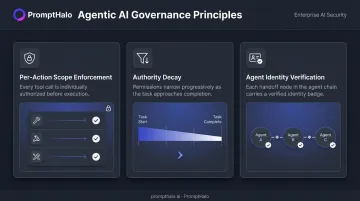
- Per-action scope enforcement — each tool call should be authorized individually, not blanket-approved at session start
- Authority decay — agent permissions should narrow as task completion approaches, not persist indefinitely
- Agent identity verification — each agent in a handoff chain must be independently verified to prevent impersonation
Translating these principles into runtime enforcement is where most governance frameworks stall. PromptHalo addresses this through security passports that travel with each agent request, carrying policy, budget, and authority decay constraints enforced externally—so an agent cannot grant itself more access than it was originally given.
Budgets decay across time, steps, and risk dimensions. When an envelope is exceeded, the agent is forced to seek re-authorization rather than proceeding unchecked. The result: agent autonomy that scales without creating open-ended compliance exposure.
Building Your AI Governance Architecture: A Practical Roadmap
Step 1 — Assess and classify your AI inventory
Before governing, know what you're governing. Conduct an AI discovery exercise covering:
- All AI apps in use, sanctioned and shadow
- Risk tier for each (EU AI Act Annex III categories or NIST AI RMF risk bands)
- Model name, version, purpose, data sources accessed, provider and deployer identity
This inventory is the starting document for every regulatory audit.
Step 2 — Map regulations to specific controls
Map each regulatory obligation to a concrete technical or process control:
| Regulation | Maps to Control |
|---|---|
| EU AI Act Article 12 | Automatic event logging with minimum fields |
| OWASP LLM01 | Prompt injection detection at inference time |
| GDPR Article 5(1)(e) | Log retention schedule with automated deletion |
| FINRA model risk guidance | Model inventory with risk ratings and documented rationale |
Step 3 — Implement layered logging with structured schemas
Design your audit logging schema before deploying AI apps. Required fields include:
- Timestamp, user ID, application ID
- Model ID and version
- Prompt hash and response hash
- Data sources accessed
- Policy check results and risk score
- Tool calls attempted and their outcomes
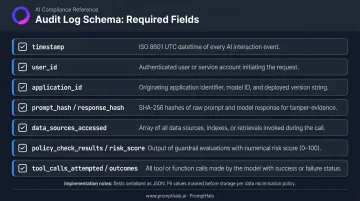
Use JSON for SIEM ingestion. Mask or tokenize PII before long-term storage.
Step 4 — Deploy inline policy enforcement before and after inference
Integrate a policy engine that evaluates:
- Every prompt before it reaches the model
- Every response before it reaches the user
- Every tool call before it executes
PromptHalo implements this three-layer model (pre-inference, post-inference, and tool call) through a single unified inspection pipeline. It makes per-action decisions in under 100ms without requiring model access or code rewrites.
Step 5 — Establish governance review cadences and incident response playbooks
That enforcement infrastructure only stays effective if your governance processes keep pace. Treat these reviews and playbooks as the operational layer on top of your technical controls:
- Quarterly compliance reviews against regulatory frameworks
- Anomaly investigation workflows triggered by dashboard alerts
- Documented incident response playbooks for AI-specific failures: data leakage via RAG, prompt injection exploitation, ungoverned agent tool calls
- Exportable audit logs in regulator-readable formats, with a defined SLA for producing a full decision-level replay of any AI interaction
The EU AI Act requires serious incident reporting within 15 days of establishing a causal link, with accelerated timelines for death (10 days) or widespread infringement (2 days). Your playbook needs to accommodate those windows.
Frequently Asked Questions
How is AI used in compliance monitoring?
AI automates compliance monitoring by continuously analyzing interaction logs, detecting anomalous patterns—such as repeated PII access attempts or policy violations—and generating structured reports mapped to specific regulatory requirements. This replaces manual log review with continuous oversight that scales with AI deployment volume.
What regulations apply to AI apps and data governance?
The primary frameworks include the EU AI Act, NIST AI RMF, GDPR and CCPA, and the OWASP LLM Top 10. Financial services and healthcare layer sector-specific rules on top of these baselines, covering everything from mandatory logging and human oversight to personal data traceability and minimization.
What is the difference between AI logging and AI governance?
Logging creates the audit record, and it's a component of governance, not the whole thing. Governance also encompasses policy enforcement before actions execute, data lifecycle management, risk classification, continuous monitoring, and incident response. Effective governance uses logs as evidence but enforces rules proactively to prevent compliance failures from occurring in the first place.
How do you govern agentic AI differently from traditional AI applications?
Agentic AI requires per-action scope enforcement, authority decay, inline enforcement at every agent handoff, and RAG retrieval monitoring. Unlike traditional applications, autonomous agents can chain compliance violations across multiple steps before any human reviews a log — session-level access controls aren't enough.
What must be included in an AI audit trail for regulatory compliance?
At minimum, each entry needs a timestamp, user and app identifiers, model ID and version, prompt metadata (hashed if sensitive), data sources retrieved, policy check outcomes, tool call allow/block results, and a risk score. All records must be stored in tamper-evident, append-only storage with a documented retention schedule.
How long must AI interaction logs be retained under the EU AI Act?
The EU AI Act sets a six-month minimum retention period for automatically generated logs of high-risk AI systems under Articles 19 and 26, unless applicable law specifies otherwise. GDPR data minimization requirements can mandate shorter effective retention for records containing personal data, making it essential to reconcile AI Act retention floors with existing data protection policies.