Introduction
AI agents have crossed a threshold that most security teams haven't fully absorbed yet. They don't just query data—they call APIs, execute multi-step workflows, spawn sub-agents, and trigger real-world actions like payments, code deployments, and database writes. All autonomously. All at machine speed.
That creates a fundamental problem: traditional IAM was designed for humans and static services. An agent that starts a session reading documents, then mid-task begins submitting financial transactions, doesn't fit neatly into any role RBAC can assign.
The identity is fluid, the actions are unpredictable, and a single misconfigured permission can expose financial transactions, customer records, and production systems in one autonomous run.
Gartner projects that 33% of enterprise software applications will include agentic AI by 2028, up from less than 1% in 2024—and over 40% of those projects will be canceled, often due to inadequate risk controls. Access control architecture is exactly the kind of risk that kills agentic projects in production.
This guide covers where classic access models break down, what the new attack surface looks like, and what modern access control for agentic AI actually requires to work in production.
Key Takeaways
- Traditional access models (RBAC, ABAC, ReBAC) can't handle agents that shift roles mid-task and operate at machine speed.
- Every tool call, API invocation, and agent-to-agent handoff is an attack surface — policy enforcement, not LLM judgment, closes it.
- Least-privilege identities, ephemeral credentials, authority decay, and per-action scope are the pillars of agentic access control.
- In regulated industries, decision-level audit trails aren't optional — they're a compliance requirement.
Why AI Agents Break Traditional Access Control Models
Classic access control models weren't built wrong. They were built for a different world—one where the principal is a human or a predictable service with a fixed identity and a stable role. AI agents are neither.
The RBAC Mismatch
NIST defines RBAC as controlling access through roles assigned to subjects—not individual identities. That works when subjects have stable roles.
An AI agent's effective "role" shifts constantly. A session that starts as read-only research can evolve, within minutes, into write operations, API submissions, or financial transactions. To handle this with RBAC, you either create a massive catch-all role that over-provisions access, or you create an explosion of granular roles that nobody maintains. Both paths fail in practice.
ABAC Loses Context in Ephemeral Runtimes
NIST SP 800-162 defines ABAC as granting authorization by evaluating subject attributes, object attributes, requested operations, and environment conditions at decision time. That's a closer fit for agents—but it assumes attributes are reliably available.
Agentic stacks built on ephemeral containers or serverless functions lose ambient context with each invocation. Without persistent, verifiable attribute propagation across the call chain, ABAC policies evaluate on incomplete data and produce incorrect decisions.
ReBAC Has a Latency Constraint
Relationship-based access control elegantly models resource ownership graphs, but graph traversal takes time. Google's Zanzibar system—the gold standard for ReBAC at scale—achieves 95th-percentile latency below 10ms with strong availability. That's impressive engineering, but it also illustrates the constraint: authorization must be engineered as a low-latency runtime dependency.
An AI agent can trigger dozens of tool calls per prompt. Each one requiring a graph lookup compounds the latency problem at production scale.
The Multi-Agent Handoff Gap
The hardest gap is one no traditional model was designed to address: agent-to-agent delegation. When a root agent spawns a child agent to handle a subtask, trust must propagate in a verifiable, scoped way.
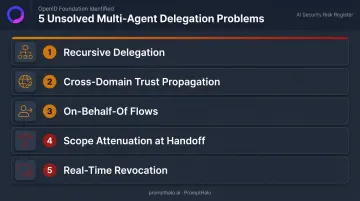
The OpenID Foundation's 2025 paper on agentic AI identity identifies five unsolved problems in current agent frameworks:
- Recursive delegation across agent hierarchies
- Cross-domain trust propagation
- On-behalf-of flows without identity loss
- Scope attenuation at each handoff
- Real-time revocation after delegation
Without explicit design for each of these, every handoff becomes a trust boundary with no enforcement. Attackers will find it.
The core gap: these models weren't built for a principal that fluidly shifts, delegates, and acts thousands of times per session. AI agents require a new layer: runtime enforcement wrapping every action, not just session-level authentication.
The Unique Access Control Risks of Agentic AI
The OWASP LLM Top 10 maps the threat landscape clearly. Four risks have direct access control implications.
Excessive Agency (OWASP LLM06)
OWASP LLM06:2025 identifies excessive agency as the risk that arises when LLMs are granted broad autonomy over tools, functions, and external systems. When agents operate without per-action authorization checks, an unexpected LLM output—a hallucination, a manipulated instruction—can trigger irreversible real-world consequences: a payment sent, a production database deleted, a cloud resource deprovisioned.
The solution is architectural: the LLM must never decide whether an action is permitted. An external policy engine makes that call.
Prompt Injection as an Access Control Failure (OWASP LLM01)
OWASP LLM01:2025 defines prompt injection as inputs that alter LLM behavior in unintended ways—including inputs invisible to humans but parsed by the model. Retrieved content, emails, tickets, and tool outputs are all potential injection vectors.
The real-world risk isn't theoretical. In 2025, Aim Security disclosed the Microsoft 365 Copilot "EchoLeak" vulnerability—a zero-click prompt injection that could have enabled sensitive business data exfiltration before Microsoft patched it.
Fine-grained, per-tool scope enforcement is the relevant defense: even if an injection succeeds at the prompt level, the downstream tool call is blocked because it falls outside the agent's explicitly scoped permissions.
Retrieval Poisoning and Vector Weaknesses (OWASP LLM08)
OWASP LLM08:2025 flags unauthorized access and data leakage risks when access controls for vector stores and embeddings are inadequate. RAG-based agents are only as trustworthy as their data sources.
Without controls at the retrieval layer, agents can be steered toward poisoned documents or surface data the requesting user has no clearance to see. Permission-aware vector stores and trust-labeled data sources are a prerequisite for safe RAG deployment — not an optional layer to add later.
Sensitive Information Disclosure (OWASP LLM02)
OWASP LLM02:2025 covers PII, financial records, health data, credentials, and proprietary source code. Agents operating with over-broad RAG permissions can surface compliance-protected records in response to seemingly innocent queries.
The breach risk is real. The Verizon 2024 DBIR found internal actors involved in 35% of breaches. Autonomous agents operating with internal credentials should be governed like high-risk internal actors—with the same logging, anomaly detection, and access scoping.
Key Principles of Modern AI Agent Access Control
Least-Privilege Identities and Ephemeral Credentials
Every agent, plugin, and sub-agent needs its own narrowly scoped identity. Static API keys or long-lived tokens in agentic contexts are a liability—a compromised token in a multi-step workflow can persist across many operations before anyone notices.
Major cloud providers have established the pattern:
- AWS STS issues temporary credentials lasting minutes to hours
- Google Cloud Workload Identity Federation eliminates long-lived service account keys entirely
- Azure Managed Identities let agents obtain tokens without managing credentials at all
The practical implementation starts every agent session in read-only mode. Elevated permissions — write, execute, transact — are granted only through explicit, audited elevation tied to a specific task scope.
PromptHalo operationalizes this through agent security passports: signed credentials that travel with each request, carrying policy, budget, and authority decay constraints specific to each agent's role. They're tamper-evident and validated at every checkpoint in the agent chain.
Authority Decay and Dynamic Scope Reduction
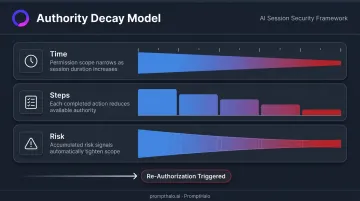
Authority decay is a pattern unique to agentic environments. As an agent progresses through a task, its permissions should actively narrow—not remain static.
Once a subtask completes (say, data retrieval), the permissions needed for that step should be revoked before the next step begins. This limits blast radius if the agent is compromised or manipulated mid-session.
Authority decay operates across three dimensions:
- Time — permissions diminish as elapsed session time increases
- Steps — each action taken reduces the available authority envelope
- Risk — accumulated risk signals tighten permission scope automatically
When any threshold is exceeded, the system forces re-authorization. The agent cannot grant itself more access than it was originally given — enforcement is external. PromptHalo's authority decay mechanism applies all three dimensions simultaneously, with no reliance on the agent to self-report its state.
In multi-agent chains, dynamic scope reduction is especially critical. Each delegating agent should pass only the minimum subset of its own permissions to the child agent—not its full authority. This prevents privilege amplification from compounding across handoffs.
External Policy Engines and Per-Action Authorization
The LLM must never be the arbiter of whether an action is permitted. Every tool invocation, API call, generated SQL statement, and agent-to-agent request must route through an external policy engine that applies deterministic rules before execution proceeds. The model proposes; the policy enforces.
For high-impact, irreversible actions, human approval checkpoints belong in the workflow architecture itself — not bolted on afterward. Actions that require this treatment include:
- Payment initiation and financial transactions
- Code deployments to production environments
- Bulk data deletions or schema modifications
- Privilege escalation requests from sub-agents
The identity of the approver must be captured in the audit record for every one of these events.
Runtime Enforcement: Moving Beyond Policy Definition
There's a critical distinction that most access control discussions miss: the difference between policy definition (what an agent is allowed to do, configured in advance) and runtime enforcement (evaluating every live action against policy before it executes).
Policy definitions that aren't evaluated inline at inference time are advisory. They describe a desired state but don't enforce it. Most production failures happen not because policies were wrong, but because they weren't applied to the specific action that caused the incident.
What Inline Enforcement Looks Like
Every inference call, tool invocation, and agent-to-agent handoff passes through an enforcement layer that makes a real-time decision before the action executes: allow, restrict, challenge, deny, or monitor.
This is where PromptHalo operates. The platform sits inline across three deployment modes:
- API gateway: sits as a proxy layer between the application and its endpoints, intercepting requests before they reach their targets
- Agent mode: integrates directly with orchestration platforms and agent frameworks to enforce decisions at the task level
- Inline middleware: embeds protection inside agentic frameworks and custom applications without modifying the underlying model
All three feed into the same inspection and enforcement pipeline. Decisions happen in under 100ms. The platform deploys in under a day with no model retraining and no code rewrite, because it never requires access to the underlying model.
Inline enforcement also governs what happens between agents, not just between an agent and an endpoint. Security passports carry verifiable agent identity and scoped authority through multi-agent chains. At each handoff checkpoint, the passport is validated against current policy and the agent's remaining authority budget before the action proceeds.
The Closed-Loop Benefit
When runtime enforcement catches an attack or policy violation, that event feeds back into the threat detection layer. PromptHalo's Red Teaming solution continuously probes for weaknesses — prompt injection, jailbreaks, RAG poisoning, adversarial task chains — and encodes newly discovered attack patterns into a shared Threat Library. The Runtime Security solution draws from that same library, so a newly discovered attack vector becomes a runtime defense without waiting for a release cycle.
That closed loop produces measurable results: ML-based detection at over 95% catch rate and under 5% false positives, compared to roughly 35% catch rate for rule-based approaches. Each new attack discovered sharpens enforcement automatically, rather than waiting for a manual policy update after an incident.
Audit Trails and Compliance in Agentic Environments
Traditional audit logs capture "who logged in and what they accessed." That granularity is insufficient for agentic AI.
What's required: every tool call, every retrieval query, every agent-to-agent delegation, and every policy decision— logged at the decision level with enough context to reconstruct the full reasoning chain.
What Regulatory Frameworks Require
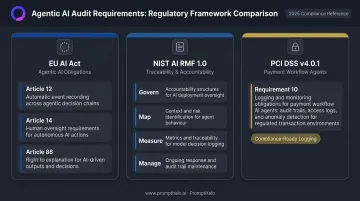
Multiple frameworks now mandate this level of auditability:
- EU AI Act Article 12 requires high-risk AI systems to enable automatic recording of events over the system lifetime. Article 14 requires effective human oversight. Article 86 gives affected persons a right to explanation for certain high-risk AI decisions.
- NIST AI RMF 1.0 organizes AI risk management around Govern, Map, Measure, and Manage—with traceability, documentation, and accountability as core trustworthy AI properties.
- PCI DSS v4.0.1 Requirement 10 mandates logging and monitoring all access to system components and cardholder data. If an AI agent touches a payment workflow or the cardholder data environment, its automated actions need attributable, tamper-evident logs.
What a Decision-Level Audit Log Captures
PromptHalo's audit logs record—for every single decision:
- The action taken and the reason for the decision
- The acting agent or passport identity
- Session and tenant context
- A precise timestamp
The log is append-only and tamper-evident. Once an event is written, it cannot be modified or removed. This creates a replayable evidence trail suitable for debugging, compliance export, and post-incident investigation.
For financial services organizations, the bar is higher. An AI agent that executes a payment workflow or surfaces customer financial data must produce records a human auditor can follow without ambiguity — records that satisfy PCI DSS and applicable model risk management guidance such as Federal Reserve SR 11-7 and OCC Bulletin 2011-12.
Those same logs serve a second function in real-time operations. Streaming them to a SIEM enables anomaly detection that flags unusual tool call frequency, out-of-scope data access, or unexpected agent delegation patterns before they escalate.
Frequently Asked Questions
What makes access control for AI agents fundamentally different from traditional IAM?
AI agents shift roles dynamically mid-task, act at machine speed across tool calls and agent-to-agent handoffs, and lack a fixed identity context. Session-level authentication grants access once and holds it for the duration, yet an agent can make thousands of consequential decisions within a single session, each requiring its own authorization check.
How should organizations implement least-privilege access for AI agents?
Issue ephemeral credentials scoped to specific tasks (AWS STS, Google Workload Identity Federation, or Azure Managed Identities). Start sessions in read-only mode and require explicit, audited elevation for write or execute actions. Revocation must cut off access instantly without disrupting other system components.
What is authority decay and why does it matter for multi-agent systems?
Authority decay means an agent's permissions actively narrow as it completes subtasks, measured across time, steps, and accumulated risk. In multi-agent chains, each child agent receives only the minimum subset of the parent's authority. This prevents privilege amplification across handoffs and limits blast radius if an agent is compromised mid-session.
Can existing RBAC or ABAC systems handle AI agent access control on their own?
No. RBAC struggles with agents whose roles shift mid-task. ABAC loses attribute context in ephemeral runtimes. Neither was designed for the latency constraints of per-tool-call policy evaluation. A supplementary runtime enforcement layer—sitting inline at each action—is necessary to bridge these gaps.
How do access controls address OWASP LLM risks like prompt injection and excessive agency?
Fine-grained per-tool scope enforcement means a successful prompt injection still cannot reach operations outside the agent's explicitly permitted scope. Per-action authorization checks ensure that hallucinated or manipulated LLM outputs cannot trigger irreversible real-world actions, because the policy engine blocks them before execution regardless of what the model proposed.
What audit trail requirements apply to AI agent actions in regulated industries?
Regulated environments require decision-level logs covering every tool call, retrieval query, policy decision, and delegation event, with enough context to reconstruct the full reasoning chain. These records must map to applicable frameworks (NIST AI RMF, EU AI Act Article 12, PCI DSS Requirement 10) and be exportable for regulatory reporting and incident reconstruction.