Introduction: Why AI Workflows Are Outrunning Your Governance Controls
Enterprises are deploying AI agents that autonomously call tools, retrieve data, and trigger downstream actions. The governance frameworks meant to oversee them were built for a different era — one where humans made each decision and auditors reviewed logs on a quarterly schedule.
That gap is where compliance failures happen.
According to BCG and MIT Sloan Management Review, 85% of companies have implemented a responsible AI program, but only 25% have fully mature frameworks in place.
McKinsey's 2025 State of AI report found that 62% of organizations are experimenting with AI agents and 23% are already scaling them. Adoption is running well ahead of governance readiness — and the exposure gap widens with every deployment.
This guide covers what data lineage and governance actually mean for agentic AI, where traditional approaches fail, the four pillars of a functional governance architecture, and a practical checklist for moving from policy to enforcement.
Key Takeaways:
- Traditional governance was built for human workflows; agentic AI operates faster than any manual review cycle
- Governance enforced at decision time catches failures that retrospective log review misses
- End-to-end lineage tracing is a compliance requirement, not an operational nice-to-have
- Risk-tiered oversight reduces friction on safe actions while preserving accountability on high-risk ones
- Runtime enforcement deploys without model access or code rewrites
What Data Lineage and Governance Mean for AI-Driven Workflows
Data Lineage in the Agentic Context
Traditional data lineage tracks static flows between pipeline steps — a dataset moves from source A to table B via ETL job C. That model breaks the moment an AI agent enters the picture.
For agentic AI, lineage means tracing every action an agent takes with data: reads from databases and vector stores, retrievals from RAG pipelines, transformations that produce summaries or scores, writes back to production systems, tool calls, and agent-to-agent handoffs. Each of these actions can move, modify, or expose data — and the system must emit a traceable record for each.
The scope is fundamentally different from traditional lineage:
- Traditional lineage: Static flows between human-controlled pipeline steps
- Agentic lineage: Dynamic, real-time traces across databases, APIs, vector stores, and downstream systems triggered by autonomous agent decisions
AI Governance for Agentic Systems
AI governance in this context defines what an agent is permitted to do — and when human approval is required. It combines four enforcement layers: access controls, policy enforcement, behavioral monitoring, and audit mechanisms.
PromptHalo's approach puts this into practice through signed agent security passports with policy, budget, and authority decay built in — so an agent cannot grant itself more access than it was originally authorized to have. Budgets across time, steps, and risk decay as the agent operates, forcing re-authorization when thresholds are exceeded.
The governance surface for an agentic system is far larger than for a dashboard or scheduled ETL job — because the attack surface grows with every autonomous decision the agent makes. Key exposure points include:
- Autonomous data source discovery outside predefined scope
- Chained tool calls that accumulate permissions across steps
- Writes back to production systems with no human checkpoint
- Agent-to-agent handoffs that transfer context and authority
Why Traditional Governance Frameworks Break Down for Agentic AI
The Core Mismatch
Traditional governance was designed for human access patterns: periodic audits, static permission sets, and rule-based controls applied at the data source. AI agents operate at inference speed. They access multiple assets simultaneously, generate new data artifacts, and make decisions faster than any manual review cycle can detect.
Rule-based access controls are particularly ill-suited here. PromptHalo's ML-based detection achieves over 95% catch rate at under 5% false positives, compared to roughly 35% catch rate and 15–20% false positives for rule-based approaches. The difference is context awareness — rules can't evaluate sensitivity, role, and risk level simultaneously at inference speed.
Three Specific Failure Modes
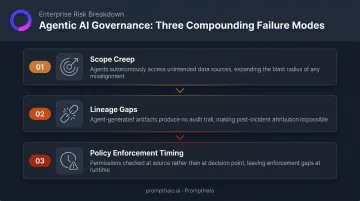
Each failure mode compounds the next:
- Scope creep: Agents autonomously discover and query data sources beyond their original design intent. Without real-time boundary enforcement, lateral data access goes undetected until after an incident.
- Lineage gaps: Agent outputs — summaries, scores, recommendations — contain derived sensitive information. If transformations don't emit lineage events, there's no audit trail for what was produced or why.
- Policy enforcement timing: Traditional controls check permissions at the data source, not at the moment an agent decides to act. A retrieval acceptable in development may violate policy in production.
The Compliance Stakes
These failure modes carry direct regulatory consequences. The EU AI Act (Regulation 2024/1689) spells out the requirements for high-risk AI systems:
- Article 12 requires automatic event logging over the system lifetime
- Article 14 requires effective human oversight during use
- Article 26(6) requires deployers to retain automatically generated logs for at least six months
FINRA Regulatory Notice 24-09 confirms that GenAI use by member firms remains subject to existing supervision and communications rules — including Rule 3110 and Rule 2210. These aren't future requirements. They apply now.
The Four Pillars of Governance for Agentic AI Workflows
Pillar 1 — Discoverability and Asset Inventory
Every data asset an agent can access must be treated as a governed asset — not hidden infrastructure. This includes databases, APIs, vector embeddings, document stores, and agent runtimes.
Without a complete, maintained inventory, governance teams cannot define risk boundaries or detect scope violations. The NIST AI RMF (GOVERN 1.6) specifically calls for AI system inventory as a baseline governance practice. Before any agent goes to production:
- Catalog every data source, API, and tool the agent can reach
- Tag sensitive fields and assign data owners
- Document approved access boundaries explicitly
Pillar 2 — End-to-End Lineage Tracing
Every agent action must emit a lineage event. This means reads, writes, retrievals, transformations, tool calls, and agent-to-agent handoffs — each linked to source, context, timestamp, and unique identifier.
Two types of lineage matter here:
| Lineage Type | What It Captures |
|---|---|
| Technical lineage | System-level data flow — which systems were accessed, in what order |
| Decision lineage | Reasoning context — what data informed the agent's output and why |
Decision lineage is what regulators increasingly require. PromptHalo's audit logs capture every decision along with its reason, the acting agent or passport identity, session and tenant context, and a timestamp. The log is append-only and tamper-evident — once written, it cannot be modified or removed — creating a replayable evidence trail for debugging, compliance export, and post-incident investigation.
Pillar 3 — Runtime Policy Enforcement
Policy must be enforced at the point of agent decision-making — not retrospectively through logging, and not only at the data source.
PromptHalo operates inline on every inference, tool call, and agent-to-agent handoff, issuing one of five enforcement responses per action:
- Allow — action proceeds
- Restrict — action proceeds with constraints applied
- Challenge — action is flagged for additional verification
- Deny — action is blocked before execution
- Monitor — action proceeds with enhanced logging
Each decision is made in under 100ms — context-aware enforcement applied before execution, not after the fact.
Pillar 4 — Human-in-the-Loop Oversight by Risk Tier
Not every agent action needs human review — but some require it. The goal is to design oversight gates that reduce friction where safe and preserve accountability where it matters.
A practical risk-tier framework:
- Low risk (reading non-sensitive reference data): proceed automatically with logging
- Medium risk (modifying pipeline configurations): automated checks, enhanced logging, alert on anomaly
- High risk (writing to financial ledgers, modifying access permissions, handling PII): require human approval before execution
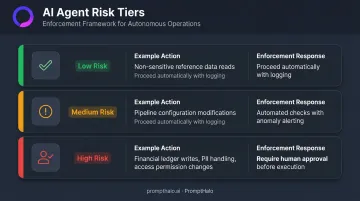
Where your organization lands on this framework depends on maturity. Most teams currently operate between assisted governance — humans decide, systems recommend — and semi-automated governance, where routine actions run automatically and exceptions escalate. Moving toward fully agentic governance, where AI executes and humans oversee only high-risk cases, requires two prerequisites: a mature enforcement layer and clear risk classification already defined.
Data Lineage as an Audit and Compliance Mechanism
For regulated industries, lineage is a compliance requirement, not an operational convenience. Auditors and regulators expect organizations to demonstrate what data was accessed, how it was transformed, and what policy applied at the time of an AI decision. Without decision-level lineage, that demonstration is impossible.
What Compliance-Grade Lineage Requires
- Tamper-evident logs that cannot be retroactively modified
- Decision-level granularity — not just pipeline-level summaries
- Framework mapping — traceability to OWASP LLM Top 10, NIST AI RMF, and the EU AI Act
- Replay capability — the ability to reconstruct any agent decision for investigation or regulatory reporting
PromptHalo's audit logs are designed to meet this bar: append-only, tamper-evident, and captured at the decision level with reasoning, agent identity, session context, and timestamp. The replayable evidence trail supports both internal incident response and external regulatory reporting.
Financial Services Exposure
The SEC's FY 2025 Examination Priorities confirm that examiners will review AI use by advisers, AI-related representations, policies and procedures, third-party AI tools, and protection of client records. The Bank of England's 2024 AI survey found 46% of UK financial firms reported only partial understanding of their AI technologies — because third-party models obscure the decision chain.
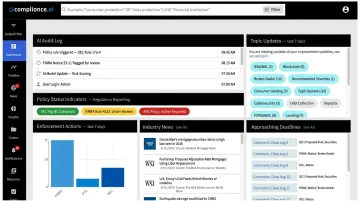
End-to-end lineage closes that gap directly. When an AI agent produces an unexpected output or potential data leakage event, security teams can trace the full chain of agent actions back to the root cause in minutes rather than days.
Enforcing Governance at Runtime: From Policy to Action
The Central Principle
Governance for agentic AI must be enforced inline, at the moment of inference, tool call, or handoff, not applied after the fact. Real-time enforcement means a policy check occurs before an action executes. The system can allow, restrict, challenge, or deny before any data is exposed or modified.
This is architecturally different from logging. Logging creates an after-the-fact record. Enforcement prevents the harm.
What Runtime Enforcement Requires
The enforcement layer must intercept agent decisions and evaluate them against current governance policy in low-latency conditions. This is not a use case for a data catalog or a DLP tool retrofitted for agent behavior. Those tools weren't built to inspect tool calls, evaluate reasoning context, or issue per-action enforcement decisions at inference speed.
PromptHalo deploys as this kind of enforcement layer, sitting inline on every inference, tool call, and agent-to-agent handoff without touching the underlying model or requiring code rewrites. It supports three integration paths:
- API gateway — intercepts traffic at the network boundary
- Agent mode — embeds directly into agentic orchestration layers
- Inline middleware — slots into existing application pipelines
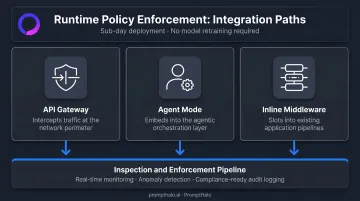
All three routes feed traffic through the same inspection and enforcement pipeline. Deployment takes under a day with no model retraining required.
Observability: Making Governance Adaptive
Enforcement alone isn't enough. Governance teams need continuous telemetry on agent behavior, access patterns, unusual query paths, and drift from intended scope.
PromptHalo's behavioral drift detection tracks how outputs change session over session, drawing on per-tenant session and memory state to surface drift before it compounds into a compliance incident. A red-team component continuously probes agent workflows for prompt injection, jailbreak, poisoning, and data-leakage vulnerabilities. Attack patterns discovered during probing feed directly into the runtime enforcement engine through a shared threat library — so new exploits become active controls in production immediately, not at the next release.
Practical Checklist: Making Your AI Workflows Governance-Ready
Step 1 — Inventory and Classify All Agent-Accessible Assets
Before deployment:
- Catalog every data source, API, vector store, and tool the agent can reach
- Tag sensitive fields and assign data owners
- Document approved access boundaries explicitly
- Treat anything not inventoried as out-of-bounds by default
Step 2 — Instrument Lineage from Day One
Lineage is a deployment prerequisite, not a post-deployment add-on:
- Ensure the orchestration layer emits lineage events for every read, write, and transformation
- Capture consistent identifiers, timestamps, and context per event
- Verify that agent-to-agent handoffs are logged with both source and destination identity
- Confirm logs are append-only and tamper-evident before go-live
Step 3 — Enforce Policy at Decision Time and Test It
Governance requires proof, not just documentation:
- Integrate runtime policy checks directly into agent execution
- Schedule adversarial red-team tests covering prompt injection, out-of-scope tool calls, and data exfiltration simulations
- Run lineage completeness checks and policy enforcement validation audits on a defined cadence
- Treat gaps in enforcement coverage the same way you'd treat an open firewall rule
Frequently Asked Questions
What is data lineage in the context of AI-driven workflows?
Data lineage for AI workflows tracks every action an agent takes with data — reads, retrievals, transformations, writes, and tool calls — creating an end-to-end record of how data moved and changed through the agent's execution. Unlike traditional lineage, it must also capture decision context: what information the agent used and why it acted as it did.
How does governance for agentic AI differ from traditional data governance?
Traditional governance applies static policies at the data source and relies on periodic human audits. Agentic AI governance enforces policies continuously during agent decision-making, tracing every autonomous action in real time — because agents can access, transform, and act on data faster than any manual review cycle.
What risks do AI agents introduce that traditional governance tools cannot address?
The primary risks are autonomous scope creep (agents accessing unintended data sources), lineage gaps from agent-generated artifacts like summaries and scores, data leakage through tool calls or RAG retrieval, and the inability of rule-based controls to evaluate context-aware policy violations at inference speed.
What should a compliance-grade audit trail for AI workflows include?
A compliance-grade audit trail must be tamper-evident, capture decisions at the inference and tool-call level with reasoning included, and map to frameworks such as NIST AI RMF or the EU AI Act. It must also support full replay of any agent decision for regulatory reporting and incident investigation.
How do you enforce data governance policies for AI agents at runtime?
Runtime enforcement requires an inline policy evaluation layer that intercepts each agent decision or tool call before execution and checks it against current access controls and sensitivity rules. It issues an allow, restrict, challenge, or deny response in near real time, without relying on the underlying model to self-enforce.
Which industries have the highest compliance exposure from ungoverned AI workflows?
Financial services, healthcare, and insurance face the highest exposure. Financial firms answer to SEC, FINRA, and OCC on AI audit records; healthcare organizations must meet HIPAA technical safeguard requirements; and insurers face NAIC governance expectations alongside EU AI Act high-risk classification for credit scoring and pricing models.