Introduction
Every major enterprise is deploying AI at scale. That part is working. What isn't working is the governance infrastructure underneath it.
The shift to agentic AI — autonomous agents, multi-agent pipelines, RAG-powered retrieval systems — has changed the governance surface in ways legacy tools weren't built for. Firewalls, DLP tools, compliance checklists, and policy documents were designed for a world where humans reviewed decisions before they executed. That world no longer exists.
The core failure pattern: most organizations treat AI governance as a documentation exercise. When models drift, agents execute unauthorized actions, or regulators arrive, documents don't hold. This is a leadership infrastructure problem.
Fragmented AI regulation will extend to 75% of the world's economies by 2030, driving over $1 billion in compliance spend, according to Gartner's February 2026 analysis. Enforcement is already active. Organizations that haven't built operational governance controls are already carrying enforcement exposure — not future risk.
Key Takeaways:
- AI governance is an operational infrastructure problem, not a documentation exercise
- Agentic AI breaks every traditional governance assumption about human review before execution
- Four pillars — Transparency, Accountability, Security, Ethics — must be operationalized, not aspirational
- EU AI Act fines and FTC enforcement apply regardless of US headquarters location
- Runtime enforcement at the point of agent action is the governance gap most organizations haven't closed
What AI Governance Systems Engineering Actually Is
AI governance defines the processes, standards, and guardrails ensuring AI systems are safe, ethical, and aligned with organizational values. "Systems engineering" transforms that definition from aspiration into operational architecture — with clear inputs, outputs, controls, and feedback loops at every stage.
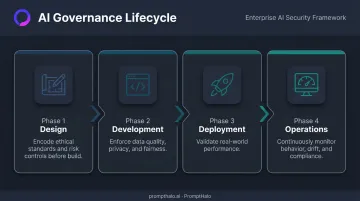
The Four Lifecycle Phases
Governance must be embedded across the full AI lifecycle, not applied retroactively:
| Phase | Governance Requirement |
|---|---|
| Design | Encode ethical standards and risk controls before a line of code is written |
| Development | Enforce data quality, privacy, and fairness standards throughout build |
| Deployment | Validate real-world performance, not just controlled test results |
| Operations | Continuously monitor behavior, drift, and compliance adherence |
Governance vs. Compliance Theater
There's a meaningful line between working infrastructure and filed policy artifacts. Organizations that mistake one for the other tend to find out at the worst possible moment — when audit findings, model failures, and regulatory action converge at once.
Governance systems engineering means controls operate continuously, not episodically. In practice, that looks like:
- Monitoring runs without manual prompting
- Alerts fire when thresholds are breached
- Accountability structures hold across teams and functions
Why the Governance Gap Is Existential in 2026
Financial Exposure from Regulatory Enforcement
The EU AI Act (Regulation 2024/1689) creates two fine tiers organizations must understand:
- Article 99(3): Up to €35 million or 7% of global annual turnover for violations of prohibited AI practices under Article 5
- Article 99(4): Up to €15 million or 3% of global annual turnover for high-risk system obligation violations
US organizations serving European customers or partners fall under extraterritorial scope regardless of where they're headquartered. Article 2(1)(c) covers providers in third countries where AI system outputs are used in the EU.
Operational Risk from Model Drift
According to IBM, model accuracy can degrade within days of deployment as production data diverges from training conditions. Organizations typically detect the deterioration weeks or months after it has already produced downstream damage.
IBM's research on agentic systems extends this further. An agent that works today might deliver degraded or incorrect responses tomorrow as models update, training data shifts, or business contexts change. Unlike static models, drift compounds across agentic pipelines — each handoff introduces another point of failure.
Key drift failure modes in production:
- Model updates from upstream providers change output behavior without notice
- Shifted production data distributions invalidate training-era assumptions
- Business context changes (new products, regulations, customer segments) that the model never learned
Agentic AI Compounds Every Gap
Gartner predicts over 40% of agentic AI projects will be canceled by end of 2027 — not because the technology failed, but due to escalating costs, unclear business value, or inadequate risk controls. The organizations that survive aren't the ones that moved fastest. They're the ones that governed what they built.
Regulatory Enforcement Is Not Waiting
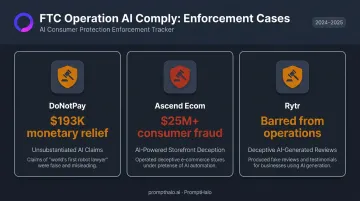
The FTC launched Operation AI Comply in September 2024, announcing five simultaneous enforcement actions targeting AI-related deceptive practices. Cases included:
- DoNotPay — $193,000 monetary relief for unsubstantiated "robot lawyer" AI claims
- Ascend Ecom — consumers allegedly defrauded of more than $25 million via AI-powered storefront claims
- Rytr — barred from selling services for generating deceptive consumer reviews
A joint statement from the FTC, CFPB, DOJ Civil Rights Division, and EEOC put organizations on explicit notice: existing consumer protection, anti-discrimination, and financial regulation already apply fully to AI-driven systems. A new federal AI law is not required for material enforcement exposure.
Reputational Risk
Enforcement actions become reputational events fast. When an AI system produces a discriminatory outcome or exposes customer data, the press cycle closes in days — but the regulatory relationship, litigation posture, and customer trust deficit persist indefinitely. For executives in financial services and other regulated industries, that combination triggers board scrutiny and puts D&O coverage conversations on the table. Governance failures aren't recoverable through PR.
The Four Pillars of Effective AI Governance Systems Engineering
Transparency and Explainability
When an AI model drives a consequential business outcome — a loan denial, credit scoring decision, hiring filter — leadership must be able to articulate the basis for that outcome. Transparency documentation isn't regulatory posturing. It's what makes internal accountability possible and what separates a managed AI asset from a liability the board cannot explain.
PromptHalo's decision-level audit logs capture every inference and agent action with the decision itself, the rationale, the acting agent identity, session context, and a timestamp. The log is append-only and tamper-evident — a replayable evidence trail structured for regulatory review.
Accountability and Named Ownership
Every AI system in production requires a named human owner whose performance review includes what that model does. Diffuse ownership is a design choice — and it consistently produces the same result: no one acts until something breaks publicly.
Governance accountability structures must define:
- Who is responsible for model performance
- Who approves deployment
- Who monitors ongoing operations
- Who holds decision authority when a system produces an unexpected outcome
Build the ownership structure before deployment. Retrofitting accountability after an incident means your first attempt at clarity happens under regulatory scrutiny.
Security Across the Full AI Lifecycle
AI models are not passive assets. Adversarial inputs can manipulate model outputs, data poisoning can corrupt training pipelines, and extraction attacks can surface sensitive personal information from models that were never meant to expose it.
The numbers justify the investment: IBM's 2024 Cost of a Data Breach Report found the global average breach cost reached $4.88 million — a 10% increase and the largest yearly jump since the pandemic. Organizations with security AI embedded extensively into prevention workflows averaged $2.2 million lower breach costs and detected and contained incidents 98 days faster than those without it.
Governance frameworks must integrate security controls from design through deployment through operations. By the time you're applying controls in response to an incident, you're managing damage — not risk.
Ethics Operationalized, Not Aspirational
Ethics policies that remain aspirational documents do not constrain model behavior. They become exhibits in regulatory or litigation proceedings.
Ethical standards must be embedded into:
- Model development reviews
- Data sourcing decisions
- Deployment gates
Organizations must translate their values into concrete policies governing data use, model fairness, and acceptable AI applications — then enforce those policies at every development checkpoint. The four pillars above aren't independent workstreams. They reinforce each other — and gaps in any one of them weaken the rest.
The Agentic AI Governance Challenge: Where Traditional Frameworks Fall Short
Traditional governance assumes humans review decisions before they execute. Agentic AI breaks that assumption completely.
Autonomous tool calls, multi-agent handoffs, and RAG retrieval pipelines execute consequential actions — financial transactions, data writes, API calls — with minimal human checkpoints. One ungoverned agent decision can trigger cascading failures across connected systems.
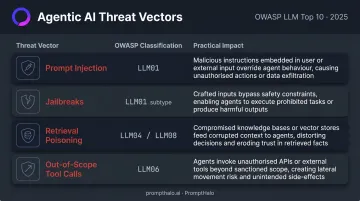
The Specific Threat Vectors
These are governance breakdowns, not isolated technical incidents:
| Threat Vector | OWASP LLM Top 10 2025 | What It Means in Practice |
|---|---|---|
| Prompt injection | LLM01:2025 | Adversarial prompts alter agent behavior mid-task |
| Jailbreaks | LLM01:2025 (subtype) | System constraints bypassed to execute prohibited actions |
| Retrieval poisoning | LLM04 + LLM08:2025 | Corrupted data in retrieval stores influences agent outputs |
| Out-of-scope tool calls | LLM06:2025 Excessive Agency | Agent invokes APIs beyond its defined authority |
Why Runtime Enforcement Is Now Required
Pre-deployment testing catches what you know to test for. Agentic systems require real-time trust decisions at every inference, tool call, and agent-to-agent handoff — before the action executes, not after harm has occurred.
The 2026 executive mandate is direct: enforce policy at the point of action, across multi-step and multi-agent workflows, before consequences become irreversible.
Purpose-Built Runtime Enforcement
That requirement points to a specific architectural need — a layer that sits inline on every inference, tool call, and agent-to-agent handoff. PromptHalo fills that role, making per-action decisions (allow, restrict, challenge, deny, or monitor) in under 100ms.
Key capabilities:
- Continuously attacks agents, RAG layers, and tool chains the way real adversaries would — surfacing exploitable paths before deployment (adversarial red-teaming)
- Agent security passports carry signed credentials with each request, embedding policy, budget, and authority parameters at the action level
- Permissions diminish over time through authority decay, forcing re-authorization when defined envelopes are exceeded
- Behavioral drift detection tracks output shifts session to session, surfacing compliance problems before they compound
- Append-only, decision-level audit logs mapped to NIST AI RMF, OWASP LLM Top 10, and the EU AI Act — tamper-evident by design
The platform deploys in under a day — no model retraining, no code rewrite, compatible with any AI application from any vendor.
Building the Core Framework: Components Every Executive Must Commission
Risk-Based AI Classification
Governance capacity is finite. Organizations applying uniform oversight across all AI systems exhaust it on low-stakes tools while high-risk models run without adequate controls.
A risk classification system categorizes AI applications by potential impact and assigns proportional governance resources. A customer-facing model influencing credit decisions requires fundamentally different controls than an internal document summarization tool. Classification drives everything downstream:
- Monitoring intensity and audit frequency
- Deployment gates and approval thresholds
- Incident response priority and escalation speed
With classification in place, the next challenge is maintaining compliance as deployed models evolve.
Automated Compliance Monitoring and Drift Detection
Manual compliance processes do not scale with AI deployment velocity. Essential infrastructure includes:
- Automated bias and performance drift detection
- Behavioral anomaly monitoring across sessions
- Dashboards visualizing model performance against defined compliance thresholds
- Alerting that fires before problems escalate into incidents requiring legal, communications, and executive intervention
Longitudinal monitoring catches gradual degradation invisible in single-response reviews. PromptHalo's behavioral drift detection tracks how AI output shifts session over session, surfacing cumulative drift before it compounds into a compliance or reputational event.
Detecting drift quickly matters most when an incident is already in motion.
Incident Response Protocols for AI Failures
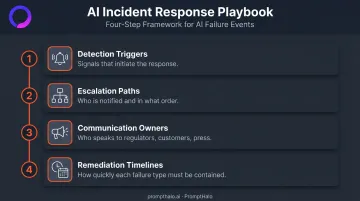
Every governance framework requires a predefined response pathway for AI incidents. Define before an incident occurs:
- Detection triggers — what signals initiate the response
- Escalation paths — who is notified and in what order
- Communication owners — who speaks to regulators, customers, press
- Remediation timelines — how quickly each failure type must be contained
IBM's breach research makes the stakes concrete: internal detection shortened breach lifecycle by 61 days and saved nearly $1 million compared with breaches disclosed by an attacker first. A response protocol built before an incident gives teams the decisional clarity to act in the first hours — when containment is still possible.
The 2026 Regulatory Landscape US Executives Must Navigate
The EU AI Act
The EU AI Act is the world's first comprehensive AI regulatory framework. Its risk-based classification assigns proportional obligations based on potential harm.
High-risk AI systems — covering financial services creditworthiness, employment decisions, critical infrastructure, and healthcare triage — face mandatory obligations under Articles 9 through 15 and 72:
- Risk management systems
- Data and data governance requirements
- Technical documentation and record-keeping
- Transparency and human oversight
- Post-market monitoring
Fine exposure: up to €15 million or 3% of global turnover for high-risk obligation violations; up to €35 million or 7% for prohibited practice violations. US organizations with EU customers or partners are directly subject under Articles 2(1)(a) and 2(1)(c).
NIST AI RMF and Federal Reserve SR-26-2
The NIST AI Risk Management Framework (Govern, Map, Measure, Manage) is the foundational domestic standard. Voluntary in most sectors, but now the benchmark against which enterprise AI governance programs are assessed by auditors, enterprise customers, and agency partners.
The Federal Reserve's revised SR-26-2 guidance (April 2026), superseding SR-11-7, shifts financial services model risk management toward an explicitly risk-based and proportional methodology aligned with NIST principles. Most relevant to banking organizations over $30 billion in total assets.
The Absence of a Single US Federal Law Amplifies Complexity
No comprehensive federal AI law is currently in force. The administration signaled intent to pass one in 2026; as of March 2026, Reuters reported active White House effort. H.R.5388, the American Artificial Intelligence Leadership and Uniformity Act, remained at "Introduced" status as of late 2025.
That gap doesn't simplify compliance — it fractures it across jurisdictions. Organizations must simultaneously navigate:
- Sector-specific requirements (banking, healthcare, consumer finance)
- State-level privacy laws
- International frameworks including the EU AI Act
- Active enforcement postures of the FTC, CFPB, DOJ, and EEOC
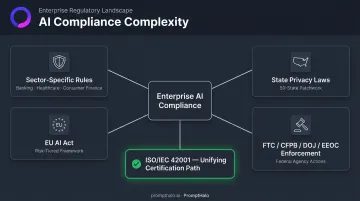
ISO/IEC 42001 — the international AI Management System standard — provides a certification path that satisfies this multi-jurisdictional complexity. It gives regulators and enterprise customers a documented, auditable record of governance maturity — one standard that maps credibly across domestic and international requirements.
Frequently Asked Questions
What is AI governance systems engineering?
AI governance systems engineering translates governance principles — ethics, accountability, transparency, security — into working operational infrastructure: controls, monitoring systems, and feedback loops embedded across the full AI lifecycle from design through ongoing operations.
What do AI systems engineers do?
AI systems engineers design, implement, and maintain the technical infrastructure that keeps AI systems operating safely and within defined parameters. Their scope covers data pipelines, model validation, monitoring architecture, security controls, and runtime frameworks that align AI behavior with governance policies.
What are the four pillars of AI governance?
The four pillars are Transparency, Accountability, Security, and Ethics. All four must be operationalized through concrete controls embedded into the AI lifecycle. Treating them as aspirational values rather than enforced controls is what causes governance frameworks to fail under actual regulatory scrutiny.
How does the EU AI Act affect US organizations?
US organizations with customers, partners, or operations in EU member states are directly subject to EU AI Act obligations under its extraterritorial provisions. High-risk AI systems face mandatory risk assessments and fines reaching €15 million (3% of turnover) for obligation violations and €35 million (7%) for prohibited practices.
What is the difference between AI governance and AI security?
AI governance is the broader framework of policies, controls, and accountability structures ensuring AI systems are ethical, compliant, and aligned with organizational values. AI security is a critical pillar within that framework, focused specifically on protecting AI systems from adversarial manipulation, data poisoning, and unauthorized access.
How do you govern agentic AI systems at runtime?
Governing agentic AI at runtime requires inline enforcement at every inference, tool call, and agent-to-agent handoff before consequential actions execute. This means moving beyond pre-deployment gates to real-time detection of prompt injection, jailbreaks, retrieval poisoning, and out-of-scope tool calls. Decision-level audit logs must accompany this detection layer to satisfy regulatory reporting requirements.