Introduction
A prompt injection attack can compromise an enterprise AI agent in milliseconds — long before a SIEM alert fires or an analyst sees the log. Traditional security tools weren't built for this. Alongside conventional network intrusions and endpoint compromises, security teams now face prompt injection attacks, jailbreaks, RAG retrieval poisoning, and unauthorized agent tool calls — threats that execute inside LLM inference pipelines with no perimeter to stop them.
The detection window has collapsed. According to CrowdStrike's 2026 Global Threat Report, average eCrime breakout time has dropped to 29 minutes, with a fastest recorded breakout of just 27 seconds. Batch analysis and signature updates cannot keep pace.
This guide breaks down the best AI platforms for real-time threat detection in 2025–2026. You'll find evaluation criteria, side-by-side comparisons, and clear guidance on choosing the right fit — whether your primary threat surface is traditional IT infrastructure, AI applications, or both.
TL;DR
- AI threat detection has evolved from rule-based SIEM alerts to ML-driven behavioral analysis and, most recently, inline runtime enforcement for agentic AI
- Traditional platforms (Cortex XSIAM, Microsoft Sentinel, CrowdStrike Falcon, SentinelOne Singularity) excel at network, endpoint, and cloud threat detection
- Agentic AI runtime security is an emerging category built to catch threats traditional tools miss: prompt injection, jailbreaks, RAG poisoning, and unauthorized tool calls
- Evaluate platforms on detection catch rate, false positive rate, enforcement latency, audit trail quality, and integration flexibility
- The right platform depends on your primary threat surface — traditional IT infrastructure, AI applications, or a mix of both
What Is Real-Time AI Threat Detection?
Real-time AI threat detection uses machine learning, behavioral analytics, and automated enforcement to identify and block malicious activity the moment it occurs. It operates across network traffic, endpoint events, cloud workloads, and AI agent actions — not through after-the-fact log analysis, but inline, as activity unfolds.
How It Differs from Legacy Approaches
Traditional signature-based SIEM tools detect only known threat patterns and require manual rule updates. ML-based systems establish behavioral baselines instead, flagging deviations — catching zero-days and novel attack techniques that signatures miss entirely.
Speed is where this gap becomes financial. IBM's 2025 Cost of a Data Breach Report found that organizations using extensive security AI and automation incurred $1.9 million lower breach costs than those without it. When threats execute in under a second, detection and response must follow just as fast.
The Emerging AI-Native Gap
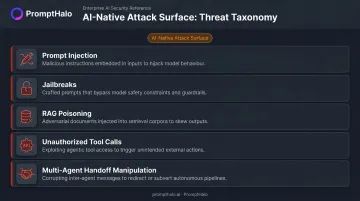
The rise of agentic AI has introduced a threat surface that firewalls, DLP tools, and endpoint detection were never built to see:
- Prompt injection: adversarial inputs that hijack an LLM's behavior mid-inference
- Jailbreaks: instruction overrides that push a model outside its intended guardrails
- RAG poisoning: corrupted retrieval pipelines that feed malicious content into LLM context
- Unauthorized agent tool calls: agents invoking APIs or tools beyond their intended scope
- Multi-agent handoff manipulation: attacks injected at the handoff layer between autonomous agents
According to the Cloud Security Alliance, 53% of organizations have already experienced AI agents exceeding their intended permissions — a threat category that SIEM platforms simply cannot observe.
Best AI Platforms for Real-Time Threat Detection
Platforms were evaluated on detection accuracy, enforcement latency, threat coverage breadth, integration flexibility, and compliance readiness.
PromptHalo
PromptHalo is purpose-built runtime security for agentic AI applications. Its security layer sits inline on every inference call, tool invocation, and agent-to-agent handoff, making allow, restrict, challenge, deny, or monitor decisions in under 100ms without touching the underlying model or requiring code rewrites.
What separates PromptHalo from every other platform on this list is its coverage of the AI-native attack surface that traditional security tools cannot inspect. Its red-teaming solution continuously probes an organization's agents, RAG layers, and tool chains across multi-step, multi-agent workflows, surfacing exploitable paths before they reach production.
Those discoveries feed directly into a shared Threat Library, which the runtime enforcement layer uses for detection, combining Threat Library signatures with classifier-based risk scoring rather than brittle static rules. The stated ML-based catch rate is above 95% at under 5% false positives.
For regulated industries, every enforcement decision is captured in append-only, tamper-evident audit logs recording the decision, its reason, the acting agent or passport identity, session and tenant context, and a timestamp structured for compliance export and post-incident investigation.
| Attribute | Details |
|---|---|
| Primary Detection Focus | Agentic AI attack surface: prompt injection, jailbreaks, data leakage, RAG poisoning, unauthorized tool and API calls, multi-agent handoff manipulation |
| Key AI Capabilities | Inline ML enforcement at inference time; closed-loop red-team-to-runtime threat library; evidence-grade audit logs mapped to OWASP LLM Top 10, NIST AI RMF, and EU AI Act |
| Best For | Enterprises shipping agentic AI features, fintech and regulated industries requiring compliance-grade audit trails, security teams protecting LLM-powered products |
Palo Alto Networks Cortex XSIAM
Cortex XSIAM is Palo Alto's AI-driven security operations platform, converging SIEM, SOAR, XDR, and threat intelligence into a single data layer. Its Precision AI engine (combining ML, deep learning, and generative AI) stitches disparate alerts into correlated incidents and reduces analyst workload across network, endpoint, and cloud environments.
It's the strongest fit for organizations already standardized on the Palo Alto stack, where cross-product correlation and automated response playbooks deliver their deepest value. A Forrester Total Economic Impact study published in 2025 evaluated its operational return; specific ROI figures are available in the primary report.
| Attribute | Details |
|---|---|
| Primary Detection Focus | Network, endpoint, cloud, and identity threat detection across the full enterprise security stack |
| Key AI Capabilities | ML-driven alert stitching into incidents; behavioral anomaly detection; Copilot-assisted natural language investigation queries |
| Best For | Large enterprises and MSSPs standardized on Palo Alto products seeking a unified AI SOC with automated response |
Microsoft Sentinel
Microsoft Sentinel is a cloud-native SIEM and SOAR platform built on Azure. Its UEBA engine uses ML to build dynamic behavioral profiles for users, hosts, IP addresses, and applications and assigns each entity an investigation priority score from 0 to 10, helping analysts focus on genuine threats rather than noise.
Copilot for Security integration enables natural language investigation queries and GPT-powered incident summaries, lowering the skill barrier for junior analysts. Microsoft named Sentinel a Leader in both the 2025 Gartner Magic Quadrant for SIEM and the Forrester Wave: Security Analytics Platforms, 2025.
| Attribute | Details |
|---|---|
| Primary Detection Focus | Cloud, identity, email, and SaaS threat detection with broad Microsoft ecosystem coverage |
| Key AI Capabilities | GPT-powered incident summarization via Copilot for Security; UEBA entity scoring; ML-based anomaly detection across Azure and M365 telemetry |
| Best For | Azure-first enterprises needing deep Microsoft 365 and identity integration with scalable cloud SIEM capabilities |
CrowdStrike Falcon Next-Gen SIEM
Falcon Next-Gen SIEM extends CrowdStrike's endpoint-first XDR platform into a unified security operations environment. Its Threat Graph processes more than 1 trillion events per day across 2 trillion vertices, correlating endpoint, identity, and network events in real time to surface lateral movement, ransomware kill chains, and malware-free attacks.
Charlotte AI adds natural language SOC interaction, allowing analysts to query investigations conversationally. The platform's endpoint-first DNA makes it particularly effective for teams whose primary threat exposure runs through workstation and server compromise, with EDR-to-SIEM integration tighter than most competitors. In 2026, it extended support to third-party EDR tools including Microsoft Defender.
| Attribute | Details |
|---|---|
| Primary Detection Focus | Endpoint, identity, and lateral movement detection with cross-domain threat correlation |
| Key AI Capabilities | Threat Graph real-time correlation; Charlotte AI natural language queries; behavioral indicators of attack (IOAs) for fileless and zero-day threat detection |
| Best For | Enterprises prioritizing endpoint-first detection and response with tight EDR-to-SIEM integration |
SentinelOne Singularity
SentinelOne's Singularity platform combines endpoint, cloud, and identity protection under a unified AI SIEM, using deep learning behavioral models rather than signatures for detection and prevention. Its autonomous response capability allows the platform to detect, contain, and remediate threats without human intervention.
Purple AI (SentinelOne's generative AI analyst) supports natural language threat hunting, query generation, and investigation workflows. In the 2024 MITRE ATT&CK Evaluations, SentinelOne reported 100% detection with 88% fewer alerts than the median across evaluated vendors (vendor-reported interpretation of MITRE results). An IDC study cited 63% faster threat identification and 338% three-year ROI for Purple AI users.
| Attribute | Details |
|---|---|
| Primary Detection Focus | Endpoint, cloud workload, and identity threat detection with autonomous prevention and response |
| Key AI Capabilities | Autonomous threat prevention via deep learning behavioral models; Purple AI generative AI hunting; Singularity Data Lake for cross-domain correlation |
| Best For | Organizations seeking autonomous endpoint and cloud protection with generative AI-assisted analyst workflows |
How to Evaluate AI Threat Detection Platforms
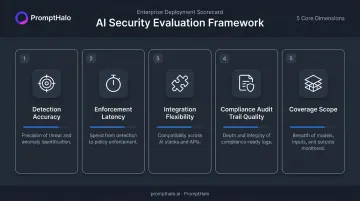
The Five-Dimension Framework
Before selecting any platform, assess it across these dimensions:
- Detection accuracy — ML catch rate vs. false positive rate under realistic enterprise conditions, not vendor-controlled demos
- Enforcement latency — time from threat signal to block or alert decision; adversary speed demands minute-to-second response
- Integration flexibility — ability to operate across heterogeneous environments without vendor lock-in or model retraining
- Compliance audit trail quality — decision-level logging mapped to recognized frameworks (OWASP LLM Top 10, NIST AI RMF, EU AI Act)
- Coverage scope — breadth of threat surface addressed, from traditional network/endpoint to agentic AI vectors
The Most Common Evaluation Mistake
Security teams frequently select platforms based on brand recognition or feature lists alone — without testing detection fidelity in their own environment. MITRE's ATT&CK Evaluations run controlled adversary emulations specifically because transparent, structured testing produces different results than vendor-scripted demonstrations. Demand proof-of-value testing with your own telemetry before committing.
Match Platform Type to Threat Surface
Choosing the wrong platform category leaves entire attack surfaces unmonitored — regardless of how many features the product offers:
- Traditional SIEM/XDR platforms (Cortex XSIAM, Sentinel, Falcon, Singularity) excel at network, endpoint, and cloud correlation — but cannot inspect LLM inference calls or agent tool invocations
- Agentic AI runtime security (PromptHalo) addresses the AI-native attack surface — but is not a replacement for network detection
- Organizations with both traditional IT workloads and AI applications likely need both categories operating in parallel
Most enterprises today fall into that third group. The question isn't which platform wins — it's which combination covers your full threat surface.
Conclusion
AI threat detection has split into two distinct problem spaces. Securing traditional IT infrastructure against cyber threats requires behavioral analytics across network, endpoint, and cloud telemetry. Securing AI applications against AI-native attacks requires inline enforcement at the inference and agent layer — a surface that SIEM, EDR, and firewall tools were never designed to observe.
Match your platform choice to where your highest-risk attack surface actually lives — then verify it holds up before you commit:
- Demand proof-of-value testing in your own environment, not a vendor sandbox
- Verify detection accuracy against independent benchmarks, not vendor-supplied claims
- Confirm that compliance audit trail outputs satisfy your specific regulatory reporting requirements
For teams deploying agentic AI, LLM-powered applications, or autonomous workflows, PromptHalo enforces trust at the inference and agent layer in real time. Red-team your AI the way attackers would, then enforce trust on every agent decision at runtime — deploying in under a day with no model retraining required.
Frequently Asked Questions
Which AI platform is best for real-time threat detection?
The right platform depends on your threat surface. Enterprises protecting traditional IT infrastructure should evaluate Cortex XSIAM, Microsoft Sentinel, CrowdStrike Falcon, or SentinelOne Singularity. Teams running AI agents or LLM-powered applications need an agentic AI runtime security platform like PromptHalo that detects threats at the inference layer.
Which AI techniques help detect cyber intrusions in real time?
Core techniques include supervised ML for classifying known attack patterns, unsupervised anomaly detection for behavioral deviations, deep learning for network and endpoint analysis, and NLP for phishing detection. Agentic AI environments also require inline inference-time enforcement — something traditional techniques cannot provide.
What is the difference between traditional SIEM and AI-powered threat detection?
Traditional SIEMs rely on static, manually maintained rules that only catch known threat signatures, requiring human investigation of every alert. AI-powered platforms continuously learn normal behavior, detect novel threats through anomaly detection, and auto-triage alerts, cutting mean time to detect and reducing analyst workload.
How does real-time AI threat detection reduce false positives?
ML models reduce false positives by learning environment-specific baselines that distinguish legitimate after-hours admin activity from genuine anomalies. Correlating multiple weak signals into high-confidence incidents, rather than alerting on individual events in isolation, further cuts noise. Closed-loop feedback from analyst decisions refines accuracy over time.
What should enterprises look for when evaluating AI threat detection platforms?
Prioritize these evaluation criteria:
- Detection catch rate and false positive rate under real-world conditions
- Enforcement latency for time-sensitive threats
- Integration breadth without vendor lock-in
- Compliance audit trail quality mapped to relevant frameworks
Also verify whether the platform covers your actual threat surface, including AI-native vectors if agentic AI or LLM applications are in scope.
Can AI detect threats targeting AI systems themselves, like prompt injection or jailbreaks?
Traditional SIEM, EDR, and firewall tools operate at the network and endpoint layer. They cannot inspect LLM inference calls or agent tool invocations, leaving them blind to prompt injection, jailbreaks, and RAG poisoning. Purpose-built agentic AI security platforms apply ML enforcement inline at the inference and tool-call layer, specifically designed to detect and block these AI-native attack vectors before they execute.