That silence is the gap this article addresses.
The AI Risk Maturity Model is the tool that exposes the distance between policy on paper and enforcement in production. What follows is a practical framework for security and compliance teams to benchmark where they genuinely stand across five levels — and identify what needs to happen next, especially as agentic AI raises the stakes considerably.
Key Takeaways
- Most enterprises cluster at Level 2 or 3 — policies and pilots exist, but technical enforcement doesn't
- Governance committees are necessary but not sufficient; mature programs enforce policy at the point of execution
- Most maturity models were never built to assess agentic AI — autonomous tool calls, RAG retrieval, and multi-agent handoffs require a different lens entirely
- Benchmarking requires honest self-scoring across four dimensions — governance, security controls, runtime enforcement, and audit evidence — not a checkbox exercise
- For regulated industries, decision-level audit trails are a maturity requirement, not an optional add-on
What Is an AI Risk Maturity Model (and Why Traditional Frameworks Fall Short)
An AI Risk Maturity Model is a structured progression — typically five stages — that describes how systematically an organization identifies, measures, and mitigates AI-specific risks across the full AI lifecycle.
It differs from general IT or cybersecurity maturity models because AI systems are probabilistic, non-deterministic, and vulnerable to adversarial attacks that legacy frameworks were never built to address.
The Limits of Existing Frameworks
NIST AI RMF, ISO/IEC 23894, and the EU AI Act are all valuable — each shares a common limitation, though: they're principle-based and lifecycle-oriented. They define what to govern, not how to enforce it technically in real time.
The data reflects this gap. A 2022 MIT Sloan/BCG study found that 84% of respondents believed responsible AI should be a top management priority — yet only 25% had a fully mature responsible AI program, and 79% said their implementations were limited in scale and scope.
The gap isn't awareness — it's operationalization. Organizations know what responsible AI should look like; few have built the controls to actually enforce it.
Where a Maturity Model Adds Value
Unlike a compliance checklist, a maturity model reveals not just whether controls exist, but how robust, repeatable, and cross-functional they are. It gives organizations a roadmap, not just a grade — answering how mature each control is, not simply whether it's present.
The EU AI Act pushes further than most frameworks — Articles 11, 12, and 26 require technical documentation, automatic event logging, and human oversight for high-risk AI systems. Even so, these provisions leave the technical design choices to implementers. No regulation prescribes a runtime enforcement architecture.
That's precisely where a maturity model fills the gap:
- It surfaces implementation depth — not just policy existence
- It maps controls to enforcement — connecting governance commitments to technical execution
- It creates accountability across functions — legal, security, and engineering operate from a shared benchmark
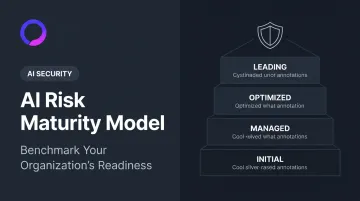
The Five Levels of AI Risk Maturity
McKinsey's 2025 Global AI Trust Maturity Survey found an average responsible AI maturity score of 2.0 on a 0-to-4 scale, rising to 2.3 in 2026 — with only about 30% of organizations reaching Level 3 or higher in strategy, governance, and agentic AI controls. Each level below builds directly on the prior one.
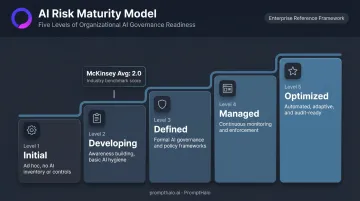
The jump from Level 3 to Level 4 is where technical enforcement — not just governance — becomes the differentiator.
Level 1: Initial (Unstructured)
AI use is ad hoc and siloed. Tools get adopted without formal inventory, no executive oversight, no AI-specific security policies. Ethical considerations are reactive at best.
The core problem: Risk at this level is invisible because it's unmeasured. Bias, data leakage, and adversarial manipulation can occur with no mechanism to detect or attribute them.
Level 2: Developing (Awareness Without Action)
Organizations begin cataloging AI systems and conducting preliminary risk assessments on third-party tools. Teams apply basic cybersecurity hygiene to AI pilots.
What's still missing: AI-native vulnerabilities — prompt injection, model drift, retrieval poisoning — are not yet systematically managed. AI pilots rarely scale to production because risk processes can't keep pace with deployment velocity.
Level 3: Defined (Formal Governance)
A formal AI governance structure takes shape: ethics review boards, dedicated AI risk policies, cross-functional collaboration between IT, compliance, and legal. Organizations adopt explainability standards and human-in-the-loop review processes.
The critical limitation: governance is process-heavy but technical enforcement is largely absent. Policies exist — they just aren't embedded in the systems they govern.
Level 4: Managed (Proactive, Monitored, Enforced)
Organizations implement continuous monitoring, AI-specific incident response playbooks, and pre-deployment red-teaming. Real-time dashboards track model performance and detect drift.
The fundamental shift here: risk management moves from reacting to AI incidents to preventing them. Security becomes embedded in the AI deployment pipeline, not bolted on after the fact.
Level 5: Optimized (Automated, Adaptive, Audit-Ready)
Full integration of AI risk into enterprise risk management, with:
- Enforces controls automatically at the inference layer, before actions execute
- Feeds discovered attacks back into detection models, compounding protection over time
- Generates evidence-grade audit trails mapped to decisions, not just events
- Satisfies regulatory reporting on demand, without manual assembly
This is the standard that regulated industries — fintech, payments, healthcare — should be targeting. Stanford HAI's 2025 AI Index reported 233 AI-related incidents in 2024, a 56.4% increase from 2023, with nearly 60% of organizations that experienced incidents rating their preparedness as only satisfactory or negative. Organizations at Level 5 don't scramble after incidents — they have the audit trails, detection pipelines, and enforcement mechanisms already in place when regulators come asking.
The Missing Dimension: Agentic AI and Runtime Security Maturity
Traditional AI risk frameworks were built for a different world: batch inference, supervised ML, a human reviewing outputs before anything consequential happens. Agentic AI breaks every one of those assumptions.
Autonomous agents make decisions, call external tools and APIs, retrieve from dynamic knowledge bases, and hand off tasks between agents — all without human checkpoints. Gartner predicts that 40% of enterprise applications will include task-specific AI agents by the end of 2026, up from less than 5% in 2025. The attack surface is expanding faster than most security programs can track.
The Agentic Threat Vectors Most Organizations Miss
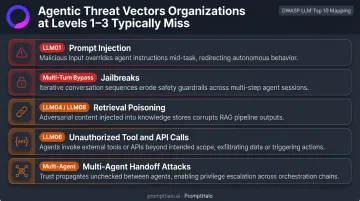
Organizations at Levels 1–3 are typically blind to these categories — all recognized in the OWASP LLM Top 10:
- Prompt injection (LLM01) — malicious instructions embedded in user input or retrieved documents that alter agent behavior
- Jailbreaks — bypass attempts against safety guardrails, including multi-turn techniques like Microsoft's documented Skeleton Key attack
- Retrieval poisoning (LLM04/LLM08) — corrupting RAG data sources so agents act on compromised information
- Unauthorized tool and API calls (LLM06) — agents exceeding their intended scope of authority
- Multi-agent handoff attacks — a compromised agent passing malicious instructions downstream to other agents
The Governance-Enforcement Gap
An organization can be at Level 3 on governance — documented policies, AI inventory, ethics committee — while sitting at Level 1 on agentic runtime security. No technical control actually intercepts and evaluates agent decisions before they execute. This is the most dangerous maturity mismatch in enterprise AI today.
What Mature Agentic Security Actually Looks Like
Closing this gap requires controls built specifically for the agentic attack surface — not repurposed firewalls or DLP tools, but purpose-built enforcement that evaluates agent behavior at the decision level. In practice, that means:
- Per-action risk scoring — every inference, tool call, and agent-to-agent handoff is evaluated individually
- Authority decay — agent permissions diminish over time and across steps, requiring re-authorization when thresholds are exceeded
- Inline enforcement — allow, restrict, challenge, deny, or monitor decisions made in under 100ms before execution
- Security passports — signed credentials carrying trust context across agent-to-agent handoffs
- Closed-loop threat intelligence — attack patterns discovered through red teaming feed directly into runtime detection, compounding protection over time
These capabilities also carry direct regulatory weight. Financial services regulators increasingly require organizations to produce decision-level evidence of what their AI systems did, why, and under what constraints — not just proof that policies exist. Organizations that can demonstrate this at the inference level will be audit-ready by design, not by scramble.
How to Benchmark Your Organization's AI Risk Readiness
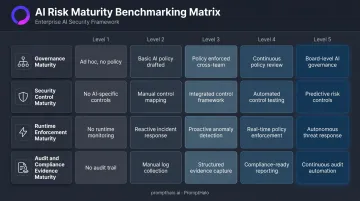
Benchmarking starts with an honest assessment across four dimensions. Most organizations score unevenly across them, and that gap is precisely what the exercise is built to reveal.
The Four Dimensions
1. Governance Maturity
| Level | What It Looks Like |
|---|---|
| 1 | No AI inventory; no defined roles |
| 2 | Partial inventory; informal oversight |
| 3 | Formal ethics/risk review; executive sponsorship |
| 4 | Governance integrated into deployment pipelines |
| 5 | Continuous governance with measurable accountability |
2. Security Control Maturity
| Level | What It Looks Like |
|---|---|
| 1 | No AI-specific security controls |
| 2 | Standard cybersecurity applied to AI; no AI-native controls |
| 3 | AI-specific policies drafted; limited technical implementation |
| 4 | Controls for prompt injection, adversarial inputs, model inversion |
| 5 | Continuous, adaptive security with ML-based detection |
3. Runtime Enforcement Maturity
| Level | What It Looks Like |
|---|---|
| 1 | No capability to intercept AI decisions |
| 2 | Post-hoc monitoring only |
| 3 | Some output filtering; no inline enforcement |
| 4 | Inline enforcement before execution; incident response playbooks |
| 5 | Automated, per-action enforcement with authority decay and risk scoring |
4. Audit and Compliance Evidence Maturity
| Level | What It Looks Like |
|---|---|
| 1 | No AI-specific logging |
| 2 | System logs exist; not decision-level |
| 3 | Structured output logs; not mapped to frameworks |
| 4 | Decision-level logs; partially mapped to NIST/OWASP |
| 5 | Tamper-evident, replayable logs mapped to OWASP LLM Top 10, NIST AI RMF, and EU AI Act |
The Role of Adversarial Testing
Self-assessment across these dimensions gives you a baseline. It cannot tell you how your AI systems hold up under deliberate attack. Red-teaming exercises that simulate prompt injection, jailbreaks, and out-of-scope tool calls expose attack paths that governance reviews and code scanners will never find.
This is the logic behind PromptHalo's "test first, then enforce" model. Red-team findings feed into a shared Threat Library that immediately updates runtime enforcement — closing gaps at the policy layer without waiting on a new release cycle. That closed-loop structure is what Level 4 and Level 5 organizations actually operate.
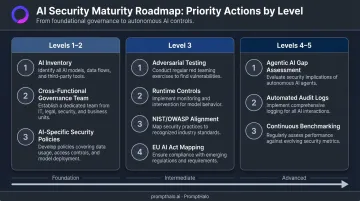
Priority Actions to Advance Your AI Risk Maturity
For Organizations at Levels 1–2
- Build your AI inventory first. You cannot manage what you haven't mapped. Catalog every AI system, including third-party tools.
- Stand up a cross-functional governance team — IT, security, compliance, legal — before procuring additional AI tools.
- Draft AI-specific security policies that address prompt injection, data leakage, and third-party model risk. Generic cybersecurity policies don't cover the AI-native threat surface.
For Organizations at Level 3
The governance foundation exists. The priority now is closing the enforcement gap:
- Implement pre-deployment adversarial testing for every AI model before production release
- Begin evaluating runtime security controls that can intercept AI decisions inline — not just monitor outputs after the fact
- Align your AI risk program to NIST AI RMF and OWASP LLM Top 10 to define your compliance evidence baseline
- Map EU AI Act obligations if your industry is regulated — and document them before an audit forces the issue
For Organizations at Levels 4–5
- Close the agentic AI security gap if autonomous agents are in scope — assess whether your current stack can detect prompt injection, retrieval poisoning, and unauthorized tool calls in real time
- Build toward automated, adaptive enforcement: decision-level audit logs should satisfy regulatory reporting on demand, without manual aggregation at incident time
- Benchmark continuously. Security and risk concerns consistently rank as the top barrier to scaling agentic AI across enterprise surveys — and the agentic threat landscape evolves faster than annual assessments can track.
Wherever your organization sits on this maturity curve, the next step is the same: close the gap between your current controls and the actual AI threat surface. The organizations that move deliberately — inventory first, enforcement second, continuous improvement third — are the ones that scale AI without scaling their risk exposure.
Frequently Asked Questions
What is an AI risk maturity model?
An AI risk maturity model is a structured framework describing progressive stages of capability in identifying, measuring, and mitigating AI-specific risks. It helps organizations benchmark their current state and prioritize what to build next — giving them a roadmap rather than just a compliance grade.
How do the five levels of AI risk maturity differ from each other?
Each level reflects increasing formality, technical enforcement, and adaptability: Level 1 is unstructured ad hoc AI use, while Level 5 is fully automated, audit-ready, enterprise-integrated risk management. In most organizations, governance matures faster than technical enforcement — and that gap is where real exposure accumulates.
How does agentic AI change AI risk maturity requirements?
Agentic AI introduces autonomous decision-making, tool calls, and multi-agent handoffs that traditional maturity models weren't designed to govern. Organizations need to treat runtime enforcement, per-action risk scoring, and agent-specific adversarial testing as core maturity dimensions — built into the model, not bolted on afterward.
What is the difference between AI governance and AI runtime security?
AI governance defines policies, roles, and review processes. AI runtime security enforces those policies at the moment decisions are made, intercepting attacks like prompt injection before they execute. Both are necessary; governance without runtime enforcement leaves the gap wide open.
How do I know which maturity level my organization is at?
Assess across four dimensions: governance, security controls, runtime enforcement, and audit/compliance evidence. Most organizations score unevenly — Level 3 on governance but Level 1 on runtime enforcement is common, and that uneven profile is where actual exposure concentrates.
Which frameworks should an AI risk maturity model align with?
Four frameworks provide the foundation: NIST AI RMF (Govern, Map, Measure, Manage) for risk process structure; OWASP LLM Top 10 for AI-specific security threats; ISO/IEC 23894 for international risk management guidance; and the EU AI Act for organizations in regulated markets or serving European customers.