Introduction: Why AI Governance Is Now a CISO-Level Imperative
AI has moved from experiment to core enterprise infrastructure faster than security controls have scaled. Models are in production, agents are executing workflows autonomously, and most security teams are still governing with tools designed for static software — not probabilistic systems that make decisions dynamically at runtime.
The exposure is direct. When AI systems fail, the consequences land squarely in the CISO's remit: data leakage, regulatory penalties, prompt manipulation, and audit failures. According to IBM's 2025 Cost of a Data Breach Report, the global average breach cost reached USD $4.4 million.
The numbers behind that figure are harder to ignore: 97% of organizations that experienced an AI-related security incident lacked proper AI access controls, and 63% had no AI governance policies in place.
The governance gap is real, measurable, and closing slowly. This guide gives CISOs a practical checklist across six security-relevant domains: AI system inventory, adversarial threat modeling, identity and agent authority, acceptable use and vendor governance, human oversight and incident response, and production monitoring.
It also covers agentic AI attack surfaces and regulatory audit readiness — the areas where ungoverned AI creates the most immediate liability.
Key Takeaways
- AI governance is a security function — CISOs own the enforcement layer, not just the policy layer
- Agentic AI exposes attack surfaces — retrieval poisoning, autonomous tool calls, multi-agent handoffs — that firewalls and DLP were never designed to see
- Effective governance requires both pre-deployment red-teaming and real-time runtime enforcement
- NIST AI RMF, OWASP LLM Top 10, and the EU AI Act now require decision-level audit trails, not system logs alone
- CISOs who build governance infrastructure now set the standard — those who wait inherit liability from AI already running ungoverned
The CISO's Distinct Role in Enterprise AI Governance
The CISO's AI governance responsibilities differ from those of the CTO or CDO in one critical way: accountability for runtime security posture, not just policy design. That means adversarial threat modeling, identity controls for AI agents, data protection across inference pipelines, and producing audit evidence for regulators before a breach forces the issue.
Most enterprises distribute AI governance across AI teams, legal, data science, and security. That's appropriate for policy development. But the enforcement controls layer belongs to the CISO: runtime security, incident response for AI failures, and audit readiness.
The Six Questions Every CISO Must Answer Immediately
Gartner notes that traditional cybersecurity governance models are insufficient for GenAI risks, with 86% of organizations now piloting, scaling, or extensively deploying GenAI. AI governance maturity means being able to answer these six questions without delay:
- What AI systems are currently in production?
- What data does each system access?
- What actions can each system take autonomously?
- What security controls exist at runtime?
- How are incidents logged and reconstructed?
- What evidence can be produced on demand for regulators or legal discovery?
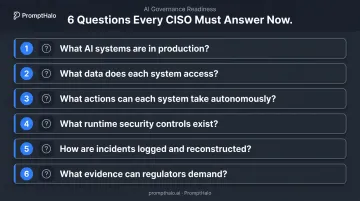
If any answer is "we're not sure," close that gap now. Uncertainty at this level is an enforcement problem, not a policy one.
The Enterprise AI Governance Checklist for CISOs
This checklist is organized into six security-relevant domains. Each reflects a control area the CISO must own or co-own. Use it to identify coverage gaps and prioritize remediation.
Domain 1: AI System Inventory and Risk Classification
Governance begins with knowing what exists, including what you didn't sanction.
Microsoft and LinkedIn's 2024 Work Trend Index found 78% of AI users brought their own AI tools to work. Shadow AI is already inside your perimeter.
Inventory requirements:
- Discover every AI system: sanctioned models, agentic workflows, copilots, and AI embedded in third-party SaaS
- Document each system's data access paths, autonomous action scope, and named owner
- Classify by risk tier aligned to EU AI Act categories: prohibited, high-risk, limited-risk, minimal-risk
- Map classifications to NIST AI RMF functions: GOVERN (accountability), MAP (context and risk), MEASURE (testing), MANAGE (post-deployment)
CISO checklist items:
- Has every AI system — including shadow AI and vendor-embedded AI — been inventoried?
- Are high-risk systems flagged for mandatory security review before deployment?
- Is each system's data access scope documented and reviewed on a defined cadence?
Domain 2: AI Security and Adversarial Threat Modeling
AI systems require threat modeling that traditional application security wasn't built to handle. Inputs can manipulate outputs, retrieved context can be poisoned, and agents can be redirected mid-task — each a distinct attack vector with no analog in conventional AppSec.
The OWASP LLM Top 10 is the CISO's practical reference for this threat landscape:
| OWASP LLM Risk | What It Means for CISOs |
|---|---|
| LLM01: Prompt Injection | User or indirect content alters model behavior and tool use |
| LLM02: Sensitive Information Disclosure | Models expose PII, credentials, or confidential data |
| LLM04: Data and Model Poisoning | Training or RAG data is manipulated to distort outputs |
| LLM06: Excessive Agency | Over-permissioned agents cause unintended harm |
| LLM08: Vector and Embedding Weaknesses | RAG retrieval introduces context and poisoning risks |
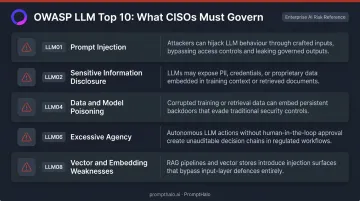
These aren't hypothetical. CISA's 2025 JCDC AI Playbook documents a real MathGPT incident where prompt injection accessed host environment variables and exposed a GPT-3 API key, leading to a denial-of-service attack.
CISO checklist items:
- Has adversarial red-teaming been performed on high-risk models before deployment?
- Do pre-deployment tests explicitly cover prompt injection, jailbreak resistance, retrieval poisoning, and data exfiltration?
- Are third-party AI vendors assessed against the same threat model as internal systems?
PromptHalo's AI red-teaming capability continuously attacks agents, RAG layers, and tool chains the way an adversary would, covering all four threat categories — with findings encoded into a shared Threat Library that trains the runtime detection engine.
Domain 3: Identity, Access, and Agent Authority Controls
AI agents don't have identities in the traditional sense. They inherit permissions from users, service accounts, and API credentials — and without explicit authority scoping, that delegation becomes unbounded.
OWASP's agentic security work explicitly names Identity and Privilege Abuse (ASI03) and Tool Misuse (ASI02) among the top risks in agentic environments. Many organizations that experience AI-related security incidents share a common gap: insufficient AI access controls.
Least-privilege principles for AI agents:
- Every agent operates under a scoped authority definition, not a broad inherited role
- Each tool call is evaluated against a defined action budget before execution
- Agent authority decays over time and across operational steps, forcing re-authorization when limits are exceeded
- Service accounts shared with AI agents are reviewed for privilege creep on a defined cadence
CISO checklist items:
- Are AI agents operating under clearly scoped authority rather than inherited broad roles?
- Is every agent action traceable to a defined identity boundary?
- Are service accounts shared with AI agents reviewed for privilege creep regularly?
PromptHalo enforces these controls through agent security passports: signed credentials that travel with each request, encoding policy, budget, and authority decay. Agents cannot grant themselves more access than originally authorized.
Domain 4: Acceptable Use Policy, Vendor Governance, and Shadow AI
A governance policy that isn't enforced at the inference layer is just a document. CISOs need controls that operate where AI actually runs.
What a CISO-enforceable acceptable use policy must include:
- Prohibited use cases: autonomous financial execution without human sign-off, clinical decisions without human review, unauthorized surveillance
- Permitted data categories for model prompting and training
- Escalation paths for violations — not just reporting mechanisms
Vendor governance checklist items:
- Are external AI providers assessed for data retention practices, model reuse, and contractual liability?
- Is there a defined approval process before business units adopt new AI tools?
- Is shadow AI actively detected and managed — not just prohibited on paper?
PromptHalo's Policy Enforcement Engine lets enterprises define custom rules to flag, log, or block AI responses in real time. Rules are applied per action across AI workflows, enforced inline before responses are delivered — not after.
Domain 5: Human Oversight, Escalation, and Incident Response
Autonomy without defined limits is a security failure mode. The EU AI Act Article 14 requires high-risk AI systems to support effective human oversight, including the ability to prevent or minimize risks to health, safety, or fundamental rights.
Human oversight requirements:
- Documented override and shutdown protocols for production AI systems
- Escalation paths for contested or anomalous AI outputs
- Human-in-the-loop requirements for high-risk decisions (financial, medical, legal)
- Override authority clearly assigned to named roles
Incident response checklist items:
- Is there a documented AI incident response plan classifying failure categories: security breach, data leakage, ethical violation, compliance exposure?
- Are rollback mechanisms tested, not just documented?
- Are post-incident reviews mandatory, with findings incorporated into policy updates?
- Do incident logs preserve prompts, retrieved context, model outputs, tool calls, and agent identity?
Domain 6: Production Monitoring, Drift Detection, and Continuous Oversight
AI systems rarely fail dramatically. Drift in model behavior, input distributions, or output patterns can create security and compliance exposure long before it surfaces in production metrics.
What to monitor:
- Behavioral drift: subtle shifts in outputs across sessions that undermine trust or compliance
- Anomalous usage patterns: unusual query volumes, unexpected tool calls, out-of-scope actions
- Distribution shift: changes in input types that indicate misuse or model degradation
CISO checklist items:
- Are automated alerts configured for drift and anomalous behavior in production?
- Are AI system logs granular enough to support forensic audit reconstruction?
- Are governance policies reviewed on a defined cadence — quarterly minimum — to incorporate new risks and regulatory developments?
NIST AI 800-4 identifies behavioral drift and distribution shift as core post-deployment monitoring challenges. ISO/IEC 42001 builds continuous improvement directly into the AI management system model.
Governing Agentic AI: The Attack Surface CISOs Cannot Ignore
Agentic AI is categorically different from prior AI deployments. These systems plan tasks, invoke tools, access internal systems, and take multi-step actions across workflows. The risk isn't in what the model generates — it's in what the system executes.
McKinsey's 2025 State of AI survey found 62% of organizations were experimenting with AI agents and 23% were already scaling agentic systems. The attack surface is expanding faster than governance frameworks can address it.
Agentic Threat Classes CISOs Must Govern
The OWASP Top 10 for Agentic Applications documents the specific threat categories:
- ASI01: Agent Goal Hijack — adversarial context redirects agent objectives mid-task
- ASI02: Tool Misuse — agents invoke tools beyond their intended scope
- ASI03: Identity and Privilege Abuse — agents exploit over-permissioned credentials
- Agentic Supply Chain Vulnerabilities — compromised frameworks, plugins, or memory stores
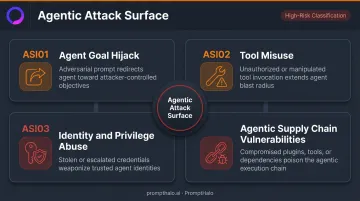
Each new tool connector, API integration, and multi-agent handoff expands the attack surface. And each handoff is a potential injection point.
Why Static Controls Fail Here
Logging after the fact is not governance when an agent can trigger cross-system workflows in under a second. By the time a SIEM alert fires, an agent may have already accessed a database, modified a record, and called an external API.
Enforcement must happen inline, before the action executes. That means evaluating intent, permission scope, and action impact at the point of execution — not after the damage is done.
Purpose-built agentic security platforms address this directly. PromptHalo's runtime enforcement layer sits inline on every inference, tool call, and agent-to-agent handoff, making per-action decisions in under 100ms: allow, restrict, challenge, deny, or monitor. The ML-based detection engine achieves a catch rate above 95% at under 5% false positives — versus roughly 35% for rule-based approaches.
Controlling the decision point isn't enough on its own. Authority decay prevents privilege creep over an agent's operational lifetime. Security passports encode per-action budgets and scope limits. As an agent operates further from its original scope, its risk profile changes and re-authorization is required before execution continues.
Agentic governance checklist:
- Has every integration surface — APIs, MCP servers, identity providers, orchestration layers — been mapped and monitored?
- Are multi-agent handoffs governed with the same rigor as single-agent actions?
- Is there a tested shutdown protocol for agents exhibiting anomalous behavior?
Regulatory Alignment and Audit Readiness: What CISOs Must Be Able to Prove
Framework Mapping
| Framework | Status | Primary CISO Use |
|---|---|---|
| NIST AI RMF 1.0 | Voluntary, published January 2023 | Control framework and governance operating model |
| OWASP LLM Top 10 | Current reference (2025 version) | Application security threat modeling |
| ISO/IEC 42001:2023 | Certifiable, published December 2023 | Management system assurance and continuous improvement |
| EU AI Act | Binding — prohibited practices enforced from 2 February 2025 | Regulatory compliance, documentation, and audit artifacts |
EU AI Act penalties for prohibited AI practices reach up to €35 million or 7% of total worldwide annual turnover — whichever is higher. Governance obligations and GPAI rules applied from 2 August 2025. This is no longer a future compliance concern.
What Audit Readiness Actually Means
Regulators increasingly expect decision-level traceability, not just system-level logs. EU AI Act Articles 11, 12, 14, and 17 require:
- Technical documentation for high-risk AI systems before market placement (Article 11)
- Automatic event recording over the system's lifetime (Article 12)
- Human oversight design for high-risk systems (Article 14)
- Quality management systems for high-risk providers (Article 17)
Documentation artifacts CISOs must be able to produce:
- System sheets or technical documentation for each high-risk deployment
- Training data provenance records
- Adversarial test results and red-team reports
- Production monitoring logs with sufficient granularity for forensic reconstruction
- Incident reports with corrective actions
- Deployment approval records with named reviewers
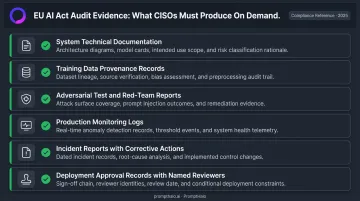
Producing these artifacts on demand — not assembling them reactively after a regulatory inquiry — is the operational standard regulators now expect. Platforms like PromptHalo generate append-only, decision-level logs mapped to EU AI Act requirements, so the evidence layer is built into normal operations rather than bolted on at audit time.
Governance KPIs to Report to the Board
Having documentation artifacts in place answers what your AI systems do. Board-level KPIs answer whether the governance enforcement layer is actually working:
- % of production AI systems with completed security reviews
- Mean time to detect anomalous agent behavior
- Audit trace completeness rate across high-risk systems
- Number of regulatory requests fulfilled within defined SLA
- Shadow AI discovery rate — systems identified outside the approved inventory
Frequently Asked Questions
What is the difference between AI governance and AI security for a CISO?
AI governance is the broader framework — policies, accountability structures, and oversight mechanisms that define how AI is used. AI security is the enforcement layer the CISO owns within that framework: runtime controls, threat modeling, incident response, and the audit evidence that proves controls were operating. Without security enforcement, governance is a policy document — not a functioning control.
Which regulatory frameworks should CISOs prioritize mapping their AI governance to?
Start with NIST AI RMF as the US baseline control framework, OWASP LLM Top 10 for application-layer threat modeling, ISO/IEC 42001 for management system assurance, and EU AI Act if your AI outputs are used anywhere in the EU — its extraterritorial reach applies regardless of where your organization is headquartered.
How does agentic AI change the CISO's governance responsibilities?
Agentic systems execute actions across connected tools autonomously, shifting the attack surface from model outputs to runtime behavior. Governance must now cover identity delegation, tool access scoping, multi-agent handoffs, and real-time enforcement — not just content filtering built for static applications.
What are the highest-priority AI systems for CISOs to govern first?
Prioritize by autonomy and data sensitivity: agentic systems with tool-calling capabilities, AI integrated into compliance or financial workflows, models accessing sensitive PII or regulated data, and any AI system that makes decisions affecting customers or triggers external system actions.
What audit evidence should CISOs be able to produce for regulators?
Decision-level logs for high-risk AI actions, adversarial test results and red-team reports, data provenance documentation, deployment approval records with named approvers, and incident reports with corrective actions — all in a form that is tamper-evident, timestamped, and reproducible on demand.
How often should CISOs review and update their AI governance checklist?
High-risk system audits warrant quarterly reviews at minimum, while production behavior requires continuous monitoring. Trigger an immediate re-assessment whenever a new AI capability, integration, regulatory development, or material incident changes the risk profile — calendar schedules alone are insufficient.