Introduction
Autonomous AI agents are already inside enterprise infrastructure — reading emails, querying databases, approving transactions, and modifying system configurations without human sign-off. Attackers noticed.
Prompt injection, tool misuse, and cascading agent compromise are no longer theoretical. The EchoLeak vulnerability (CVE-2025-32711) demonstrated a zero-click data exfiltration path through Microsoft 365 Copilot using nothing more than malicious email content.
The problem is that your existing security stack was never built for this. Firewalls, DLP tools, and code scanners operate on static application logic. They cannot see autonomous tool calls, RAG retrieval pipelines, multi-agent handoffs, or session-persistent memory — which is exactly where agentic attacks live.
This guide compares six leading agentic AI security platforms — PromptHalo, Palo Alto Prisma AIRS, Zenity, Prompt Security, CyberArk Secure AI Agents, and Noma Security — evaluated on runtime enforcement, detection methodology, lifecycle coverage, and integration depth. By the end, you'll have a clear picture of which platform fits your architecture, risk profile, and deployment timeline.
TL;DR
- Agentic AI creates a new attack surface — prompt injection, memory poisoning, tool misuse, privilege escalation — that legacy security stacks cannot detect or stop
- The strongest platforms cover the full agent lifecycle: discovery and posture at build time, inline enforcement at runtime, automated response after compromise
- Prioritize ML-based detection — rule-based approaches miss sophisticated attacks that look normal at the API level
- Require model-agnostic deployment with audit logs mapped to OWASP LLM Top 10, NIST AI RMF, and native SIEM/SOAR integration
- Six platforms compared — PromptHalo, Palo Alto Prisma AIRS, Zenity, Prompt Security, CyberArk Secure AI Agents, and Noma Security — each with a distinct capability profile
Why Agentic AI Security Demands a Different Approach
Traditional applications execute fixed logic. AI agents plan, reason, and execute multi-step actions autonomously, so a single compromised agent can exfiltrate data, abuse credentials, and alter configurations before a human analyst sees the first alert.
According to Capgemini's 2025 research, 30% of GenAI early adopters had already integrated AI agents into business operations, with agent projects projected to grow 48% by end of 2025.
Deloitte found that only 20% of organizations had a mature governance model for autonomous AI agents. That gap is where attackers operate.
The Threat Categories That Matter
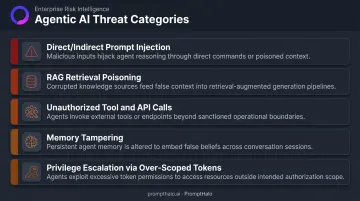
Security teams need controls across five distinct threat vectors — none of which appear as anomalies in a standard SIEM:
- Direct and indirect prompt injection — malicious instructions embedded in user inputs or in content agents retrieve (documents, emails, web pages)
- RAG retrieval poisoning — compromised data sources that corrupt agent reasoning before any inference occurs
- Unauthorized tool and API calls — agents invoking out-of-scope actions because permissions were never properly scoped
- Memory tampering — corrupted context that poisons future agent decisions across sessions
- Privilege escalation through over-scoped tokens — agents accumulating permissions they were never explicitly granted
The platforms below were selected specifically because they address this threat model at the agent layer — covering tool calls, retrieval, memory, and multi-agent handoffs that legacy security tooling was never designed to inspect.
Top Agentic AI Security Platforms Compared
Selection applied five criteria consistently across vendors: runtime enforcement depth, agentic attack surface coverage, deployment model and integration fit, detection methodology, and audit trail quality for regulated environments.
PromptHalo
PromptHalo is a purpose-built runtime security and trust platform for agentic AI. Its architecture is closed-loop: a red-team engine continuously attacks your agents, RAG layers, and tool chains to surface exploitable paths. Every discovery feeds directly into the runtime enforcement engine through a shared threat library, so protection compounds over time rather than decaying.
The runtime layer sits inline on every inference, tool call, and agent-to-agent handoff, making allow/restrict/challenge/deny/monitor decisions in under 100ms. ML-based detection operates at over 95% catch rate and under 5% false positives. Security passports, authority decay, and per-action budget enforcement give security teams granular control without blocking agent autonomy.
It deploys in under a day with no model retraining and no code rewrite — across API gateway, agent mode, or inline middleware integration paths — and works with any AI application from any vendor.
| Category | Details |
|---|---|
| Core Capabilities | Prompt injection and jailbreak blocking, retrieval poisoning detection, out-of-scope tool and API call enforcement, data leakage prevention, security passports and authority decay, inline decisions in under 100ms |
| Deployment & Integration | Model- and vendor-agnostic; deploys in under one day; no model retraining or code rewrite; tamper-evident audit logs mapped to OWASP LLM Top 10, NIST AI RMF, and EU AI Act |
| Best For | Enterprises and fintech teams that need runtime-first, compliance-ready agentic AI protection without disrupting existing model investments or requiring long integration timelines |
Palo Alto Networks Prisma AIRS and Cortex AgentiX
Palo Alto Networks delivers agentic AI security through two integrated products: Prisma AIRS (AI Runtime Security) and Cortex AgentiX, both running on the same Cortex data lake and orchestration infrastructure. This gives large enterprises a unified management layer spanning posture management, DLP, runtime enforcement, and automated response.
The platform's standout capability is integration breadth. It includes native connectors for Salesforce AgentForce and Microsoft Copilot Studio, and AI Security Posture Management (AI-SPM) that extends visibility into SaaS-embedded agents. A runtime AI firewall monitors prompts and responses in real time, while RAG pipeline dependency mapping surfaces how sensitive data moves through multi-agent workflows.
| Category | Details |
|---|---|
| Core Capabilities | AI-SPM across SaaS-embedded, cloud-hosted, and custom agents; prompt and response inspection; RAG pipeline data flow mapping; DLP integrated with DSPM; RBAC and human-in-the-loop approvals; immutable audit trails via Cortex |
| Deployment & Integration | Delivered via Cortex infrastructure; pre-built integrations with SIEM, SOAR, XDR, and IdP; official onboarding for Salesforce Agentforce and Microsoft Copilot Studio |
| Best For | Large enterprises seeking platform consolidation across data security, AI posture management, and runtime enforcement within a single, familiar vendor relationship |
Zenity
Zenity delivers security and governance for AI agents across the full lifecycle, from initial discovery through runtime threat response, with unified coverage across SaaS-managed, cloud-deployed, and endpoint-based agents from a single console. It has deployed in Fortune 500 environments managing hundreds of autonomous agents across multiple SaaS platforms.
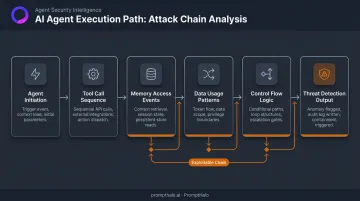
Its standout capability is the Correlation Agent, which analyzes complete execution paths — tool calls, memory access sequences, data usage patterns, and control flow logic — to surface malicious intent that API-level logging would never catch. It stitches build-time configuration data with runtime behavior, exposing how seemingly isolated misconfigurations compound into exploitable attack chains.
| Category | Details |
|---|---|
| Core Capabilities | Shadow AI discovery; RBAC and human-in-the-loop approvals; tool allowlisting; AI-SPM; Correlation Agent for intent-aware execution path analysis; inline prevention at runtime |
| Deployment & Integration | Integrates with SIEM, SOAR, XDR, and IdP; single console across SaaS, cloud, and endpoint; build-time configuration data enriches runtime detection |
| Best For | Enterprise security teams managing large, heterogeneous agent ecosystems across multiple SaaS platforms who need intent-aware governance and a unified console |
Prompt Security
Prompt Security operates as a runtime enforcement and MCP gateway layer, sitting between AI applications and the tools, models, and data sources they connect to. It targets organizations dealing with AI tool sprawl who need prompt injection defense and MCP gateway controls across environments mixing different LLMs, self-hosted models, and dozens of third-party tool integrations.
Its standout capability is MCP gateway security with dynamic risk scoring. Because a single MCP server can expose an agent to dozens of downstream systems, Prompt Security inspects and enforces policy on every AI-to-server interaction in real time — assessing risk, enforcing policy, and blocking malicious tool usage before it reaches connected systems.
| Category | Details |
|---|---|
| Core Capabilities | Prompt injection detection at execution time; sensitive data redaction at egress; MCP gateway security with dynamic risk scoring; shadow AI discovery; policy-based enforcement; searchable compliance audit logs |
| Deployment & Integration | Integrates with major LLM providers, self-hosted and on-premises models, SIEM, SOAR, and MCP gateway; fits into heterogeneous AI environments without stack rearchitecting |
| Best For | Organizations with mixed LLM and self-hosted model deployments that need MCP-level control and strong prompt injection defense without displacing existing infrastructure |
CyberArk Secure AI Agents
CyberArk approaches agentic AI security from an identity-first perspective, treating AI agents as a new class of privileged machine identity requiring the same discovery, least-privilege enforcement, lifecycle management, and threat detection frameworks applied to human accounts and traditional service identities.
Its AI Agent Gateway grants task-specific, time-limited access rather than standing permissions — ensuring agents receive only the minimum privileges required for a defined task and only for its necessary duration. Threat detection flags abnormal agent behavior and enables rapid suspension or shutdown, while LLM interaction observability supports both security investigations and compliance evidence.
| Category | Details |
|---|---|
| Core Capabilities | AI agent discovery with context enrichment; Privilege Enforcement Gateway for zero standing privileges; lifecycle management and audit logging; threat detection and rapid agent suspension; LLM interaction observability |
| Deployment & Integration | Integrates with SaaS, cloud, and developer environments; connects to existing PAM and IdP infrastructure; supports agent onboarding, management, and deprovisioning workflows |
| Best For | Enterprises with mature PAM programs that want to extend existing identity governance to AI agents without adopting a separate, siloed agentic security product |
Noma Security
Noma Security provides a unified platform for securing and governing AI systems and autonomous agents, with particular strength in end-to-end discovery, posture management, and runtime protection covering models, agents, MCP servers, and data sources simultaneously. It maps dependencies across the full AI ecosystem and continuously validates AI systems through integrated red teaming.
Its AI supply chain governance capability lets organizations define approved models, tools, and servers to establish a controlled AI supply chain — making it well-suited for governing AI systems an organization did not build itself, including third-party and vendor-supplied agents.
| Category | Details |
|---|---|
| Core Capabilities | Continuous AI-SPM across models, agents, MCP servers, and data sources; runtime policy enforcement on prompts, responses, and tool calls; prompt injection and jailbreak protection; AI supply chain governance; integrated red teaming |
| Deployment & Integration | Agentless discovery; connects to cloud-hosted, SaaS, and on-premises AI deployments; maps dependencies across full AI ecosystem including third-party and vendor-supplied agents |
| Best For | Organizations governing a mix of internally built and third-party AI agents who need posture management, runtime enforcement, and supply chain control from a single platform |
How We Chose These Platforms
Selection was not based on brand recognition. Every platform was evaluated against the same three-part question: does it act before or after an agent executes a harmful action, does it address the actual agentic attack surface (not adapted general-purpose security), and how does its detection methodology perform against novel attacks that bypass static rules?
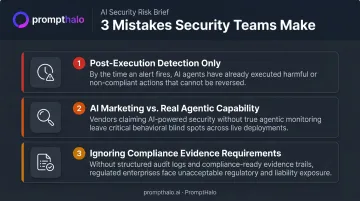
Three Mistakes Security Teams Make in This Category
Selecting platforms that detect post-execution. Forensic logging has value for investigations, but an agent that completes a data exfiltration or configuration change in seconds cannot be stopped by a log entry. Inline enforcement before execution is a non-negotiable baseline.
Conflating AI-themed marketing with actual agentic security capability. Many established security vendors have added "AI security" messaging to existing products. The real question: was the platform designed for autonomous tool calls, RAG pipelines, and multi-agent handoffs, or does it inspect LLM inputs and outputs as a bolt-on?
Overlooking compliance evidence requirements. Discovering audit trail gaps during a regulatory review costs far more to fix than preventing them upfront. NIST AI 600-1 recommends AI red-teaming to assess resilience against prompt injection, and EU AI Act Article 12 requires automatic event logging throughout a high-risk AI system's lifecycle. Verify these requirements are covered before procurement, not after.
Getting the feature set right is only half the evaluation. Deployment model and integration fit determine whether a platform actually gets used. Watch for:
- Long professional services engagements before the platform goes live
- Parallel consoles disconnected from your SIEM or identity provider
- Integration gaps that force manual correlation across tools
Any of these adds operational overhead that erodes the security value the platform was meant to deliver.
Conclusion
Choosing an agentic AI security platform is a fundamentally different decision from choosing a traditional security tool. The threat model is purpose-built for autonomous systems, the attack surface is invisible to standard security controls, and a platform selected on general AI branding may leave the most dangerous gaps uncovered.
Before finalizing any decision, confirm two non-negotiables: inline runtime enforcement that acts before agent actions execute (not forensic logging after the fact) and compliance-grade audit trails that can satisfy regulatory reporting requirements as AI deployment scales in fintech and other regulated environments.
Both criteria point to the same architectural requirement: a platform that tests before you deploy and enforces at every decision point after. PromptHalo is built specifically for that problem. It red-teams your AI to find exploitable attack paths, then enforces trust on every agent action at runtime, without touching your models or requiring a code rewrite. Request a demonstration to see the red-team engine and runtime enforcement in action.
Frequently Asked Questions
What is agentic AI security and how does it differ from traditional application security?
Agentic AI security protects autonomous systems that plan, reason, and act across enterprise infrastructure — covering agent prompts, tool invocations, memory, and operating identities. Traditional application security was built for fixed, deterministic logic and has no visibility into any of those surfaces.
What is prompt injection and why is it considered a primary threat vector for AI agents?
Prompt injection embeds malicious instructions in user inputs or in external content an agent retrieves, causing it to execute attacker-controlled tasks before any analyst sees what happened. The attack surface is any data source the agent can read — which is why the EchoLeak vulnerability required zero user interaction.
How do agentic AI security platforms protect against risks from tool calls and MCP connections?
Leading platforms intercept tool and MCP invocations at execution time, validating them against approved allowlists and blocking out-of-scope calls before they reach connected systems. Post-execution logging cannot prevent data exfiltration or configuration changes that complete in seconds.
What compliance frameworks should an agentic AI security platform support?
Verify coverage for OWASP LLM Top 10, NIST AI RMF, EU AI Act Article 12, and ISO/IEC 42001 as baselines. Tamper-evident, decision-level audit trails are non-negotiable in regulated environments — confirm log completeness before you sign anything.
How quickly can an agentic AI security platform be deployed, and does it require model access?
Purpose-built platforms like PromptHalo deploy in under one day with no model retraining and no code rewrite, operating as an inline layer between the agent and its tools. Enterprise security platforms with broader scope often require weeks of integration work or access to proprietary model internals — clarify this upfront.
What should security teams prioritize when shortlisting agentic AI security vendors?
Confirm three minimum-viable controls before any deeper evaluation: inline enforcement that acts before agent actions execute; continuous shadow AI discovery so unsanctioned deployments surface from day one; and decision-level audit logs capturing every invocation, action, and system accessed. Without those three, no other feature compensates.