Introduction
AI systems now process mortgage applications, authorize payments, surface clinical recommendations, and execute compliance workflows at scale. That makes them high-value targets — and a fundamentally different attack surface than anything traditional security tools were built to handle.
The numbers back this up:
- The Federal Reserve's 2025 BTOS data found 30% of finance firms had adopted AI by year-end 2025, with 63% of finance workers actively using generative AI
- Deloitte's survey of US health technology executives found 61% were already building agentic AI initiatives or had secured budgets
- Federal agencies reported 3,611 AI use cases as of April 2026, with 445 classified as high-impact
As organizations deploy agentic AI at scale, security and compliance teams face pressure from three directions at once: adversaries probing these systems in the wild, regulators moving from guidance to enforceable obligations, and internal risk committees demanding evidence — not assurances.
This article covers the five AI pen testing trends reshaping regulated industries in 2026, what's driving them, and what security teams should do about it.
Key Takeaways
- Agentic AI is now the dominant new attack surface in regulated environments, driven by autonomous tool calls, RAG retrieval, and multi-agent handoffs
- Regulatory mandates (EU AI Act, SR 26-2, DORA, NIST AI RMF) now require documented, auditable evidence of AI-specific security testing
- Annual pen tests are being replaced by continuous red-teaming cadences tied to model updates and agent deployments
- Prompt injection, RAG poisoning, and jailbreak testing are now standard scope items in regulated-sector engagements
- Audit-grade, decision-level evidence is what regulators and boards now expect as the core compliance deliverable
5 Key AI Penetration Testing Trends Shaping Regulated Industries in 2026
These are the five AI pen testing trends most consequential for security and compliance teams in regulated sectors this year.
Trend 1: Agentic AI Systems Become the Primary Pen Test Target
The pen test scope has shifted well beyond LLM prompt boundaries. The real attack surface now includes autonomous agent behaviors: tool call abuse, unauthorized API invocation, out-of-scope resource access, and multi-agent trust exploitation.
Traditional application scanners and DLP tools were never designed to detect these. Consider two examples: an AI agent that autonomously initiates a payment after a prompt injection, or a healthcare agent that retrieves PHI outside its authorized scope through a poisoned RAG retrieval step. Neither vulnerability shows up in a conventional vulnerability scan.
Why the urgency? Gartner predicts that 40% of enterprise applications will feature task-specific AI agents by end-2026, up from less than 5% in 2025. A PwC survey of 308 US executives found 79% had already adopted AI agents — yet only 20% trusted agents for financial transactions. That trust gap is exactly the kind of gap attackers exploit.
In regulated environments, the most dangerous scenarios share a pattern: agents with broad tool permissions, multi-agent pipelines where trust assumptions aren't explicitly enforced, and RAG systems pulling from unvalidated knowledge bases. PromptHalo's red-teaming approach covers adversarial task chains across these multi-step, multi-agent workflows — the production scenarios that matter most.
Key attack surfaces to test in 2026:
- Tool call permissions and API invocation boundaries
- Agent-to-agent handoff trust policies
- RAG retrieval pipeline injection points
- Multi-agent workflow authorization chains
- Autonomous action scope and budget enforcement
Trend 2: Regulatory Mandates Now Explicitly Require AI-Specific Security Testing
2026 marks the year AI security testing moves from a best-practice recommendation to a regulatory obligation. Several frameworks converge on this point simultaneously.
The regulatory landscape in 2026:
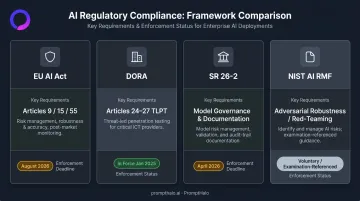
| Framework | Relevant Requirement | Status |
|---|---|---|
| EU AI Act | Article 9 testing requirements; Article 15 cybersecurity; Article 55 adversarial testing for GPAI systemic-risk providers | General application: Aug. 2, 2026 |
| DORA | Articles 24–27 digital operational resilience testing; TLPT every 3 years for selected entities | In force since Jan. 17, 2025 |
| SR 26-2 | Principles-based model governance replacing SR 11-7; documentation, testing, validation requirements | Issued Apr. 17, 2026 |
| NIST AI RMF | Measure and Manage functions; AI 600-1 recommends adversarial robustness testing and AI red-teaming | Voluntary but examination-referenced |
One important nuance: SR 26-2 explicitly excludes generative and agentic AI as issued — the Federal Reserve and OCC have signaled a separate guidance request is forthcoming. Regulated firms should not wait for that guidance before testing. That delay already has a measurable cost: IDC found security teams are involved in AI model design and deployment in only 21% of cases. That figure is a proxy for how underprotected most regulated AI deployments are today, even as examiners are beginning to ask for AI-specific test evidence that general security audit reports cannot provide.
Trend 3: Continuous AI Red-Teaming Replaces Point-in-Time Assessments
AI models, retrieval pipelines, and agent toolsets change far more frequently than traditional software. A model retrained on new data, a RAG knowledge base updated with fresh documents, a new tool integration added to an agent: each change can introduce attack paths that didn't exist during the last annual pen test.
Annual assessments leave blind spots that stay open for months. The trend in regulated environments is toward continuous or change-triggered adversarial testing.
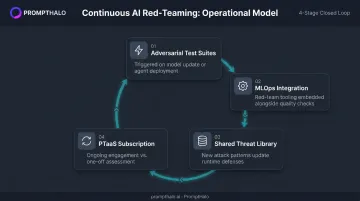
What this looks like operationally:
- Adversarial test suites run after every significant model update or agent deployment
- AI red-team tooling embedded in MLOps workflows alongside standard quality checks
- A shared threat library where newly discovered attack patterns automatically update runtime defenses
- PTaaS-style subscription models for AI security, rather than one-off engagements
Microsoft, Google, and NIST all recommend this cadence. Microsoft's AI red teaming guidance explicitly calls for scheduled continuous red-teaming runs using synthetic adversarial data post-deployment. Google's AI Red Team notes that AI systems require regularly evaluating and updating attack methods because AI technology matures rapidly.
For regulated organizations, the practical case is straightforward: if the model changes, the attack surface changes. The compliance evidence from last quarter's test may not reflect what the system does today.
Trend 4: Audit-Grade Evidence from AI Pen Tests Becomes a Regulatory Currency
A PDF pen test report no longer satisfies examiners reviewing AI system security. What regulators and internal risk committees increasingly want is decision-level, replayable evidence.
That means logs showing exactly what an AI agent did in response to a simulated attack: what data it accessed, what tools it invoked, whether trust policies were enforced, and how each decision maps to a specific control framework.
The EU AI Act creates the clearest statutory basis for this. Article 11 requires technical documentation for high-risk AI systems, and Article 12 requires logging capabilities — before market placement and kept current thereafter. Annex IV specifies documentation contents in detail.
For financial services and healthcare, examiner expectations are evolving in the same direction. SR 26-2 review processes and HIPAA audit preparations are increasingly exposing AI-specific gaps that traditional web app or network pen test reports cannot fill.
PromptHalo's audit logs are designed to meet this standard. Every decision is captured with its reason, the acting agent identity, session and tenant context, and a timestamp.
The log is append-only and tamper-evident: once written, entries cannot be modified or removed. That creates a replayable evidence trail for compliance export and post-incident investigation — the artifact auditors want when they ask what did the agent actually do, and was it authorized?
Trend 5: Prompt Injection, RAG Poisoning, and Jailbreak Testing Go Mainstream
These attack types have moved from academic research into standard scope items in regulated-sector engagements.
Unit 42's analysis of web-based indirect prompt injection found these attacks occurring in the wild — 75.8% of malicious pages contained a single injected prompt, with goals ranging from irrelevant output generation (28.6%) to data destruction (14.2%). NIST's AI agent hijacking evaluation reported an average success rate of 57% across five injection tasks. EchoLeak, a zero-click prompt-injection vulnerability in Microsoft 365 Copilot disclosed by Aim Security, demonstrated data exfiltration was achievable through indirect prompt injection in production enterprise deployments.
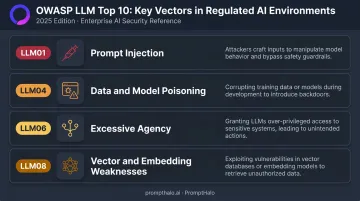
OWASP reflects this in its 2025 LLM Top 10:
- LLM01: Prompt Injection — including indirect injection through websites, files, or retrieved content
- LLM04: Data and Model Poisoning — manipulation of pre-training, fine-tuning, or embedding data
- LLM06: Excessive Agency — unauthorized tool and API invocations
- LLM08: Vector and Embedding Weaknesses — RAG-specific attack vectors
In regulated environments, these aren't theoretical risks. Jailbreaks bypassing compliance guardrails, RAG poisoning surfacing manipulated regulatory guidance, prompt injection triggering unauthorized financial actions — each has demonstrated exploitability in production systems. Testing for them is no longer optional.
What's Driving These AI Pen Testing Trends
Multiple converging forces are pushing regulated industries toward more rigorous, AI-native penetration testing at once.
Technology Advances
Agentic AI frameworks — LLM-orchestrated workflows, autonomous agents, RAG pipelines — have created an entirely new attack surface class. Existing security controls weren't designed for it.
The tooling to attack these systems is maturing just as fast. Adversarial AI research has produced reliable prompt injection and retrieval poisoning techniques now accessible well beyond academic circles. Threat actors are using AI for reconnaissance, vulnerability research, and phishing generation at scale, according to Google Threat Intelligence Group.
The Microsoft Digital Defense Report 2025 notes that AI agents could allow threat actors to automate the full attack lifecycle: reconnaissance, vulnerability scanning, and exploitation, end to end.
Gartner predicts AI agents will reduce the time to exploit account vulnerabilities by 50% by 2027. Regulated organizations delaying AI pen testing are falling further behind the adversarial capability curve each quarter.
Regulatory and Compliance Pressure
Three overlapping frameworks are tightening expectations on regulated organizations:
- EU AI Act general provisions take effect August 2026, requiring documented risk management for high-risk AI systems
- SR 26-2 replaces SR 11-7 with a principles-based model governance framework, placing more interpretive accountability on institutions
- NIST AI RMF adoption is being referenced directly in examination guidance
Together, these frameworks require evidence of adversarial testing, not just policy documentation.
Market Demand and Risk Economics
Enterprise procurement in fintech, insurance, and healthcare is beginning to require AI security attestations alongside traditional SOC 2 and ISO 27001 reports. The ability to demonstrate that AI systems have been adversarially tested is becoming a real differentiator in partner onboarding and vendor due diligence.
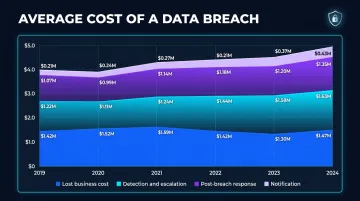
The cost case for proactive testing is direct. IBM's 2025 Cost of a Data Breach Report puts the global average breach cost at $4.4 million, with AI governance gaps cited as a contributing factor. The potential cost of an AI-native incident in a regulated environment — a prompt injection triggering an unauthorized transaction, or a RAG poisoning surfacing incorrect medical guidance — is not a theoretical exposure.
How These Trends Are Reshaping Regulated Industries
Operational Impact
Security workflows are being restructured. AI systems now require their own test inventory, adversarial suites are being integrated into deployment pipelines, and incident response playbooks are being rewritten to address AI-specific failure modes — agent tool abuse, retrieval poisoning, multi-agent trust violations — that don't map onto existing vulnerability management processes.
Compliance workflows are shifting in parallel. Security teams in regulated firms are generating new evidence artifacts — decision logs, attack replay records, control mapping reports — and learning to present them to examiners who are still developing their own AI security literacy.
Business Impact
AI pen testing results are influencing board-level decisions. Regulated institutions are beginning to treat AI security posture as a material risk disclosure item. The ability to produce audit-grade evidence of adversarial testing is becoming a differentiator in enterprise procurement and regulatory examinations alike.
The closed-loop model — where red-teaming identifies exploitable attack paths and runtime enforcement acts on those findings — is the model that regulators and enterprise risk committees are beginning to expect as standard. PromptHalo connects adversarial testing to runtime enforcement through a shared threat library, so every discovery from testing strengthens production defenses directly.
Workforce Impact
Regulated organizations face a genuine skills gap on both sides of the discipline:
- Traditional pen testers lack expertise in AI-specific attack vectors like prompt injection and retrieval poisoning
- AI/ML engineers lack the offensive security knowledge to assess their own systems
- The ISC2 2025 Cybersecurity Workforce Study found AI was the most pressing cybersecurity skills need at 41%, with 73% of respondents expecting AI to create more specialized roles
This is driving demand for specialized AI security vendors that can deliver adversarial testing without requiring organizations to build full in-house AI red-team capabilities. Platforms like PromptHalo address this directly by delivering risk-scenario-mapped reports with prioritized, actionable fixes rather than raw technical findings — output that existing security teams can act on without deep AI/ML expertise.
Future Signals for AI Pen Testing in Regulated Industries
Technologies to Watch
- Self-learning adversarial agents that adapt attack strategies in real time based on target AI system responses
- Digital twin testing environments that allow regulated organizations to run continuous adversarial simulations against replicas of production AI systems without operational risk
- Multi-modal attack surfaces as AI systems incorporate vision, voice, and document inputs alongside text — each modality introduces new injection vectors
Regulatory Trajectory
Three regulatory shifts are converging on the same deadline:
- The Federal Reserve and OCC have explicitly signaled a forthcoming separate guidance request on generative and agentic AI
- The EU AI Office is operationalizing GPAI obligations, with enforcement timelines now firm
- Within two years, AI-specific pen testing requirements are expected to move from guidance into formal examination criteria across financial services and healthcare
Organizations with continuous AI red-teaming programs already in place will meet that shift ready. Those building from scratch under examination pressure won't have that luxury.
The Convergence Ahead
That regulatory pressure is accelerating a technical shift already underway. The architecture leading organizations and security vendors are building toward: a single, continuous security posture where findings from adversarial tests automatically update enforcement policies, threat libraries, and compliance evidence. Testing and runtime protection feed the same system — not two separate workflows running in parallel.
Conclusion
AI penetration testing in regulated industries is no longer forward-looking. The five trends covered here are active in 2026, driven by regulatory mandates, expanding agent attack surfaces, and evidence requirements that have fundamentally changed what security assurance looks like for organizations deploying AI in finance, healthcare, and critical infrastructure.
Regulated organizations that treat AI pen testing as a continuous, evidence-generating discipline — not an annual checkbox — will be better positioned to satisfy regulators, protect customers, and deploy AI features faster with a credible trust story. Every model update and agent deployment that ships without structured red-teaming adds to that exposure quietly, until a regulator or an attacker makes it visible. Platforms like PromptHalo are built specifically for that gap — testing AI the way attackers would, then enforcing trust on every agent decision at runtime, so the evidence is there before anyone asks for it.
Frequently Asked Questions
Is pentesting still in demand?
Demand is strong and growing. As enterprises deploy LLMs and agentic systems at scale, regulated industries face mounting pressure from frameworks like the EU AI Act and NIST AI RMF to demonstrate adversarial testing with documented evidence.
What is AI penetration testing and how does it differ from traditional pen testing?
AI pen testing targets AI-specific attack vectors — prompt injection, jailbreaks, RAG poisoning, tool call abuse, and agent manipulation — that fall outside the scope of traditional network, web app, or infrastructure assessments. It requires different tools, methodologies, and expertise than conventional penetration testing.
Which regulated industries face the most pressure to adopt AI-specific security testing in 2026?
Financial services (SR 26-2, DORA), healthcare (HIPAA), and government (NIST AI RMF, FedRAMP) face the most explicit regulatory pressure — with financial services organizations carrying the most immediate compliance deadlines heading into 2026.
How does AI pen testing support compliance with frameworks like the NIST AI RMF or EU AI Act?
AI pen testing produces the documented adversarial test results, control validation, and audit-grade logs these frameworks require — satisfying NIST AI RMF's Measure and Manage functions and the EU AI Act's Article 9 testing and Article 12 logging obligations for high-risk AI systems.
What are the most common AI-specific vulnerabilities found during pen testing in regulated environments?
The most common findings are:
- Prompt injection attacks that hijack agent instructions
- RAG poisoning that corrupts knowledge base outputs
- Jailbreaks that bypass compliance guardrails
- Unauthorized tool and API invocations
- Sensitive data leakage through agent outputs
How often should regulated organizations conduct AI penetration testing?
Given how frequently AI models, retrieval pipelines, and agent toolsets change, pen testing should shift to a continuous or change-triggered cadence. Regulated organizations with higher-risk AI deployments should treat red-teaming as an ongoing operational practice rather than an annual exercise.