Introduction
AI agents are now requesting privileged access to APIs, databases, and sensitive systems — making autonomous decisions at machine speed, with no human approval step between a request and execution. Enterprises deploying these agents for credit decisions, fraud workflows, and internal operations face an audit gap their existing controls weren't built to close.
Traditional PAM tools weren't built for this. Credential vaults track human checkout events. Session recorders capture keystrokes.
Neither captures what an AI agent decided, why it accessed a particular data source, or what it returned downstream.
Closing that gap requires solving two problems at once — and this guide addresses both:
- Using AI to improve PAM operations — replacing manual access reviews and rule-based alerting with ML-driven behavioral analytics and continuous risk scoring
- Governing AI agents as privileged non-human identities — applying audit and compliance controls to autonomous agents under 2026 regulatory expectations
Who this is for: CISOs, compliance managers, and IAM teams in financial services and other regulated industries. This guide delivers a practical framework for building an audit-ready AI PAM program that satisfies NIST AI RMF, SOC 2, PCI DSS v4.0, and the EU AI Act.
Key Takeaways
- AI agents making autonomous tool calls and API requests are privileged actors — govern them as such, not as passive software
- Traditional session-based PAM logs fail to capture the decision-level context regulators require
- 68% of organizations lack identity security controls for AI agents (CyberArk, 2025)
- NIST AI RMF, SOC 2, PCI DSS, and the EU AI Act all carry distinct AI agent audit requirements
- 2026-ready PAM programs need tamper-evident, decision-level logs that are replayable and mapped to regulatory controls
Why Traditional PAM Falls Short When AI Agents Are the Privileged Actors
The Non-Human Identity Gap Nobody Planned For
Traditional PAM was built around a core assumption: privileged users are humans. According to CyberArk's 2025 Identity Security Threat Landscape, 88% of organizations still define privileged users as humans only — yet machine identities now outnumber human identities 82:1. Among those machine identities, 42% hold privileged or sensitive access.
The governance gap is real: 68% of organizations lack identity security controls for AI, and 47% cannot secure shadow AI usage. Meanwhile, SailPoint's 2025 survey of 353 IT and security professionals found 96% view AI agents as a growing security risk, but only 44% have implemented policies to secure them. Most telling: 80% reported unintended AI agent actions, including unauthorized system access (39%) and sensitive data sharing (33%).
Where Existing PAM Architecture Breaks Down
The problem is architectural, not just a coverage gap. AI agents generate access events that never appear in credential management logs:
- An agent invoking a REST API doesn't check out a credential from a vault
- A RAG retrieval against a vector datastore doesn't generate a session recording
- An agent-to-agent handoff doesn't appear in any human access log
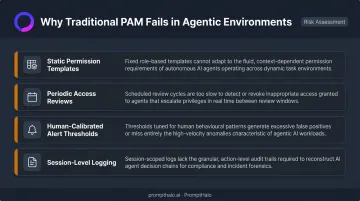
This invisibility is the core problem — traditional controls simply weren't designed to see it. When organizations then try to retrofit rule-based PAM onto agentic workloads, that architectural mismatch produces four recurring failure modes:
- Static permission templates don't account for context drift as an agent's task scope changes mid-workflow
- Periodic access reviews — typically quarterly — can't match machine-speed privilege escalation
- Alert thresholds built for human behavior generate excessive false positives on agentic activity patterns
- Session-level logging records what happened in a session but not the decision chain behind each action
Authority Decay as the Architectural Response
Each of these failure modes points to the same root cause: the permission model assumes a static session with a bounded human actor. Modern PAM must enforce least privilege at the individual tool call or inference level, with authority that actively decays as the agent operates.
PromptHalo implements this through agent security passports: signed credentials that travel with each request and carry policy, budget, and authority decay parameters built in. Budgets track across time, steps, and risk. When a budget envelope is exceeded, the system forces re-authorization before the agent can continue , preventing an agent from granting itself more access than it was originally authorized to hold.
How AI Is Enhancing Core PAM Operations in 2026
ML-Based Behavioral Analytics Replace Rule-Based Monitoring
Rule-based PAM monitoring only catches what you've already thought to look for. ML-based behavioral analytics go further: they build a baseline for each privileged identity — human and non-human — and flag statistical deviations from that baseline.
For human identities, this catches insider threats, lateral movement, and unusual access timing without manual threshold configuration. For AI agents, it detects behavioral drift — subtle shifts in what an agent is doing that diverge from its defined operational scope, across sessions, over time.
PromptHalo's behavioral drift detection tracks how agent behavior changes session-over-session, drawing on per-tenant session and memory state to recognize when outputs are drifting from expected patterns. Detection runs in milliseconds, so anomalies surface during execution — before a drifting agent can act on corrupted outputs.
Continuous Risk Scoring Replaces Quarterly Reviews
The quarterly access review cycle was always a compromise. In an agentic environment, it's functionally useless: an AI agent can accumulate and abuse privileged access dozens of times in the window between reviews.
Continuous risk scoring assigns every privileged account, service account, and AI agent a dynamic risk score, updated in real time based on:
- Behavioral signals — deviations from established usage patterns
- Entitlement profile — permissions held versus permissions actually used
- Access context — timing, location, downstream systems reached
- Agent scope — whether actions remain within the agent's defined operational boundary
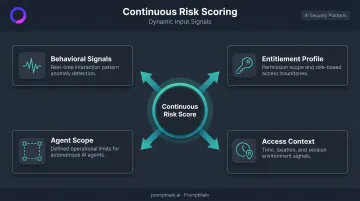
Security teams stop triaging everything equally and focus on the highest-risk identities instead.
Microsoft's 2024 State of Multicloud Security report found that only 2% of granted permissions were actually used across 51,000 human and workload identities. AI-driven analysis of actual usage patterns can identify those unused entitlements and generate role adjustment recommendations — or trigger automatic deprovisioning when an agent's behavior diverges from its defined scope.
What AI-Native PAM Audit Logs Must Capture in 2026
Why Session Logs Aren't Enough Anymore
Keystroke capture, session video, and credential checkout records answer one question: what happened during a session? They don't answer what regulators and courts increasingly need to know: why did the AI make that decision, what data did it retrieve, and what did it return?
A March 2026 analysis by Brooks Kushman attorneys on JD Supra makes the legal dimension explicit: AI prompts, outputs, and metadata may be discoverable in litigation, and courts have already ordered preservation of AI interaction logs, overriding default deletion settings. Missing or mutable audit logs can impair responses to regulatory inquiries, enforcement actions, and legal holds.
That makes incomplete audit logging both a compliance failure and an active litigation liability.
The Minimum Audit Record for AI Agent Actions
An AI-native audit record must capture more than a timestamped event. At minimum, each log entry should include:
- The triggering event — the inference request, prompt, or tool invocation that initiated the action
- The tool, API, or data source accessed — specifically, not generically
- The access decision — allow, restrict, challenge, deny, or monitor — and the justification for that decision
- The output or response generated by the agent
- The full agent identity chain — which agent acted, and which downstream agents received a handoff
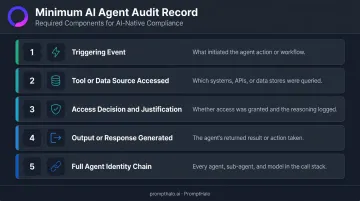
PromptHalo captures all of these in append-only, tamper-evident audit logs at the decision level. Every record includes the decision, the reason, the acting agent's passport identity, session and tenant context, and a timestamp — and entries cannot be modified or removed after the fact, satisfying the cryptographic protection requirements under NIST SP 800-53 AU-9.
Replayability: What It Actually Means
Replayability is not event-only logging with timestamps. A compliance reviewer or regulator needs to reconstruct the exact state of an AI agent's decision at the time it occurred — including what data the agent had access to, what it retrieved, and what action it authorized.
PromptHalo produces signed, replayable verdicts for every decision, structured for three distinct use cases: debugging operational issues, compliance export for regulatory reporting, and post-incident investigation. The signed verdict means the decision state can be fully reconstructed — not just referenced as a historical event.
Mapping AI Agent Actions to Major Compliance Frameworks
NIST AI RMF
The NIST AI Risk Management Framework organizes AI governance into four functions — Govern, Map, Measure, Manage — each mapping directly to PAM audit requirements for AI agents:
| Function | PAM Audit Requirement |
|---|---|
| Govern | Document AI agent roles, permission boundaries, and escalation policies |
| Map | Identify which systems agents can reach and what data they can touch |
| Measure | Continuous monitoring outputs, risk scores, anomaly rates |
| Manage | Incident response trails for every AI-driven action |
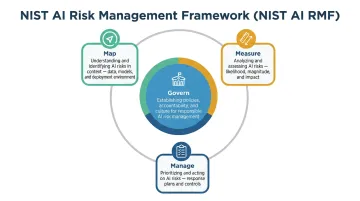
In February 2026, the U.S. Treasury released a Financial Services AI Risk Management Framework that adapts NIST AI RMF to financial-sector considerations, making it the baseline governance reference for regulated financial institutions in the US.
SOC 2 Type II and PCI DSS v4.0
SOC 2 CC6 (logical access controls) now extends to machine and agentic identities. CC6.1 restricts logical access to authorized entities, meaning AI agents operating in SOC 2 scope environments must be inventoried, authorized, and logged with the same rigor as human privileged accounts.
PCI DSS v4.0.1 adds two specific requirements relevant to AI agents in cardholder data environments:
- Requirement 7: Restrict access to system components and cardholder data by business need to know, covering any AI agent with access to payment data
- Requirement 10: Log and monitor all access to system components and cardholder data, including actions taken by automated or AI-driven processes (Requirement 10.2.1.2 specifically covers interactive use of application or system accounts)
Auditors are now asking directly how AI agents and non-human identities are governed within scope.
EU AI Act
Under Regulation (EU) 2024/1689, AI systems used to evaluate creditworthiness or establish credit scores qualify as high-risk AI systems. For these systems, the Act requires:
- Technical documentation (Article 11) describing system design and risk controls
- Record-keeping and logging of outputs (Article 12)
- Human oversight mechanisms that allow each decision to be audited, challenged, or reversed (Article 14)
In a PAM context, this means every privileged action taken by a high-risk AI agent must be captured — with its justification — in a form a human reviewer can audit, challenge, or reverse.
OWASP LLM Top 10 and Zero Trust
The OWASP Top 10 for LLM Applications 2025 gives compliance teams a risk taxonomy for AI-specific findings. Four categories are directly relevant to PAM audit controls:
- LLM01 Prompt Injection: unauthorized manipulation of agent actions
- LLM02 Sensitive Information Disclosure: data leakage via agent outputs
- LLM05 Improper Output Handling: unvalidated agent responses triggering downstream actions
- LLM06 Excessive Agency: agents exceeding their authorized scope
Zero Trust architecture under NIST SP 800-207 requires verifying every request regardless of origin. For AI agents, that means authentication and authorization at every action, not once at session start. The architectural requirements that follow: per-action authorization, continuous verification, and automatic scope reduction when an agent's behavior exceeds its defined risk profile.
Building a 2026-Ready AI PAM Compliance Posture
Most organizations can't see what their AI agents are actually doing at the action level. That's the starting problem. Building a compliance posture requires closing that visibility gap before anything else can work.
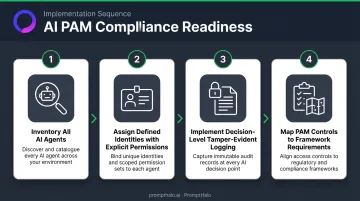
A Practical Implementation Sequence
Inventory all AI agents operating in your environment. Classify each by privilege level, data access scope, and whether it operates in regulated systems. This includes shadow AI deployments that weren't formally approved.
Assign each agent a defined identity with explicit permissions. Apply the same review cycle used for human privileged accounts — continuous where possible, at minimum quarterly.
Implement decision-level logging with tamper-evidence for every agent action that touches a regulated system. Timestamped event logs are not sufficient. The log must capture the decision and its justification, not just the fact that an event occurred.
Map existing PAM controls to framework requirements and identify gaps specific to agentic AI. Treasury's FS AI RMF and CISA's 2026 guidance on careful adoption of agentic AI both emphasize alignment with existing cybersecurity frameworks — this is an extension of existing controls, not a replacement of them.
Inline Enforcement vs. After-the-Fact Reconstruction
Once those controls are in place, the architecture you choose determines whether your compliance posture is real-time or retrospective. The core distinction: layering an AI governance overlay on top of existing PAM versus inline enforcement that intercepts every agent action before it executes.
After-the-fact audit reconstruction tells you what happened. Inline enforcement prevents unauthorized actions from completing in the first place and generates audit evidence as a byproduct of enforcement, instead of requiring separate instrumentation.
PromptHalo is built around the inline enforcement model. It sits on every inference, tool call, and agent-to-agent handoff, making per-action allow/deny decisions in under 100ms. Security passports, risk profiling, authority decay, and per-action scope enforcement give compliance teams granular control at the agent level. The decision-level audit trail — mapped to OWASP LLM Top 10, NIST AI RMF, and the EU AI Act — generates automatically as enforcement runs, with no model retraining and no code rewrite required.
Frequently Asked Questions
How do AI agents change the requirements for privileged access management?
AI agents are non-human identities that make autonomous, high-speed privileged access decisions across tool calls, APIs, and agent handoffs. They require per-action authorization, continuous scope enforcement, and decision-level audit logs. Traditional session-based PAM was not designed to produce any of these.
What compliance frameworks apply to AI agent actions in enterprise PAM programs?
The primary frameworks include:
- NIST AI RMF — Govern, Map, Measure, Manage functions
- SOC 2 Type II CC6 — logical access controls
- PCI DSS v4.0.1 — Requirements 7 and 10
- EU AI Act — obligations for high-risk AI systems
- OWASP LLM Top 10 — risk taxonomy for AI-specific audit findings
What should AI-powered PAM audit logs contain to satisfy regulators?
Logs must capture the triggering event, the tool or data source accessed, the access decision and its justification, the output generated, and the full agent identity chain (including downstream handoffs). Tamper-evident and replayable logs are required — timestamped event records alone are not sufficient.
How does AI improve detection of privileged access abuse compared to rule-based systems?
ML-based detection builds behavioral baselines and flags statistical anomalies, catching both novel attack patterns and gradual behavioral drift that rule-based threshold approaches miss entirely. PromptHalo's ML detection engine achieves over 95% catch rate at under 5% false positives, compared to roughly 35% catch and 15–20% false positives for rule-based approaches.
What is the difference between AI-assisted PAM and governing AI agents through PAM?
AI-assisted PAM uses machine learning to help humans manage access: automating access reviews, surfacing anomaly alerts, and recommending role adjustments. Governing AI agents through PAM means treating the agents themselves as privileged identities subject to least privilege, continuous monitoring, and full audit trail requirements.
How can organizations achieve continuous compliance for AI-driven privileged access without constant manual review?
Continuous compliance requires real-time inline enforcement at the agent action level, automated risk scoring updated by behavior, and automatically generated audit evidence mapped to regulatory control requirements. This replaces periodic review cycles with always-on governance, eliminating the gap between when an AI agent acts and when a human reviewer discovers it.