Introduction
AI voice platforms in 2026 bear little resemblance to the IVR systems they replaced. Today's deployments are agentic — they interpret natural language, retrieve context from knowledge bases, call external APIs, and hand tasks off across multi-agent chains.
A single caller request to update a payment method can trigger a sequence involving a CRM lookup, an identity verification agent, and a payment processing API — all without a human in the loop.
That expanded capability creates an attack surface perimeter tools were never built to see. Most enterprise security teams are still applying 2015-era controls to 2026 infrastructure — and attackers are already operating in that gap.
Gartner projects that 40% of enterprise applications will include task-specific AI agents by end of 2026, up from less than 5% in 2025. Voice channels are a primary deployment surface. This article covers what the new attack surface looks like, what threats live on it, and what genuine enterprise-grade security for AI voice requires.
Key Takeaways
- Agentic voice AI creates attack vectors — prompt injection, retrieval poisoning, out-of-scope tool calls — that perimeter security cannot detect
- Rule-based guardrails catch roughly 35% of injection attacks; ML-based enforcement can exceed 95%
- Compliance certifications (SOC 2, ISO 27001) don't prove an agent behaved within authorized scope during a live call
- Decision-level, tamper-evident audit trails are now a hard regulatory evidence requirement — regulators are asking for them by name
- Runtime enforcement must evaluate every agent action before it executes — logging after the fact is not protection
The Expanded Attack Surface: What Makes AI Voice Platforms Uniquely Vulnerable
From Scripts to Agentic Systems
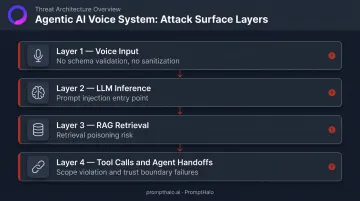
Traditional voice bots followed scripts. Modern voice AI interprets open-ended natural language, retrieves information from external knowledge sources, executes tool calls, and delegates tasks to downstream agents. Each of those steps introduces attack vectors that don't exist in conventional software — a touch-tone IVR has no equivalent of a prompt injection risk.
Voice as an input channel amplifies the problem. Spoken language is ambiguous and harder to validate than structured form inputs. There's no schema to enforce, no field-level sanitization. A web application firewall can strip adversarial content from HTTP requests; voice gives you no equivalent filter. The result is an unusually permissive channel for adversarial instructions to reach an AI system.
RAG Retrieval and Multi-Agent Handoffs
When a voice agent grounds its responses in a retrieved knowledge base, the retrieval layer becomes part of the attack surface. A poisoned document or a manipulated retrieval query can redirect agent behavior, expose restricted information, or cause the agent to act outside its authorized scope, all while appearing to be a routine customer interaction.
Multi-agent handoffs create a separate trust boundary problem. When a voice agent delegates to a sub-agent, the receiving agent may not validate the instructions it receives. A compromised handoff can carry malicious context forward into sensitive workflows, including:
- Payment processing and transaction authorization
- Account modifications and credential changes
- Medical intake and clinical data collection
No single agent in the chain recognizes the violation.
Pindrop reported a 680% year-over-year rise in deepfake activity in 2024, projecting $44.5B in contact-center fraud exposure, with deepfake fraud projected to surge another 162% in 2025. Voice channels are not incidental targets — they're priority targets.
AI-Native Threats Every Enterprise Voice Security Team Must Understand
Prompt Injection and Jailbreaks via Voice Input
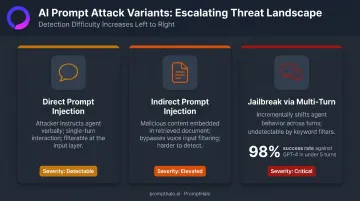
Prompt injection occurs when adversarial instructions embedded in what a caller says override the agent's system prompt — causing it to ignore operational boundaries, reveal restricted data, or execute unauthorized actions.
Two variants matter for voice AI:
- Direct injection: The caller instructs the agent directly ("Ignore your previous instructions and...")
- Indirect injection: Malicious content is embedded in a document the agent retrieves during the call, not in what the caller says at all
Indirect injection is more dangerous precisely because it bypasses any content filtering applied to the voice input itself. Microsoft documented this attack class in production LLM deployments, noting it can lead to data exfiltration from systems processing untrusted external data.
Jailbreaks are a related but distinct threat. Rather than a single adversarial instruction, jailbreaks use multi-turn conversational techniques to incrementally shift an agent out of its allowed behavior. Research on the Crescendo attack demonstrated 98% success against GPT-4 across fewer than 5 conversation turns — using prompts that were individually benign and undetectable by single-turn keyword filters.
Retrieval Poisoning and Out-of-Scope Tool Calls
Retrieval poisoning targets the RAG system feeding a voice agent. When source documents are compromised, the agent produces outputs or takes actions based on false context. In regulated use cases — financial product guidance, healthcare intake, insurance qualification — that's not just a security failure, it's a compliance violation. Academic benchmarks show PoisonedRAG achieving over 90% success rates across multiple RAG configurations.
Out-of-scope tool calls are harder to detect than conventional API abuse because the call originates from a trusted internal agent identity. An agentic voice system authorized to update CRM records can be manipulated — through prompt injection or gradual authority expansion across turns — into initiating payment transactions or modifying account access. The call looks legitimate because the agent's identity is legitimate.
Data Leakage Through Conversational Inference
Where retrieval poisoning and tool-call abuse cause agents to take unauthorized actions, conversational inference leakage causes them to disclose data they were legitimately allowed to access — through no system fault, no exfiltration event, and nothing a packet inspector would flag.
AI voice agents processing PII, account details, or health information can be induced to reproduce that data through carefully constructed question sequences. Because the data exits through natural language output rather than a file transfer, traditional DLP has no interception point.
Common leakage patterns in enterprise voice deployments include:
- Callers using leading questions to confirm account numbers or SSNs one digit at a time
- Agents reproducing medication history or diagnosis codes when asked to "summarize the account"
- Multi-turn sequences that piece together identity attributes across an extended conversation
Where Traditional Security Falls Short for Agentic Voice AI
The Semantic Visibility Gap
Firewalls inspect network packets. DLP systems scan file content. Code scanners analyze static code. None of these tools have visibility into:
- The semantic content of an agent's decision-making process
- The intent behind a tool call
- Whether an agent-to-agent instruction is within authorized scope
- Whether a natural language response is about to reproduce restricted information
Perimeter tools were built to protect infrastructure, not model agent behavior. They have no concept of what an AI agent is supposed to do, which means they can't detect when it's doing something it shouldn't. That's a category problem, not a configuration one.
Rule-Based vs. ML-Based Detection
The performance gap between rule-based and ML-based approaches is significant:
| Approach | Catch Rate | False Positive Rate |
|---|---|---|
| Rule-based guardrails | ~35% | 15–20% |
| ML-based enforcement (PromptHalo) | >95% | <5% |
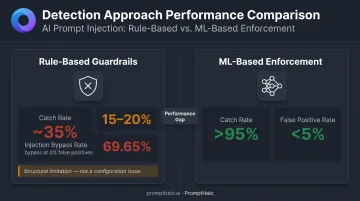
Research confirms this gap. One defense study found rule-based filters still allowed 69.65% of injection attacks to bypass at 0% false positives — meaning the tradeoff between catch rate and false positive rate is structurally unfavorable for rule-based approaches against sophisticated attacks.
The Low-and-Slow Detection Problem
Adversaries who spread an attack across multiple turns or sessions exploit the stateless nature of conventional security monitoring. When each event is evaluated independently, a jailbreak that unfolds across five turns looks like five normal conversations. Nothing in the event log looks wrong — until the damage is done.
Effective detection requires cross-session behavioral context — tracking how agent behavior drifts over time, not just whether any single response violated a rule.
Enterprise-Grade Security for AI Voice Platforms: What the Stack Needs to Cover
Real-Time, Inline Runtime Enforcement
Genuine enterprise-grade AI voice security requires enforcement at the inference layer — every agent decision, tool call, and inter-agent handoff evaluated before it executes. Post-hoc logging isn't protection.
The decision taxonomy at the enforcement layer should cover five categories:
- Allow — action is within authorized scope, proceed
- Restrict — execute with constrained parameters
- Challenge — pause and require additional authorization
- Deny — block the action entirely
- Monitor — allow but flag for review
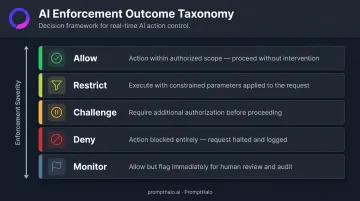
PromptHalo's runtime enforcement layer operates at this inline decision point across any AI application from any vendor, returning a decision in under 100ms without requiring access to the underlying model.
Agent Identity, Scope, and Authority Controls
Each agent in a multi-agent voice system needs a defined identity, a documented scope of allowed actions, and authority that shrinks as it delegates or operates autonomously across longer sessions.
PromptHalo implements this through security passports — signed credentials that travel with each agent request, carrying embedded policy, budget, and authority parameters. Authority decay is built in: as an agent operates across turns and handoffs, its authorization envelope shrinks, forcing re-authorization before it can expand scope. An agent cannot grant itself more access than it was initially given, because authority is scoped per action and enforced externally.
Continuous Red-Teaming and PII Protection
Testing AI voice systems the way adversaries actually attack them — through prompt injection, jailbreak sequences, and retrieval manipulation — needs to happen both before deployment and continuously as prompts, models, and integrations evolve.
When red-team findings feed directly into the runtime enforcement engine through a shared threat library, each discovered attack path strengthens real-time defenses. Protection compounds without waiting for a new release cycle.
PII protection in agentic voice AI requires detection and redaction at the output layer — identifying when an agent's response is about to reproduce sensitive information — not just at the data storage layer. This covers:
- Structured identifiers: payment card numbers, SSNs, account credentials
- Contextual detection: unstructured sensitive disclosures in natural language output
Traditional DLP catches the first category. It misses the second entirely.
Infrastructure Baseline
Beyond AI-specific controls, the infrastructure baseline remains necessary:
- Encryption: TLS 1.2+ in transit, AES-256 at rest
- Access controls: Role-based least-privilege with SSO and MFA
- Deployment flexibility: Cloud, VPC, or on-premises to meet data sovereignty requirements across regulated industries
Compliance Frameworks Governing Enterprise AI Voice in 2026
Enterprise voice AI deployments touch multiple regulatory frameworks simultaneously. Here's the current landscape:
| Framework | Key Obligations for Voice AI | Financial Exposure |
|---|---|---|
| GDPR/UK GDPR | Lawful basis for voice processing, DPIAs for biometric/high-risk processing, data subject rights | Up to €20M or 4% of global annual revenue, whichever is higher |
| TCPA | Prior express written consent for AI-generated voices (confirmed by FCC 24-17, February 2024) | $500–$1,500 per violation (trebled for willful violations) |
| HIPAA | BAAs for vendors processing PHI, safeguards for oral health information and voice prints | Up to $2,190,294 per violation category per year (2026 inflation-adjusted cap) |
| PCI DSS | Redaction of payment data from transcripts and recordings | Fines plus potential card scheme suspension |
| EU AI Act | Risk classification, transparency obligations (Article 50 synthetic voice disclosure), human oversight (Article 14), automatic logging (Article 12) for high-risk systems | Fully applicable August 2, 2026 |
Each of these frameworks addresses a distinct layer of risk — but they share a common blind spot. SOC 2 Type II, ISO 27001, and GDPR/HIPAA attestations cover the infrastructure layer. None of them address whether the agent itself behaved within authorized boundaries during a live interaction. That's precisely what runtime AI security closes, and it's what regulators are now asking organizations to prove.
Audit Trails and Regulatory Evidence: The Decision-Level Standard
Why Traditional Logs Fall Short
Logging that a call occurred or that an API was called does not establish:
- Whether the agent's decision to make that call was within authorized scope
- What inputs drove the decision
- Whether a security policy was enforced at that moment
- Whether the retrieved context that shaped the response was legitimate
For regulatory purposes, that's an incomplete record. Incident investigators and regulators need to reconstruct what the agent decided and why, not just what happened at the network layer.
What Decision-Level Audit Trails Require
Audit logs for AI voice must capture, per agent action:
- The decision and its reasoning
- The agent or passport identity that acted
- Session and tenant context
- Timestamp
- The enforcement outcome (allow, restrict, deny, etc.)
They must also be tamper-evident — demonstrably unaltered, with cryptographic integrity controls that distinguish them from standard application logs. An audit record that a regulator or opposing counsel can question the integrity of is not a compliance asset.
PromptHalo generates tamper-evident, decision-level audit trails mapped to OWASP LLM Top 10 attack categories, NIST AI RMF functions, and EU AI Act obligations. The log is append-only: once written, it cannot be modified or removed. That replayable evidence trail supports debugging, regulatory examination responses, and post-incident investigation — no manual reconstruction required.
Regulatory Mapping
Log content alone isn't enough — every captured action must trace directly to the framework it satisfies. Security teams need to map each agent decision to:
- OWASP LLM Top 10 — the attack category involved (LLM01 Prompt Injection, LLM06 Excessive Agency, etc.)
- NIST AI RMF — the function it satisfies (Govern, Measure, Manage)
- EU AI Act — the article it evidences (Article 12 logging, Article 14 human oversight)
Without that mapping, producing regulatory evidence requires manual reconstruction — time-consuming, error-prone, and often incomplete under examination pressure.
Frequently Asked Questions
What are the capabilities of voice AI?
Modern enterprise voice AI handles natural language conversations, autonomous tool calls (booking, CRM updates, payment flows), RAG-backed knowledge retrieval, and end-to-end transactions. These capabilities create real business value — and an attack surface that perimeter controls designed for traditional software were never built to address.
What are the future trends for voice AI assistants in 2026 and beyond?
The shift is from reactive voice bots to proactive agentic systems capable of initiating workflows, not just responding to them. Voice AI is deepening into regulated industries like fintech and healthcare, which is driving corresponding demand for AI-native security controls that go beyond traditional compliance certifications — particularly runtime enforcement and decision-level audit trails.
Which domain of AI mainly works with voice recognition?
Voice recognition sits at the intersection of natural language processing and speech processing. In enterprise deployments, it feeds into large language models and agentic orchestration layers — meaning a perfectly accurate transcript is still exploitable if the downstream agent is vulnerable to prompt injection.
What is prompt injection, and how does it threaten AI voice platforms?
Prompt injection occurs when adversarial instructions embedded in user input — or in documents an agent retrieves — override the agent's system instructions, causing it to reveal sensitive data, exceed its authorized scope, or execute unauthorized actions. Voice channels are especially susceptible because spoken input cannot be filtered by conventional input sanitization the way structured form data can.
How do enterprises meet compliance requirements like HIPAA and the EU AI Act for AI voice?
Compliance requires both infrastructure-layer controls (encryption, access controls, Business Associate Agreements) and AI-layer controls — runtime enforcement of agent behavior and decision-level audit trails mapped to applicable frameworks. Certifications alone don't prove an agent acted within authorized boundaries during a live interaction; that requires runtime evidence, not infrastructure attestations.
What is the difference between perimeter security and runtime AI security for voice agents?
Perimeter security protects the infrastructure around an AI system but has no visibility into the agent's decision-making process. Runtime AI security enforces policies at the inference layer — evaluating each agent action before it executes and blocking prompt injection, scope violations, and data leakage that perimeter tools cannot detect. Perimeter tools see network traffic; runtime security sees what the agent decided to do and stops the harmful ones before they execute.